Why you should experience Seoul Metropolitan Library in Seoul, South Korea.
The Seoul Metropolitan Library, formerly Old Seoul City Hall, stands as the conscience of the capital, a stone relic that has watched empires fall, nations rise, and democracy find its voice beneath its clock tower's steady gaze.
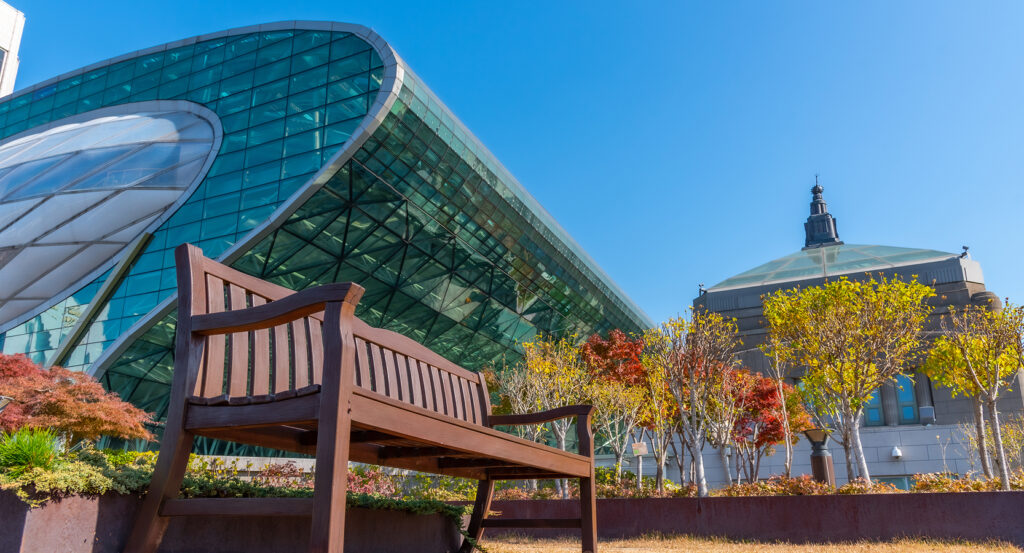
At first glance, its modest Art Deco façade seems almost understated beside the sweeping glass of the new City Hall behind it. But step closer, and you can feel its gravity, the weight of nearly a century of civic life, preserved in every carved arch and granite block. This is where Seoul's pulse once beat fastest: where mayors delivered decrees, where wartime radio broadcasts echoed through its corridors, and where the people's calls for freedom once gathered just outside its doors. Today, reborn as the Seoul Metropolitan Library, it's no longer a place of command but of reflection. Within its walls, quiet has replaced authority, yet its spirit remains unchanged, steadfast, resilient, deeply human. The Old Seoul City Hall isn't just a building; it's the city's memory, made visible.
How to fold Seoul Metropolitan Library into your trip.
Seoul Metropolitan Library was completed in 1926, designed by Japanese architect Ichiro Nomura in the restrained Imperial Crown style that blended Western Art Deco geometry with traditional Japanese rooflines.
It served as the administrative headquarters for Seoul through the colonial period, the Korean War, and the nation's long struggle toward democracy. For nearly 80 years, it stood as the face of authority, its tall arched windows and clock tower symbolizing civic endurance through political upheaval. In the early 2000s, as Seoul's government began planning a new sustainable City Hall, the fate of the old building hung in question. Citizens rallied to preserve it, recognizing its historical and memorable significance. The city chose rebirth over replacement. The structure was meticulously restored and reopened in 2012 as the Seoul Metropolitan Library, marking one of South Korea's most symbolic acts of adaptive reuse. Restoration efforts kept over 70% of the original masonry, while modern steel reinforcements ensured the building could survive future generations. Few know that the clock mechanism in the tower still runs on its original 1920s components, carefully maintained as a living artifact. Even more poignant is what lies within the building's design: the council chamber where pivotal post-war reconstruction decisions were made, the mayor's office preserved with its period furnishings, and the hidden basement shelters that once protected officials during the bombings of the Korean War. The old façade's placement in front of the new City Hall was no accident, it was meant to serve as both foundation and reflection, history physically supporting progress.
Seoul Metropolitan Library is best experienced slowly, as both architecture and allegory.
Take Subway Line 1 or 2 to City Hall Station (Exit 5), and as you rise onto Seoul Plaza, stand for a moment between eras, the stone structure before you and the curved glass edifice rising behind. Begin outside, tracing the façade's details: the symmetrical windows, the carved floral motifs, and the clock face that has kept time through war and peace alike. Then step through its heavy oak doors into the present-day Seoul Metropolitan Library. The transformation is breathtaking, where clerks once typed and ministers met, now students read and citizens gather. On the second floor, you'll find archival exhibits showcasing the building's evolution, including photographs of its construction, wartime damage, and restoration blueprints. Take the stairs to the fourth-floor Seoul Archives Room, where original documents from the early republic are preserved beneath soft amber light. For an intimate experience, visit during the late afternoon, when sunlight pours through the tall windows and paints the walls in gold, the perfect time to feel the contrast between the solidity of stone and the lightness of renewal. Before you leave, circle the building to view it from behind: the old and new City Halls fused together, two eras speaking in one architectural sentence. Pair your visit with a walk along Deoksugung Palace's Stone Wall Road, where the whispers of history continue under the shade of gingko trees. The Old Seoul City Hall Building at City Hall in Seoul isn't just a historic landmark, it's a declaration in stone that progress without memory is hollow, and that even the past can find new purpose under a brighter light.
Where your story begins.
Start your planning journey with Foresyte Travel.
Experience immersive stories crafted for luxury travelers.