
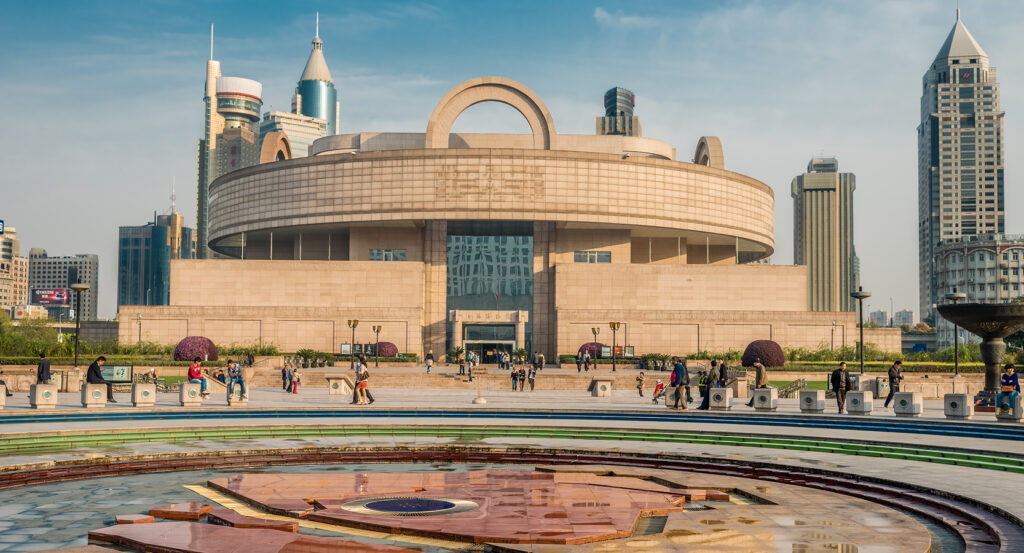
Why you should experience Ancient Chinese Jade Gallery at Shanghai Museum in Shanghai, China.
The Ancient Chinese Jade Gallery at Shanghai Museum is a sanctuary of light and shadow, a space where stone breathes, and centuries of devotion are frozen mid-motion.
The atmosphere feels weightless the moment you enter: cool air, soft lighting, and a faint shimmer of green radiating from the jade displays that seem to glow from within. In one direction, translucent bi discs hover like moons behind glass; in another, ancient ritual blades lie silent beside carved dragons coiled in eternal sleep. Across the room, marble Buddhas, sandstone guardians, and bronze deities hold their postures with serene power, faces calm, gestures fluid, their presence almost sentient. What unites them is stillness, the kind that doesn't rest but listens. To walk through this gallery is to wander through time itself, where artistry was not about decoration but reverence, a discussion between hand, spirit, and the permanence of stone.
What you should know about Ancient Chinese Jade Gallery at Shanghai Museum.
The Jade and Sculpture Hall showcases over 6,000 years of Chinese craftsmanship, tracing the evolution of material from Neolithic jade carvings to Tang and Ming religious statuary.
Jade, revered as the “essence of heaven and earth,” has always symbolized purity, virtue, and immortality. The earliest pieces, cong tubes and bi discs from the Liangzhu culture (circa 3000 BCE), are geometric and minimal, representing the bridge between the spiritual and earthly realms. The precision of these carvings, done with primitive tools and abrasives, remains one of archaeology's great marvels. Moving forward in time, Han dynasty jade burial suits are displayed in astonishing condition, their tiny plates stitched together with gold or silver thread to preserve the body's essence after death. Nearby, Tang dynasty Buddhist sculptures reflect India's influence on Chinese aesthetics, serene smiles, elongated silhouettes, and folds of stone that flow like fabric. The Song and Yuan dynasties shifted the focus inward: small-scale jade carvings of scholars, immortals, and mountain scenes reflect a turn toward philosophy and nature worship. The exhibition design echoes this progression: circular galleries symbolizing eternity and renewal, with lighting that mimics dawn at the center and twilight toward the edges, a meditation on the cyclical nature of life and art. Few visitors notice the subtle scent in the air, a trace of sandalwood, intentionally diffused to evoke the temple origins of many sculptures on display.
How to fold Ancient Chinese Jade Gallery at Shanghai Museum into your trip.
The Jade and Sculpture Hall rewards the quiet traveler, someone willing to look longer, to see beyond surface and shine.
Visit in the late morning (around 11 a.m.) when the sunlight from the museum's central atrium filters gently into the space, casting a halo across the jade displays. Begin with the Neolithic section to witness the birth of symbolic craftsmanship, the bi discs and cong tubes whose simplicity carries the weight of entire belief systems. From there, move into the Buddhist sculpture wing, where the Tang and Northern Wei statues radiate calm, each one carved not just from stone, but from meditation itself. Pause before the Bodhisattva of Mercy; its subtle smile is said to have been modeled after a single moment of breath during prayer. Allow yourself 45 minutes to absorb the atmosphere, this is a gallery meant for stillness, not pace. Before you leave, spend a few moments at the Ming jade mountain carving, where scholars are depicted gazing toward a pine-covered peak. The carving is small, but the message vast: to ascend inward is the highest art. Step back into the museum afterward, carrying that quiet strength, the kind that comes from knowing that even stone, under the right hands, can speak.
Where your story begins.
Foresyte Travel reveals places that feel extraordinary long before you arrive.
Experience premium editorial crafted for luxury travelers.

















































































































