
Why Shibuya 109 matters.
Shibuya 109 is a magnetic fashion building where Dogenzaka's youth-driven character meets Minoru Takeyama's unmistakable cylindrical architecture, decades of street-style influence and the commercial culture that helped make Shibuya synonymous with Japanese fashion.
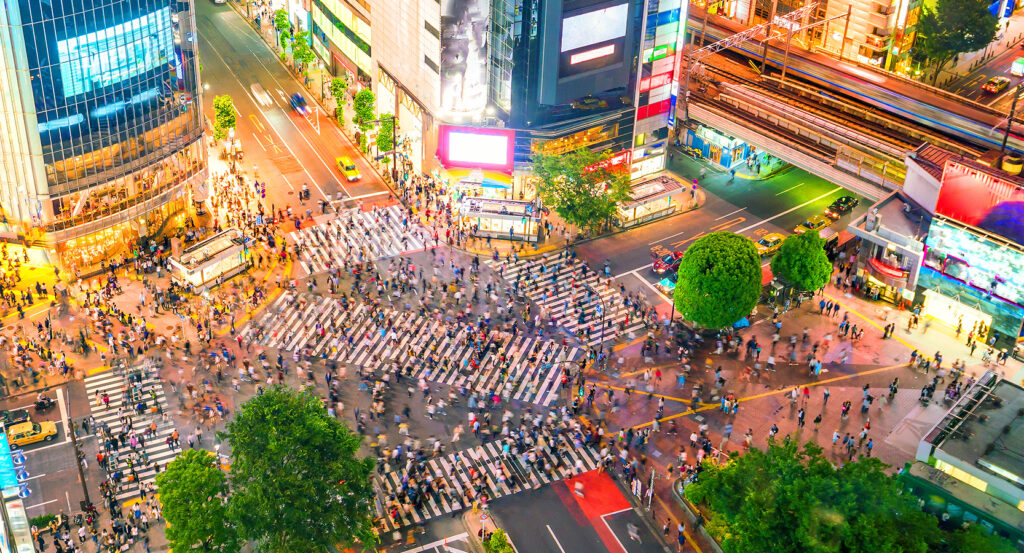
Set along Dogenzaka near Bunkamura-dori and just steps from Shibuya Crossing, the building occupies the triangular point where two major streets divide, placing its rounded front directly in the pedestrian sightline from Shibuya Station. Architect Minoru Takeyama turned that difficult geometry into the building's principal visual device, projecting a metallic cylinder toward the station and drawing the adjoining elevations backward along both streets. Inside, compact boutiques cluster across eight floors above ground and two below, with circulation repeatedly returning shoppers to dense sequences of independent storefronts and displays. The cylinder continues above the entrance as an immense advertising surface capped by the 109 mark, allowing campaigns and fashion imagery to alter the building's public face. The result is a commercial building whose architecture, street position and concentrated retail environment operate as one system, pulling movement from the station toward Dogenzaka and giving Shibuya fashion a physical address visible across the district.
What defines Shibuya 109.
Shibuya 109 is best known for becoming the commercial center of Japanese gyaru fashion after opening in April 1979 as Fashion Community 109 and radically narrowing its focus toward teenage women during the 1990s. Tokyu developed the project with local landowners at a moment when Shibuya Parco and other new businesses were drawing young crowds toward Koen-dori, creating a strategic need to pull pedestrian activity back toward Dogenzaka. The original concept was broader than the institution it became: womenswear shared the building with menswear, kimono, jewelry, sporting goods, general merchandise and restaurants, and first-year performance surpassed its 10-billion-yen annual sales target before reaching 14 billion yen in fiscal 1980. The name changed to Shibuya 109 in September 1989, followed by difficult years after the asset-price collapse. A decisive shift began 1993 when high-school students arriving for affordable Shibukaji fashion generated strong traffic to basement shops, encouraging management to concentrate progressively on teenage womenswear. By 1995 that audience had become the explicit target of a floor-by-floor overhaul that continued for six years. The transformation intersected with the mid-1990s rise of gyaru magazines and the Amuraa phenomenon surrounding Namie Amuro, placing Shibuya 109 at the center of a youth culture increasingly created by teenage consumers themselves. Popular saleswomen became nationally recognized “charisma shop clerks,” and labels including me Jane, CECIL McBEE, COCOLULU and ROSE FAN FAN circulated through a building whose staff could influence style far beyond individual shops. Sales returned to growth in fiscal 1996, expanded at double-digit rates through fiscal 1999 and eventually reached a peak of 28 billion yen in 2008.
The building itself carries a parallel architectural history centered on Takeyama's response to its constrained site and Shibuya's pedestrian movement. The project had already entered development when Takeyama received the facade commission, and he shaped the station-facing cylinder to catch people dispersing from Shibuya Station and guide their movement around its curve toward the branching streets. The completed structure paired his facade with a floor plan attributed to Tomohiko Komada, creating a wedge-shaped commercial building whose exterior form remains immediately legible despite decades of change around it. Tokyu Construction and Taisei Corporation executed the project, which DOCOMOMO Japan selected in 2023 as part of its recognition of significant modern architecture in Japan. Forty years after the opening, the cylinder became the focus of another major design intervention when Shibuya 109 Entertainment launched the building's first public competition for a replacement logo. The call generated 9,537 submissions, four finalists advanced to a public web vote and a new mark was selected in July 2018. Installation culminated on April 28, 2019, the fortieth anniversary, renewing the graphic element that had made Takeyama's cylinder an advertising beacon since the building's earliest years. The episode preserved the architectural device while allowing a new generation to determine the symbol carried upon it, continuing the building's unusual relationship between fixed urban form and rapidly changing youth culture.
How Shibuya 109 fits.
Shibuya 109 works as the anchor for a Dogenzaka route through three nearby institutions that carry the district beyond fashion into private collecting, municipal architecture and the medieval lineage behind the Shibuya name.
Begin at Toguri Museum of Art, where collector Tohru Toguri transformed a postwar concern about the disappearance of inherited Japanese culture into one of the country's significant specialist collections of ceramics. Toguri began collecting as Western consumer culture spread through Japan during the 1950s, then concentrated increasingly on decorative porcelain with guidance from antique specialists. He established the museum in November 1987 on the former Shoto estate of the Nabeshima family, whose domain in Kyushu had produced the elite Nabeshima porcelain that became one of his collection's principal strengths. Its holdings now encompass 7,000 works centered on Imari and Nabeshima ware alongside Chinese and Korean ceramics, giving the institution an unusually focused account of East Asian porcelain traditions only a short walk beyond Shibuya's commercial core. Continue to The Shoto Museum of Art, a municipal institution that Shibuya Ward began planning after its 1973 Long-Term Basic Plan identified the need for new cultural facilities. A preparatory council including Teiichi Hijikata of the Museum of Modern Art, Kamakura helped establish the program before Seiichi Shirai Architectural Institute received the commission in 1978. Shirai confronted a residential site restricted to 10 meters above ground by placing two of the museum's four levels underground and organizing the interior around a soaring central atrium that brings light deep into the building. Construction began in December 1978, finished in May 1980 and was followed by more than a year of environmental stabilization before the museum opened on October 1, 1981. The oval plan, fountain pool and pale Kounseki granite exterior belong to Shirai's final period, giving the route a concentrated encounter with an architect whose work moved between European study, Japanese craft and highly individual postwar design. Conclude at Konnoh Hachimangu Shrine, where Shibuya's name enters a history extending centuries before its modern association with railways and fashion. The shrine traces its foundation to 1092, when the Hachiman deity was enshrined on land connected with the warrior lineage that developed into the Shibuya clan. Shigeie received the Shibuya surname from Emperor Horikawa, established his residence around the shrine and made it the clan guardian, leaving a surviving stone associated with Shibuya Castle inside the precinct. The present shrine building dates to 1612 and arose through patronage associated with Aoyama Tadatoshi and Lady Kasuga during the struggle surrounding the future Tokugawa Iemitsu, preserving early Edo gongen-zukuri architecture and carved tiger and baku ornament. That survival gives modern Shibuya an unusually tangible connection to the warrior family whose name eventually became attached to the entire district. The progression moves from Toguri's postwar preservation of East Asian ceramics through Shirai's purpose-built municipal museum into Konnoh Hachimangu Shrine's connection with the medieval Shibuya clan, carrying Shibuya 109 outward from contemporary fashion toward deeper histories of collecting, architecture and place.
Where your story begins.
Foresyte Travel reveals places that feel extraordinary long before you arrive.
Enjoy editorial crafted for luxury travelers.
Foresyte may earn a commission when you book.

















































































































