
Why Shinjuku Gyoen matters.
Shinjuku Gyoen is a sweeping historic garden where Naitomachi's former daimyo-estate character meets imperial horticulture, European landscape design and an immense green counterweight to the vertical intensity of modern Shinjuku.
Set along Shinjuku-dori near Gaien Nishi-dori and just steps from Shinjuku-gyoemmae Station, the 58.3-hectare garden occupies an unusually expansive tract between the commercial core of Shinjuku and Sendagaya, allowing surrounding towers to disappear behind mature tree cover soon after entry. Broad lawns and enormous tulip trees give the Landscape Garden an open pastoral scale, followed by the Formal Garden's axial beds and rows of plane trees and the ponds, bridges and composed vegetation of the Japanese Traditional Garden. The terrain changes gently across lawns, woodland and water, creating long sightlines that contract into shaded paths before reopening around ponds or distant stands of trees. More than 900 cherry trees extend the spring season across numerous cultivars, and autumn transfers attention to maples, plane trees and the imperial chrysanthemum tradition maintained within purpose-built display structures. The result is a garden whose exceptional scale supports several distinct landscape traditions without fragmenting the encounter, allowing horticulture, water, woodland and open ground to unfold across one of Central Tokyo's richest surviving expanses.
What defines Shinjuku Gyoen.
Shinjuku Gyoen is best known for evolving from the Naito family's Edo estate through Japan's formative agricultural research program into an imperial garden whose present plan emerged from an extraordinary collaboration between horticulturist Hayato Fukuba and French landscape architect Henri Martinet. Tokugawa Ieyasu granted Naito Kiyonari 70 hectares in the area in 1590, and later generations maintained a suburban residence whose Tamagawa-en garden was completed in 1772 using surplus water from the Tamagawa Aqueduct. The Meiji government acquired the estate after 1868 and established the Naito Shinjuku Experimental Station there in 1872, placing agricultural experimentation on ground previously shaped by daimyo culture. Fukuba entered the station as an agricultural student in 1877, then spent three years studying in France and Germany beginning in 1886 before returning to advance controlled greenhouse cultivation. His work produced the Fukuba Strawberry, Japan's first named strawberry cultivar, and contributed to cultivation of Muscat of Alexandria grapes and predecessors of the modern muskmelon. Fukuba became head of the Shinjuku Imperial Botanical Garden in 1898 and traveled to the Paris Exposition in 1900, where three large chrysanthemum displays received acclaim. During that journey he commissioned Henri Martinet, professor at the Versailles horticultural school, to redesign the grounds as a Western garden. Five years of reconstruction from 1902 to 1906 established the plan that still structures Shinjuku Gyoen, joining Martinet's European design with existing Japanese garden elements and Fukuba's horticultural expertise. Imperial cherry viewing moved to the garden in 1917, followed by the imperial chrysanthemum exhibition in 1929. Air raids destroyed nearly the entire garden in 1945, yet restoration recovered the 1906 composition before Shinjuku Gyoen opened to the public as a National Garden on May 21, 1949.
The greenhouse preserves a separate scientific lineage extending back to the experimental station's earliest horticultural work. A 100-square-meter glasshouse erected in 1875 initiated greenhouse cultivation on the site, followed in 1892 by a Western-style heated facility capable of supporting orchids and tropical plants. Early twentieth-century horticulturists produced numerous orchid hybrids carrying the Shinjuku name, including Cattleya Shinjuku and Laelia Shinjuku, linking the garden directly to the development of Japanese orchid cultivation. A new exhibition greenhouse completed in 1958 became the largest facility of its type in Asia at the time and expanded the public role of collections once developed principally for research and imperial use. The present glasshouse opened in 2012 with 2,750 square meters of display area arranged for tropical wetland, rainforest, subtropical and arid flora. Its public collection encompasses more than 1,000 kinds of plants, rising to 2,700 varieties when cultivation areas behind the exhibition are included. Shinjuku Gyoen has also held its Orchid Exhibition since 1983, carrying a horticultural specialty developed under imperial administration into the garden's contemporary scientific and public life.
How Shinjuku Gyoen fits.
Shinjuku Gyoen works as the anchor for a Naitomachi route through three nearby sites that reconstruct the post town, religious culture and literary world that developed immediately beyond the former Naito estate.
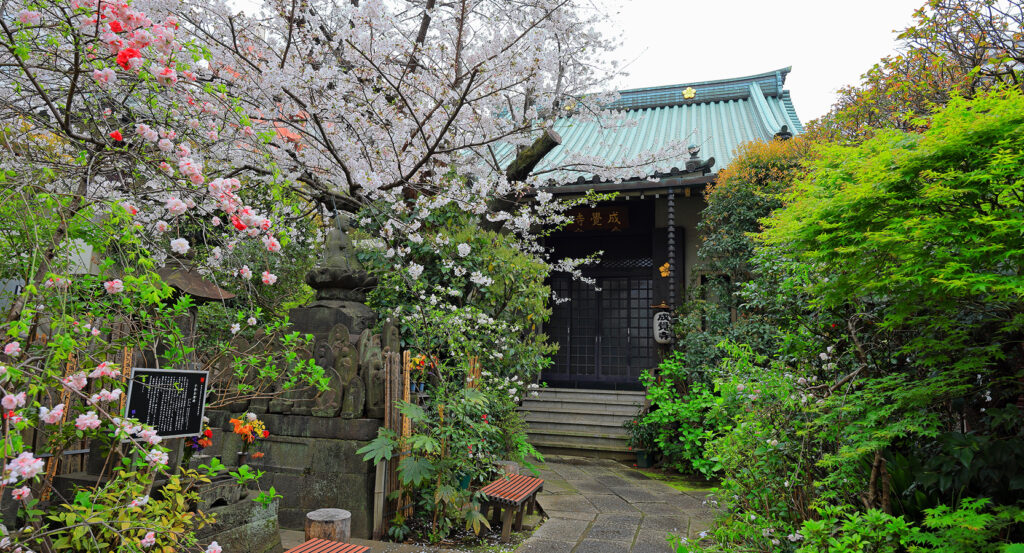
Begin at Taiso-ji Temple, whose predecessor was a hermitage established by the monk Taiso 1596 before Naito Masakatsu, fifth head of the Naito family, was buried there in 1629. Naito Shigenori granted the temple 7,396 tsubo of land in 1668, and successive Naito family burials strengthened a connection that later placed the temple inside the Naito Shinjuku post town; surviving cultural properties include the Naito cemetery, a bronze Jizo belonging to the Edo Six Jizo, an Enma figure, Datsueba and a Christian lantern. Continue to Sanyutei Encho Former Residence Site, where the leading Meiji-era rakugo performer Sanyutei Encho lived from 1888 to 1895 on a property of 1,000 square meters surrounded by bamboo and vegetable fields. Encho developed works including Kaidan Chibusa Enoki and Meijin Choji during this period, leaving a literary association with a part of Shinjuku that still retained a semi-rural character late in the nineteenth century. Conclude at Shinjuku Historical Museum, whose permanent collection carries the district backward from modern metropolitan Shinjuku through the Naito Shinjuku post town, medieval settlement and archaeological traces reaching into prehistory. Its holdings include Naito family personal objects, maps, prints and Utagawa Hiroshige's Yotsuya Naito Shinjuku from One Hundred Famous Views of Edo, reconnecting the present district with the highway settlement whose name eventually became Shinjuku itself. The progression moves from the Naito family's temple and post-town culture through Encho's Meiji literary world into the museum preserving the district's deeper historical sequence, placing Shinjuku Gyoen inside the wider history from which modern Shinjuku emerged.
Where your story begins.
Foresyte Travel reveals places that feel extraordinary long before you arrive.
Enjoy editorial crafted for luxury travelers.
Foresyte may earn a commission when you book.

















































































































