
Why Skyline Queenstown matters.
Skyline Queenstown is a pioneering alpine attraction where Queenstown's adventure-tourism heritage meets the engineering ambition of New Zealand's first commercial gondola operators, transforming Bob's Peak into one of the Southern Lakes region's most consequential recreational destinations.
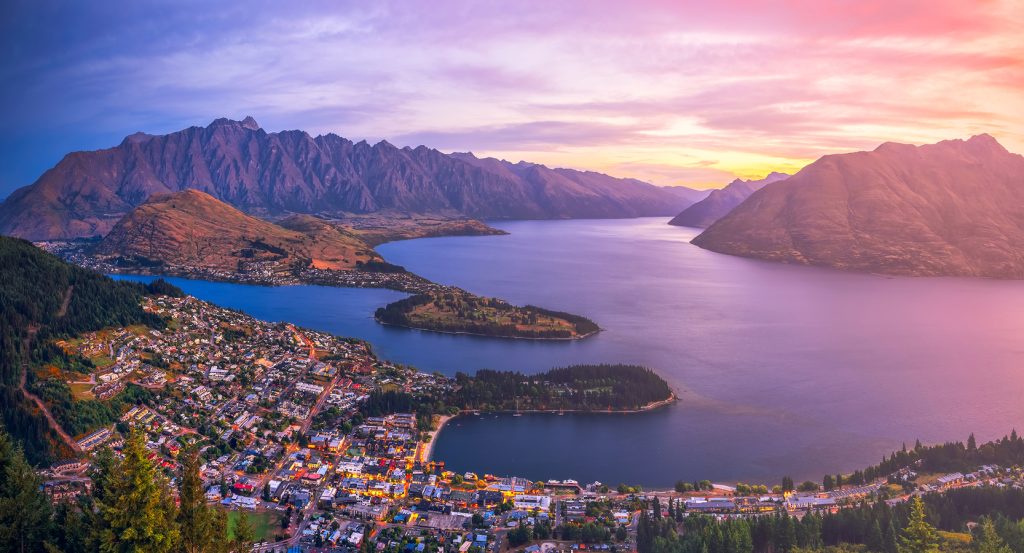
Rising above the upper end of Brecon Street on the forested slopes of Bob's Peak, northwest of Queenstown's commercial center, the attraction connects the town's historic hillside streets to an elevated mountain complex overlooking Lake Wakatipu and the surrounding Southern Alps. Its gondola ascends through steeply graded woodland before reaching an exposed mountainside position 480 meters above the town, revealing expansive views across Queenstown Bay, Cecil Peak and the Remarkables. The summit complex incorporates broad glazed façades, sheltered viewing areas and contemporary hospitality interiors arranged to preserve uninterrupted sightlines toward the lake and surrounding mountain ranges. Outdoor terraces extend the architectural composition into the alpine landscape, with the building's elevated position emphasizing the contrast between Queenstown's compact urban center and the surrounding mountain terrain. The result is a substantial mountain attraction whose aerial transport infrastructure, contemporary architecture and panoramic setting establish a distinctive physical connection between Queenstown's urban development and its alpine geography.
What defines Skyline Queenstown.
Skyline Queenstown is best known for pioneering commercial gondola tourism in New Zealand, developing from a privately constructed mountain access road into an internationally expanding recreation enterprise. The venture originated with Queenstown bus operator Ian Hamilton, who recognized the commercial potential of the elevated viewpoint above the settlement. Hamilton constructed a steep access road in 1961, overcoming gradients averaging one in seven and reaching one in four and a half along its most demanding sections. His initial operation transported passengers uphill in Volkswagen minibuses, establishing a modest sightseeing business that demonstrated substantial demand for elevated views of the surrounding landscape. Hamilton died in a motor accident in 1963, prompting John Dumble to acquire his shares and participate in the venture's subsequent development. Dumble joined Hensman and Cliff M. Broad in establishing Skyline Tours, which began constructing a timber chalet on Bob's Peak in November 1963. Queenstown mayor George Cochrane officially opened the chalet in January 1964, introducing a permanent hospitality facility serving refreshments to passengers arriving by road. The Queenstown Borough Council granted permission for an aerial cableway in 1965, enabling the company to pursue a more efficient means of mountain access. Skyline Enterprises was incorporated in 1966 to finance and construct the project, selecting a French Pomagalski gondola system installed in association with Christchurch engineering company C.W.F. Hamilton. Construction began that August, requiring substantial work across steep terrain to establish the supporting towers, cable infrastructure and terminal facilities. The first gondola ascended Bob's Peak on November 17, 1967, introducing the multicolored bubble cabins that became closely associated with Queenstown's emerging tourism industry. The operation carried 56,000 passengers during its first year, demonstrating the commercial viability of aerial sightseeing in a town whose tourism infrastructure was still developing. Growing demand prompted an extension to the chalet in May 1971, supporting a business that had reached 95,000 annual customers. Skyline subsequently expanded beyond Queenstown, opening its Rotorua operation in March 1985 and introducing the gravity-powered luge concept that became central to the company's international development. A replacement Austrian Doppelmayr gondola entered service in Queenstown in 1987, introducing four-person cabins alongside substantial improvements to the terminal buildings and restaurant. A $6 million redevelopment followed in 1994, incorporating a curved glass wall assembled from thirty tonnes of glazing and extending the building's views toward Coronet Peak and the Arrowtown basin. Associate Tourism Minister Murray McCully officially opened the reconstructed complex on October 27, 1994, during a period of substantial growth in Queenstown's international visitor economy. The company introduced its luge operation to Queenstown in 1998, extending the attraction beyond scenic transportation into gravity-powered recreational engineering. Skyline reached one million Queenstown luge rides in November 2000, establishing the activity as an important component of the company's commercial development. Its subsequent international expansion included Mont-Tremblant in Canada in 2003, demonstrating the transferability of the company's distinctive mountain recreation model. A substantial redevelopment program commenced in 2019 following Environment Court approval, introducing a replacement ten-person gondola system, new terminal infrastructure and expanded hospitality facilities. The new gondola entered service in June 2023, substantially increasing passenger capacity and replacing the four-person system installed during the 1980s. A new upper-complex extension opened on March 16, 2026, representing a major milestone in the NZ$300 million redevelopment program. The project's final phase involves reconstructing the remaining upper facilities and integrating them with the completed extension, with full completion scheduled for early 2029. Skyline Queenstown's development connects the entrepreneurial ambitions of early regional tourism operators to increasingly sophisticated transport engineering, recreational technology and mountain hospitality infrastructure.
Skyline's distinctive appeal develops through the coordinated relationship between aerial transportation, gravity-powered recreation and the physical geography of Bob's Peak. The gondola establishes the central technical foundation, using continuously circulating cabins suspended from an overhead cable to transport passengers across a substantial vertical elevation change. Its ten-person cabins incorporate broad windows and a modern loading system, allowing the ascent to function simultaneously as transportation and an extended observation of the surrounding landscape. The route's steep gradient creates a progressive change in perspective, with the town's streets and buildings gradually resolving into a compact settlement surrounded by lake water, mountain slopes and the wider Wakatipu basin. This relationship between engineering and topography continues through the Skyline Luge, whose gravity-powered carts descend specially constructed tracks incorporating banked corners, changes in gradient and controlled braking systems. Riders regulate their speed through a mechanical steering and braking mechanism, allowing the course to accommodate different levels of confidence and technical ability. The two tracks provide contrasting configurations, with the 750-meter Scenic Track emphasizing gentler curves and the 830-meter Advanced Track incorporating more demanding sections. Their design demonstrates how recreational engineering can transform a steep mountainside into a structured activity while retaining the underlying character of the terrain. A dedicated chairlift returns participants uphill, creating a continuous circulation system that connects the descending tracks with their elevated starting point. Mountain biking develops a more demanding relationship with the slopes through purpose-built downhill trails served by the gondola. The operation introduced New Zealand's first gondola-assisted mountain biking service in 2011, establishing a transport model that allows riders to concentrate on technically demanding descents through forested terrain. Track design incorporates changes in elevation, bermed turns and constructed features that respond to the mountain's natural contours, connecting recreational cycling to the engineering requirements of controlled downhill movement. The summit's hospitality program complements these activities through dining spaces oriented toward the surrounding alpine landscape. Stratosfare Restaurant develops its principal distinction through an elevated dining room whose extensive glazing places the lake and mountains at the center of the meal. Its buffet service accommodates a broad range of New Zealand and international preparations, establishing a substantial hospitality operation within the mountain complex. The March 2026 extension introduced additional dining facilities and expanded observation areas, strengthening the relationship between the building's architecture and its panoramic position. Skyline's defining achievement lies in the integration of these complementary functions into a single mountain operation, connecting transport engineering, recreational design and elevated hospitality through the distinctive geography of Queenstown.
How Skyline Queenstown fits.
Skyline Queenstown works as the culmination of an outing connecting Queenstown's nineteenth-century pioneer settlement, the restoration of native wildlife habitat and the mountain landscape that shaped the town's development as an alpine recreation center.
Begin at Queenstown Cemetery, the historic burial ground whose development accompanied the transformation of a temporary goldfields settlement into a permanent community. The cemetery was established during Queenstown's early colonial development, providing a burial place for residents whose lives were shaped by mining, pastoral farming and the demanding conditions of nineteenth-century settlement. In 1864, the Queenstown Improvement Committee requested government assistance to fence the burial ground and appoint trustees responsible for its management, reflecting growing concern for the protection of an important civic institution. An initial fence followed in 1867, and a substantial schist boundary wall was constructed 1886 using traditional stone masonry techniques. The surviving wall extends for several hundred meters and preserves a direct physical connection to the construction practices of Queenstown's early settlers. Continue to Kiwi Park, the family-operated wildlife sanctuary whose development transformed a neglected hillside dumping ground into an important center for native species conservation. Dick and Noeleen Wilson leased the overgrown property in 1984, beginning a two-year restoration program that removed abandoned vehicles, industrial rubbish, invasive broom and extensive blackberry growth. The sanctuary opened on January 13, 1986, following the construction of aviaries, wildlife facilities and a substantial native planting program undertaken by the Wilson family. Its conservation work subsequently expanded to include more than twenty native species, with breeding and release programs supporting kiwi, South Island kākā, whio and pāteke. The park has bred and released more than one hundred kiwi, and successive generations of the Wilson family have planted thousands of native trees to restore habitat and support the recovery of indigenous wildlife. Conclude at Tiki Trail, the steep woodland route that connects Queenstown's lower hillside to the elevated alpine terrain surrounding Bob's Peak. The 2.1-kilometer trail climbs 450 meters through Douglas fir plantations and surviving native beech forest, preserving a pedestrian connection between the settlement and its surrounding mountain landscape. Its lower section follows the forested slopes above the historic burial ground, gradually ascending through increasingly demanding terrain before reaching the upper mountain environment. The trail forms part of the wider Te Taumata-o-Hakitekura conservation and recreation landscape, connecting to the Ben Lomond Track and the more demanding alpine routes extending toward the mountain's 1,748-meter summit. Queenstown Lakes District Council's reserve management program recognizes the route's importance for public recreation, forest conservation and access to the surrounding mountain environment, preserving a substantial walking corridor through a landscape increasingly shaped by commercial tourism. The progression moves from Queenstown Cemetery's preservation of pioneer settlement history through Kiwi Park's restoration of native wildlife habitat and culminates in Tiki Trail's direct engagement with the surrounding alpine terrain, connecting the human settlement, ecological recovery and mountain geography that shaped Queenstown's development.
Where your story begins.
Foresyte Travel reveals places that feel extraordinary long before you arrive.
Enjoy editorial crafted for luxury travelers.
Foresyte may earn a commission when you book.

















































































































