
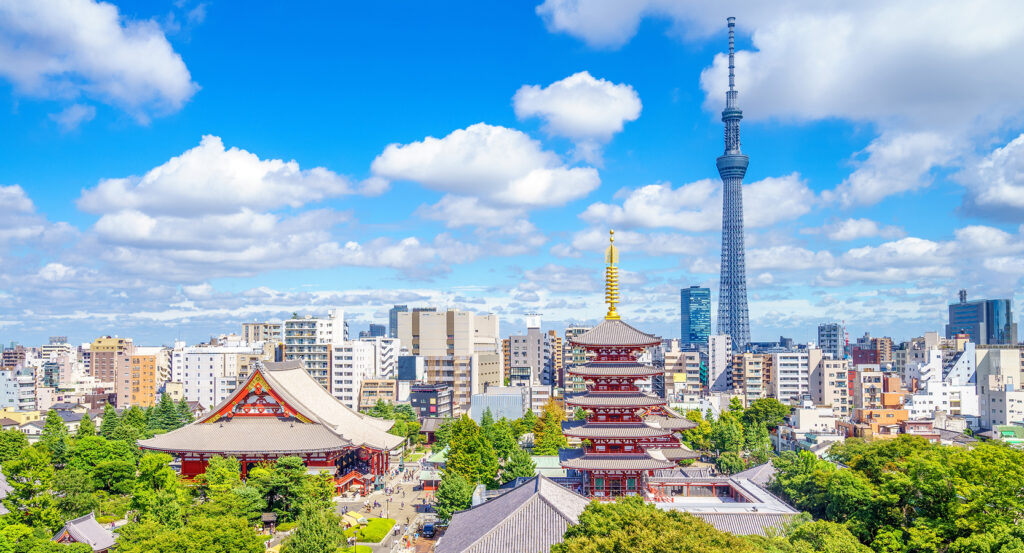
Why Tokyo Skytree East Tower matters.
Tokyo Skytree East Tower is a soaring contemporary high-rise where Oshiage's shitamachi character meets the vertical scale and metropolitan ambition of Tokyo Skytree Town.
Set along the eastern edge of Tokyo Skytree Town near Yotsume-dori and just steps from Oshiage Station, the tower rises directly above a major rail interchange at the point where Sumida's dense street grid reaches the vast Skytree complex. Its 158-meter profile climbs 31 storeys above a Lower East Yard composition, giving the eastern end of the development a second vertical marker beside Tokyo Skytree. Upper levels open broad sightlines across eastern Tokyo, placing the Sumida River, Arakawa basin and dense roofs of Oshiage beneath a dramatically elevated horizon. Landscaped terraces and the East San-do approach bring the tower back to pedestrian scale at ground level, creating a sharp transition between planted exterior spaces and the immense structures overhead. The result is a high-rise whose height, elevated outlook and integration with the surrounding complex reveal how radically Oshiage's physical scale changed during the creation of Tokyo Skytree Town.
What defines Tokyo Sky Tree East Tower.
Tokyo Skytree East Tower is best known for forming the principal high-rise building of the East Yard within Nikken Sekkei's three-part composition for Tokyo Skytree Town. The larger project emerged after six Tokyo broadcasters created a new-tower initiative in December 2003 seeking a transmission structure in the 600-meter class, prompting Sumida and local organizations to request Tobu Railway's participation one year later. Tobu committed to the project in February 2005, and broadcasters selected Oshiage as their first candidate the following month before the site received final selection in March 2006. The Rising East Project concept followed in October 2006, expanding the undertaking beyond the broadcasting tower into a new district spanning the Tower Yard, West Yard and East Yard. Nikken Sekkei developed the architectural design between April 2006 and June 2008, giving the East Yard a 158-meter tower with 31 storeys above ground and three below. An Obayashi, Kabuki Construction and Tobu Construction joint venture built the East Yard as a distinct construction package within the larger development. Seventeen office levels concentrated a substantial business component at the eastern end of a project otherwise dominated visually by the 634-meter broadcasting tower. Completion in February 2012 placed Tokyo Skytree East Tower within a 229,729-square-meter development whose three yards opened together on May 22, linking the tower's creation directly to the broader reinvention of Tobu Railway's Oshiage property.
Tokyo Skytree East Tower also carries a technical program developed around seismic control and reduced energy demand within the wider Tokyo Skytree Town project. Its steel, steel-reinforced-concrete and reinforced-concrete construction incorporates a vibration-control structure across a building reaching 148 meters to its principal architectural height and 158 meters at its highest point. High-performance insulation and solar shading reduce heat entering the office tower, linking the envelope directly to lower cooling loads. Tokyo Skytree Town extends that strategy through solar generation and rooftop rainwater capture, placing the East Tower inside a district-wide approach to resource use. A district heating and cooling system connects the development's major buildings, allowing thermal production to operate across the site as a coordinated network. The completed East Tower joins high-rise seismic engineering, envelope performance and shared thermal infrastructure within the same architectural project, giving Nikken Sekkei's eastern tower a technical role extending well beyond its contribution to the skyline.
How Tokyo Sky Tree East Tower fits.
Tokyo Skytree East Tower works as the starting point for a daytime route through three Sumida sites that carry Oshiage from local sacred tradition through nineteenth-century political memory into the artistic legacy of Honjo.
Begin at Tobiki Inari Shrine, where two origin traditions connect the sanctuary to the medieval history of Oshiage: one traces its foundation to an airborne ginkgo branch that embedded itself in the ground during a storm and grew into a great tree, and another links the shrine to members of the Hōjō clan who settled here after the fall of the Kamakura shogunate. The surviving ginkgo is at 500 to 600 years old, making it the oldest among the four Sumida ginkgo trees surviving from the Edo period; wartime fire damaged the tree before renewed growth restored its crown. Continue to Nose Myokendo, where Nose Yoritsugu transferred an image of Myoken Daibosatsu from his family's Osaka homeland to an Edo estate in 1774, establishing a devotional center associated with protection and good fortune. The temple later entered the biography of Katsu Kaishu after a dog severely injured him as a child and his father, Katsu Kokichi, performed cold-water austerities at Myokendo while praying for his recovery; a bust of the elder Kaishu commemorates that connection after earthquake and wartime destruction required a fifteen-year reconstruction beginning in 1953. Conclude at The Sumida Hokusai Museum, opened in 2016 in the district where Katsushika Hokusai was born in 1760 and spent most of his ninety-year life. Kazuyo Sejima designed its faceted aluminum exterior on part of the former Edo residence of the Tsugaru clan of Hirosaki, whose lord once commissioned Hokusai to paint a horse on a folding screen; inside, the Peter Morse Collection contributes 600 Hokusai works and research items acquired intact by Sumida after Morse's death in 1993, joining the Muneshige Narazaki Collection in a specialist institution rooted directly in the artist's birthplace. The progression moves from Tobiki Inari Shrine's medieval foundation traditions and centuries-old ginkgo through Nose Myokendo's eighteenth-century devotion and Katsu Kaishu connection into Hokusai's Sumida biography, Kazuyo Sejima's architecture and two major scholarly collections, revealing cultural strata that long predate the high-rise district now rising above Oshiage.
Where your story begins.
Foresyte Travel reveals places that feel extraordinary long before you arrive.
Enjoy editorial crafted for luxury travelers.
Foresyte may earn a commission when you book.

















































































































