Why Stockholm City Hall matters.
Stockholm City Hall is a National Romantic civic building where Kungsholmen's waterfront setting meets Sweden's municipal democracy, Ragnar Östberg's architectural vision and the ceremonial traditions of the Nobel Prize banquet.
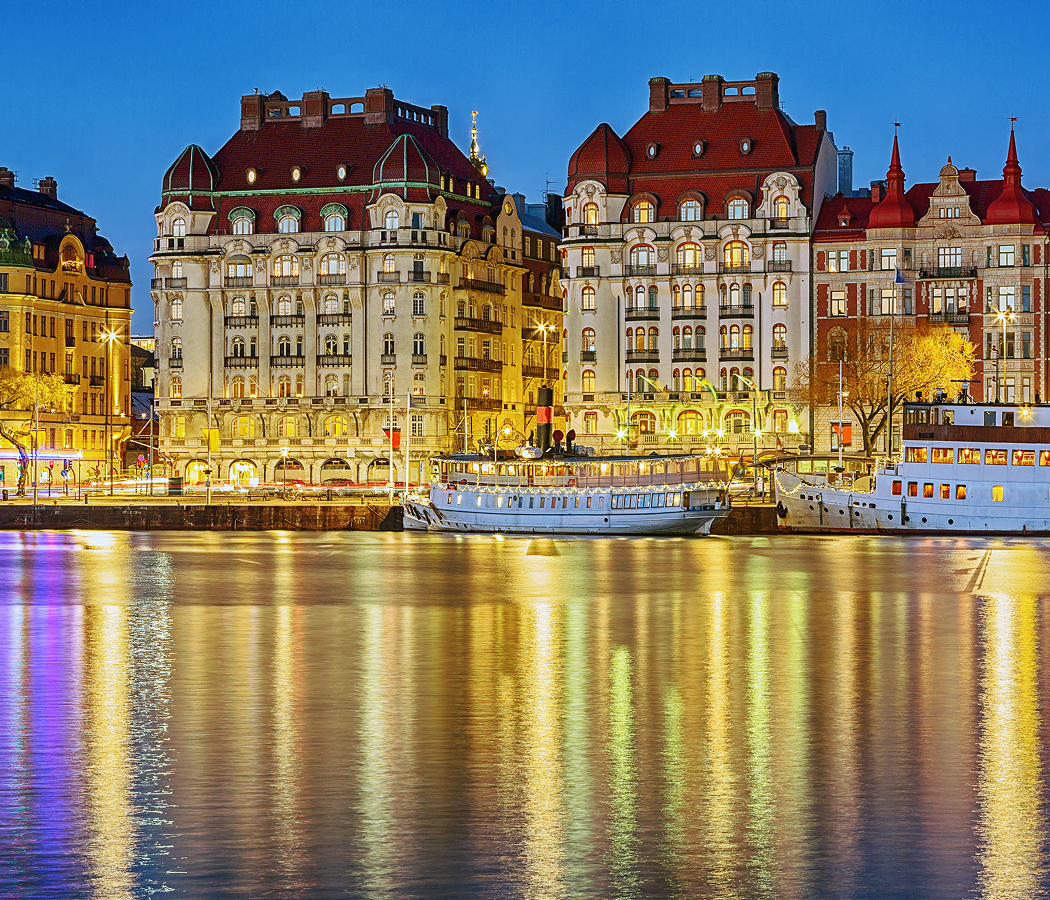
Set along Hantverkargatan near Ragnar Östbergs Plan and directly beside Riddarfjärden, the city hall occupies Kungsholmen's southeastern waterfront at the western approach to Central Stockholm, overlooking Riddarholmen and Södermalm across the water, with Norr Mälarstrand extending westward along the island's southern shore. Its red-brick elevations enclose two principal courtyards, including an open waterfront court framed by arcades. A square tower rises above the southeastern corner, crowned by three gilded crowns associated with Sweden's national heraldry. Granite foundations meet the shoreline beneath terraces and colonnades that connect the building's ceremonial spaces with the surrounding water. The result is a municipal complex whose architecture integrates Swedish historical references, public administration and Stockholm's island geography.
What defines Stockholm City Hall.
Stockholm City Hall is best known for its National Romantic architecture, its association with the annual Nobel Prize banquet and its position among the principal achievements of Swedish architect Ragnar Östberg. Stockholm's expanding municipal government required larger administrative premises during the early twentieth century, following decades of industrial growth and urban development. The city selected the former Eldkvarn mill site on Kungsholmen, where a major fire in 1878 had destroyed much of the industrial complex. Architectural competitions held during the first decade of the twentieth century brought Östberg into the project, which underwent substantial revisions before construction began. His design combined influences from northern European medieval architecture, Italian civic palaces and Swedish building traditions. Construction commenced in 1911 and continued through a period marked by the First World War and significant economic pressures. The building's extensive brickwork required specialized craftsmanship, including the production of millions of bricks in forms suited to the architectural program. Östberg coordinated the work of artists, sculptors and craftspeople responsible for the building's decorative interiors. The completed city hall was inaugurated on 23 June 1923, coinciding with commemorations of the four-hundredth anniversary of Gustav Vasa's entry into Stockholm. Its opening established a permanent architectural setting for the city's political administration and representative ceremonies. The Nobel Prize banquet moved to the building in 1930, establishing a recurring association between municipal architecture and international scientific, literary and humanitarian recognition. The banquet developed into one of Sweden's most prominent annual ceremonial gatherings, attended by Nobel laureates, members of the royal family and invited dignitaries. Municipal council meetings continue in the building, maintaining its original governmental function alongside its ceremonial role.
Ragnar Östberg's architectural program organizes the building around a sequence of halls, galleries and courtyards whose proportions draw upon different European civic traditions. The Blue Hall, despite its name, retains exposed red-brick walls beneath a high ceiling supported by arcades and columns. Östberg originally considered blue decoration for the space but retained the brick surfaces as the design developed. The hall accommodates the Nobel Prize banquet, where long tables occupy the central floor beneath the surrounding galleries. A broad staircase descends into the room, providing the ceremonial entrance used during the annual event. The Golden Hall contains extensive mosaics designed by artist Einar Forseth, incorporating eighteen million pieces of glass and gold-colored tesserae. Its central composition depicts the Queen of Lake Mälaren, a personification of Stockholm seated above the surrounding city. Additional mosaics portray figures and episodes associated with Swedish history and international cultural exchange. The Council Chamber contains a painted timber ceiling inspired by the exposed roof structures of traditional Scandinavian buildings. Its interior arrangement accommodates the elected municipal council, with seating organized around the chamber's governmental functions. The Prince's Gallery extends along the waterfront and contains painted scenes by Prince Eugen depicting views of Stockholm across Riddarfjärden. These paintings connect the building's interior decoration with the actual landscape visible through its windows. The tower reaches 106 meters and contains a substantial collection of bells and architectural spaces associated with the building's ceremonial design. Its upper levels provide views across Stockholm's central islands, waterways and historic districts. Sculptural ornament throughout the complex incorporates Swedish historical figures, mythological subjects and symbols associated with civic authority. The building's artistic program joins architecture, painting, sculpture and decorative craftsmanship within a functioning seat of municipal government.
How Stockholm City Hall fits.
Stockholm City Hall works as the civic centerpiece for a Central Stockholm itinerary connecting parliamentary government, royal history and the architectural institutions surrounding the city's principal waterways.
Begin at Riddarhuset, the House of Nobility situated near the northern approach to Riddarholmen. The building was constructed during the seventeenth century as a meeting place for Sweden's noble estates, with contributions from architects including Simon de la Vallée and Jean de la Vallée. Its Dutch Classicist architecture incorporates a symmetrical façade, sculptural decoration and a substantial ceremonial hall. The interior contains heraldic shields representing Swedish noble families, preserving the institutional history of the aristocracy within the kingdom's former political system. The building's location near the historic royal precinct connects it with the governmental organization of early modern Sweden. Continue to Riddarholmen Church, the former Franciscan monastery church standing on the island immediately west of Stockholm's medieval center. Its origins extend to the late thirteenth century, when the Franciscan order established a religious complex on the site. Following the Reformation, the church became associated with royal burials and dynastic commemoration. Its chapels contain tombs and memorials connected with Swedish monarchs, including members of the Vasa, Carolingian and Bernadotte dynasties. The church's openwork cast-iron spire was installed during the nineteenth century following damage to an earlier tower. Its surviving medieval structure and later royal additions preserve successive phases of Swedish political and religious history. Conclude at the Riksdag Building, the seat of Sweden's national parliament on Helgeandsholmen. Architect Aron Johansson designed the principal complex, which was completed in 1905 after extensive construction and alterations to the island's urban fabric. Its architecture incorporates expansive stone façades, sculptural decoration and formal parliamentary interiors. The building accommodates the Riksdag, Sweden's unicameral legislature, whose 349 members exercise national legislative authority. Parliamentary reforms during the twentieth century changed the organization of Sweden's representative government, including the replacement of the bicameral system in 1971. The progression moves from aristocratic political institutions through royal commemoration and culminates at the national legislature, connecting Stockholm City Hall with the architectural history of Swedish government.
Where your story begins.
Foresyte Travel reveals places that feel extraordinary long before you arrive.
Enjoy editorial crafted for luxury travelers.
Foresyte may earn a commission when you book.