
Why teamLab Planets TOKYO matters.
teamLab Planets TOKYO is an immersive digital-art museum where Toyosu's waterfront reinvention meets grand light, responsive environments and physical encounters that dissolve conventional boundaries between artwork and observer.
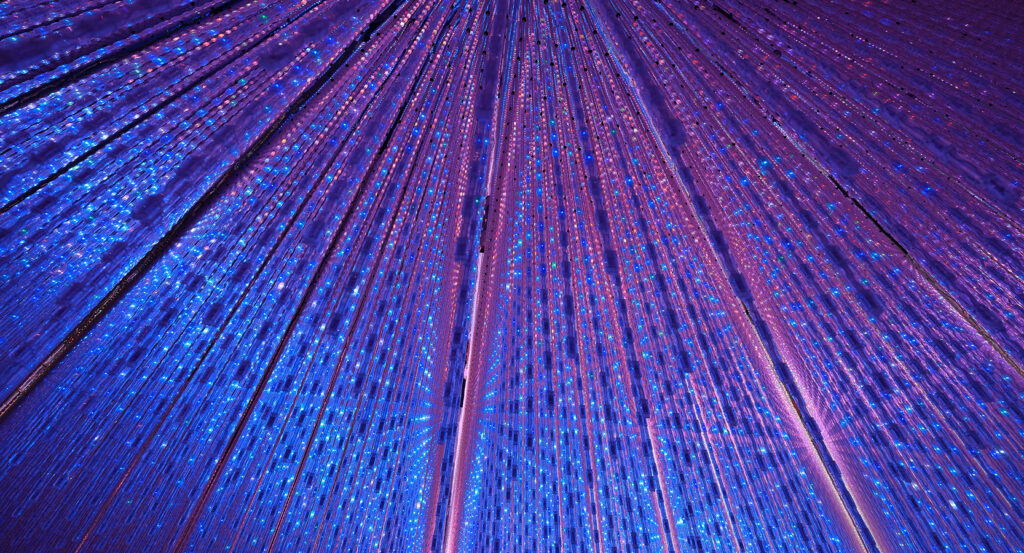
Set along the Shin-Toyosu waterfront near Harumi-dori and just steps from Shin-Toyosu Station, the museum occupies a low-slung complex within the rapidly redeveloped landscape between Central Toyosu and the wholesale-market district. Entry begins barefoot, immediately changing the physical terms of a museum visit as corridors lead through darkness, water and mirrored surfaces into rooms whose boundaries become difficult to perceive. Waterfall of Light Particles at the Top of an Incline sends illuminated water down a rising passage, and Drawing on the Water Surface Created by the Dance of Koi and People places moving digital koi around bodies standing directly inside the water. The Infinite Crystal Universe surrounds movement with dense points of suspended light, then Floating Flower Garden lowers thousands of living orchids into the path as the installation responds to human position. The result is a museum where water depth, darkness, reflected light, living plants and responsive digital imagery make bodily movement the principal means of encountering the art.
What defines teamLab Planets TOKYO.
teamLab Planets TOKYO is best known for translating an experimental teamLab installation first presented in Odaiba into a 10,000-square-meter Toyosu museum that subsequently became the world's most visited museum devoted to a single art group. The project developed from DMM.PLANETS Art by teamLab, a 2016 installation staged for 47 days whose demand produced waits exceeding six hours and demonstrated the scale of public interest in teamLab's body-immersive work. PLANETS Co., Ltd. then organized the larger Toyosu project with teamLab, opening it on July 7, 2018 as a time-limited institution originally scheduled to operate through autumn 2020. Its initial artistic structure centered on immense installations designed to remove physical distance between a person and an artwork through water, mirrored infinity, changing light and responsive digital systems. Continued demand repeatedly extended the museum's lifespan as Toyosu itself developed into a major cultural and commercial waterfront district. Attendance reached 2,412,495 during calendar year 2023, followed by 2,504,264 admissions between April 1, 2023 and March 31, 2024. Guinness World Records recognized that latter figure in June 2024 as the highest annual attendance for a museum devoted to a single art group, surpassing the previous record held by teamLab Borderless in Odaiba. The institution then undertook its largest physical expansion, increasing its scale by 1.5 times and opening Athletics Forest, Catching and Collecting Forest and Future Park on January 22, 2025 with more than 20 additional artworks. teamLab Planets received 2.51 million admissions during 2025, sustaining the extraordinary audience scale reached before the expansion. A project conceived for a limited run had developed across seven years into an expanding museum whose successive additions preserved teamLab's original emphasis on physical participation while extending it into movement, education and collective creation.
Catching and Collecting in the Sacred Forest introduced a new artistic mechanism by connecting digital animals with a smartphone application built around capture, observation and release. Endangered and extinct creatures move across walls and floors inside the installation, and participants use digital arrows or nets to catch them before examining the resulting creatures through the application and returning them to the projected environment. Athletics Forest develops teamLab founder Toshiyuki Inoko's concept of understanding the world through the body by making spatial perception dependent on jumping, climbing and balancing across installations such as Multi Jumping Universe and Aerial Climbing through a Flock of Colored Birds. Rapidly Rotating Bouncing Spheres in the Caterpillar House changes the relationship again through spheres that spin when approached and stop when touched, converting movement among participants into visible changes across the room. Graffiti Nature extends participation into image creation as drawn creatures enter a digital environment and interact within a larger projected habitat. Future Park applies teamLab's collaborative-creation project to works including Sketch Umwelt World, where drawings become moving figures inside a shared environment and survive beyond the individual act of drawing. These additions shifted the museum's participatory model from immersion alone toward physical learning, collection and co-creation, expanding the ways a person's actions alter the work and the actions available to everyone entering afterward.
How teamLab Planets TOKYO fits.
teamLab Planets TOKYO works as the anchor for a waterfront route through three nearby sites connecting Tokyo's energy infrastructure, the historic relocation of the capital's wholesale market and the immense engineering works that reshaped access across Tokyo Bay.
Begin at Gas Science Museum, whose history reaches back to the original Gas Science Museum established by Tokyo Gas in Toyosu in 1986. Tokyo's land readjustment program later prompted its relocation within the district, and the replacement facility opened as Gas Science Museum in June 2006, using exhibits and demonstrations to interpret gas production, energy systems and environmental questions. The new institution reached 1.1 million cumulative admissions on the fourth anniversary of its opening in 2010, extending an educational operation tied directly to the industrial company whose former landholdings helped shape modern Toyosu. Continue to Toyosu Market, created when the Tokyo Metropolitan Government transferred the wholesale functions of Tsukiji Market to a 407,000-square-meter site on the waterfront. Fish, fruit and vegetable operations began there on October 11, 2018, bringing close to 900 businesses into a purpose-built complex organized around the Fisheries Wholesale Market, Fisheries Intermediate Wholesale Market and Fruit and Vegetables buildings. Observation corridors expose the immense logistics system to public view, and the tuna-auction deck provides a direct vantage onto one of the market's most consequential commercial rituals. Conclude at Toyosu-ohashi Bridge, the crossing developed between Toyosu and Harumi as the surrounding waterfront entered a new phase of infrastructure investment tied to the market relocation and the wider transformation of Tokyo Bay. The bridge spans the Harumi Canal on the principal road connection through the market district, extending the engineered landscape beyond the reclaimed ground itself and toward the former Olympic Village site across the water. The progression moves from Tokyo Gas and the industrial origins of modern Toyosu through the wholesale-market relocation that fundamentally altered the district into the bridge infrastructure binding the reclaimed waterfront together, placing teamLab Planets TOKYO inside one of Tokyo's most extensive twenty-first-century urban transformations.
Where your story begins.
Foresyte Travel reveals places that feel extraordinary long before you arrive.
Enjoy editorial crafted for luxury travelers.
Foresyte may earn a commission when you book.

















































































































