
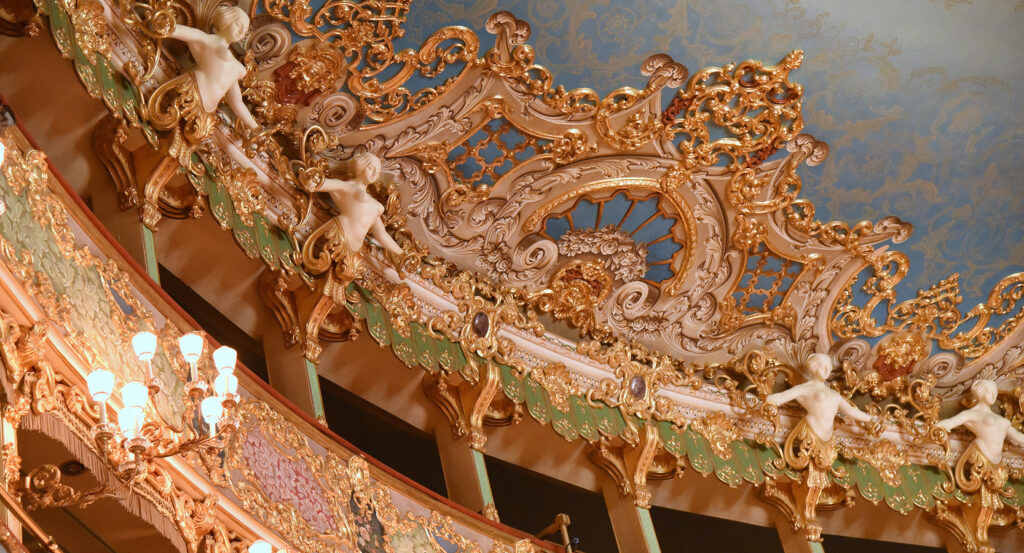
Why you should experience The Chandelier at Teatro La Fenice in Venice, Italy.
The Chandelier is the crowning glory of Teatro La Fenice, a celestial masterpiece that hovers like a halo above the Grand Opera Hall.
Look upward, and you'll see a painted sky blooming with myth and light: Apollo, god of music, surrounded by the Muses who embody art, poetry, and dance. At its center descends the grand chandelier, a cascade of glass and fire that turns the entire hall into a living constellation. When the lights dim and the orchestra begins, the dome seems to breathe; its frescoes glow softly in the golden illumination, transforming the ceiling into an instrument of atmosphere. The chandelier doesn't just light the room, it completes the performance. Every gleam reflects centuries of Venetian craftsmanship, echoing the city's eternal dance between elegance and endurance.
What you should know about The Chandelier at Teatro La Fenice.
The dome is both illusion and precision, an optical symphony designed to elevate the senses.
After the 1996 fire destroyed La Fenice, the ceiling was recreated from surviving sketches, photographs, and fragments of plaster that artisans salvaged from the ashes. The fresco was meticulously repainted by contemporary Venetian masters using traditional pigments and gold dust, ensuring the colors would shimmer under candlelight as they did in the 18th century. The chandelier itself is a marvel, composed of over 1,000 hand-cut glass prisms and weighing more than a ton, yet engineered to hang delicately from the center of the dome's oculus. Its crystal structure refracts light across the ceiling's curve, animating the painted figures above as if they were in motion. The dome's elliptical shape and curvature were calculated to perfect acoustics: its concavity subtly amplifies sound from the stage, diffusing it evenly throughout the hall. Few realize that the chandelier can be lowered by an intricate pulley system hidden behind the fresco, a design adapted from original 18th-century mechanisms. Every evening, when it rises into place before the curtain lifts, the ritual feels like a resurrection, light reborn from darkness, just as La Fenice has been time and again.
How to fold The Chandelier at Teatro La Fenice into your trip.
When you visit Teatro La Fenice, take time to look up, and stay still.
Stand in the center of the Grand Opera Hall beneath the chandelier's glow, and let your gaze travel across the fresco's orbiting figures. Visit during a daytime tour to appreciate the fresco's soft colors under natural light, or attend an evening performance when the chandelier ignites, its light cascading through tiers of gold and crimson. From the Royal Box, the view is transcendent, the chandelier framed perfectly against the painted heavens, reflecting in the mirrors that line the balcony. Try to arrive early before a performance, when the hall is still and the chandelier is at full brilliance; the effect is like standing inside a sunrise sculpted from glass. After the curtain falls, stay a moment longer as the chandelier dims, the fresco fades into shadow, and the dome returns to stillness. It's a reminder that in Venice, even silence glows. The Chandelier isn't merely decoration; it is La Fenice's beating light, the luminous soul of a theater that has turned survival into art.
Where your story begins.
Foresyte Travel reveals places that feel extraordinary long before you arrive.
Experience premium editorial crafted for luxury travelers.




















































































































