
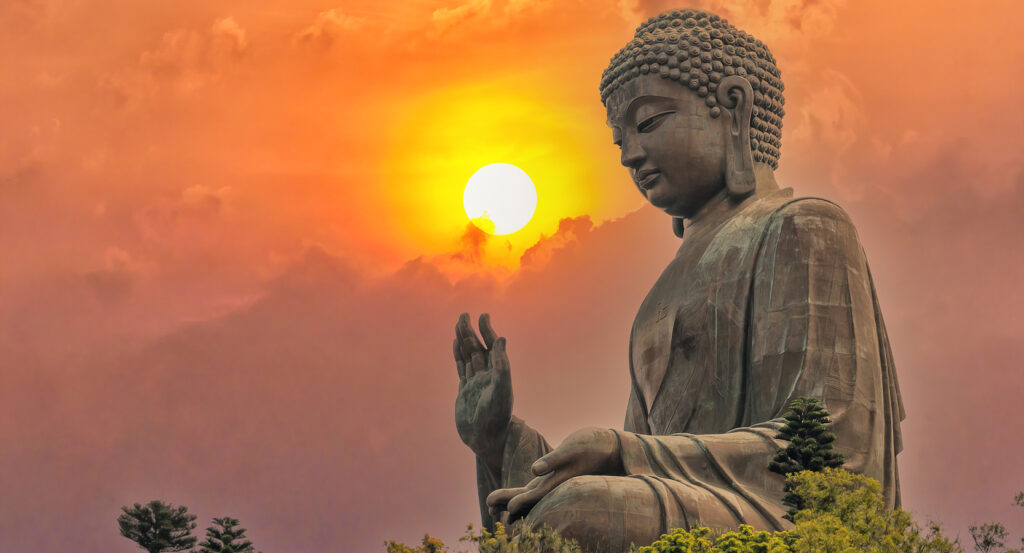
Why Po Lin Monastery matters.
Po Lin Monastery in Hong Kong is the spiritual heart of Lantau Island, a sanctuary of incense, devotion, and mountain air.
Tucked beneath the shadow of the Big Buddha, this Buddhist complex is one of Hong Kong's most serene and soul-stirring sites. Step through its entrance and the chaos of the modern world dissolves into a slow rhythm of bells, chanting, and the gentle rustle of banyan trees. The monastery's courtyards gleam with golden statues and intricate wood carvings, their surfaces glowing in the soft light that filters through drifting incense. Inside the main temple hall, rows of lotus lamps flicker at the feet of three immense golden Buddhas, representing the past, present, and future, their calm faces watching over worshippers and wanderers alike. Outside, the soundscape shifts from prayer to nature: cicadas, wind chimes, and the faint echo of the monastery bell rolling through the hills. Po Lin isn't just a religious site; it's a living poem, one written in the language of stillness and light.
What defines Po Lin Monastery.
Founded in 1906 by three monks from Jiangsu, Po Lin began as a humble retreat called “The Big Hut.”
Over time, it grew into one of Hong Kong's most important centers of Buddhism, earning its modern name, “Precious Lotus”, in homage to the flower that symbolizes purity and awakening. The architecture blends Tang dynasty grandeur with local craftsmanship: sweeping roofs, vermilion beams, and glazed tiles that shimmer like wet jade after rain. Every element holds symbolic meaning, the number of steps, the placement of statues, even the alignment of halls designed to harmonize with the surrounding peaks of Ngong Ping Plateau. The monastery played a central role in the creation of the Big Buddha in the 1990s, serving as both spiritual and logistical base during its construction. Few realize that the complex also houses an extensive library of sutras and sacred texts, preserved meticulously in temperature-controlled halls. The vegetarian kitchen, famed across Hong Kong, serves food prepared by resident monks, a practice rooted in mindfulness and compassion. Even the air here feels intentional, slower, clearer, as if filtered through centuries of prayer.
How Po Lin Monastery fits.
Reaching Po Lin is a journey worth savoring.
Take the Ngong Ping 360 cable car for panoramic views of the South China Sea and mist-draped mountains, or arrive by bus from Tung Chung if you prefer a winding, scenic ascent. Once at Ngong Ping Village, follow the walkway lined with prayer wheels toward the monastery's entrance, where stone lions and incense burners stand guard. Begin at the main hall, offering a moment of quiet reflection before exploring the surrounding courtyards filled with bonsai trees and lanterns. Don't rush, linger in the details: the dragon carvings along the rooflines, the rhythmic chanting from within, the way sunlight filters through the temple smoke like silk. Stay for a vegetarian meal at the dining hall, where tofu, mushrooms, and lotus-root dishes are served with humble grace. Before leaving, walk the short path to the base of the Big Buddha, the monastery's expansive counterpart, and look back at Po Lin tucked in the valley below. From this vantage, it feels eternal, a place where the sacred and the everyday meet, where even a traveler passing through can hear the echo of enlightenment in the mountain wind.
Where your story begins.
Foresyte Travel reveals places that feel extraordinary long before you arrive.
Enjoy editorial crafted for luxury travelers.
Foresyte may earn a commission when you book.

















































































































