
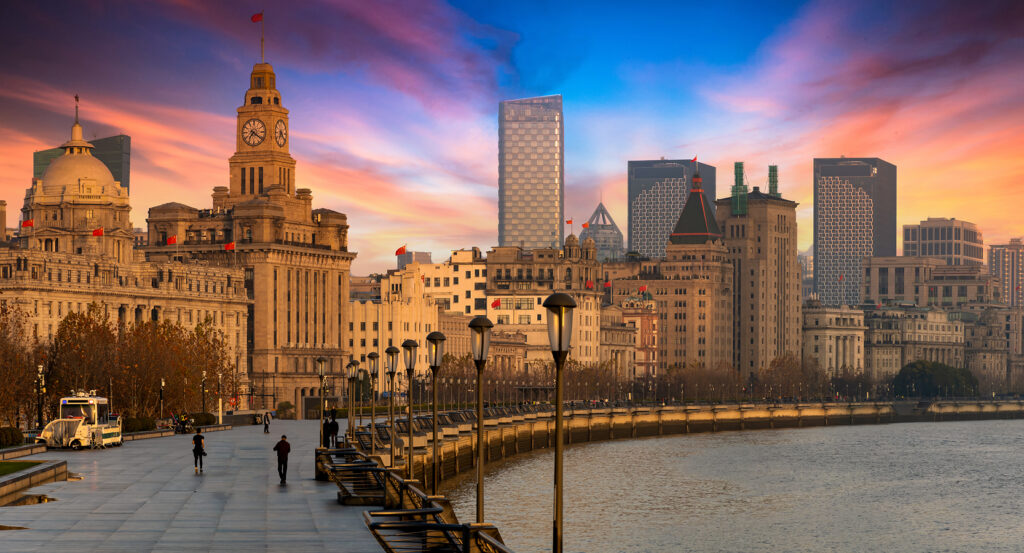
Why Custom House matters.
The Customs House on The Bund is the beating clock of old Shanghai, a monument of precision, authority, and architectural grace that has kept time over the city's transformations for nearly a century.
Standing beside the Peace Hotel, its towering clock tower rises above the colonial skyline, its bronze bells tolling across the Huangpu River with a melody once known as the “Voice of the Bund.” Beneath its austere granite façade lies the story of commerce and empire, of a city that built its fortune on the rhythm of ships and silver. The Customs House is not just another heritage building, it's the metronome of Shanghai's evolution, marking the hours of a metropolis that never truly sleeps. To stand at its base is to feel the city's pulse, a fusion of imperial ambition, industrial power, and timeless rhythm still echoing through the river breeze.
What defines Custom House.
The Shanghai Customs House, completed in 1927, is among the oldest and most enduring landmarks on The Bund, and one of only two structures from the early 20th century that still perform their original function.
It replaced an earlier customs office built in 1857, which had overseen the booming trade that transformed Shanghai into the gateway of the East. Designed by the British firm Palmer & Turner, the same architects behind the Peace Hotel, the building captures the restrained grandeur of Neo-Classical design, its massive Doric columns and symmetrical façade conveying authority and permanence. The clock tower, rising 90 meters, was modeled after London's Big Ben, complete with a five-ton bell mechanism imported from England. In its early days, the chimes played “Westminster Quarters,” signaling each hour to ships navigating the Huangpu. During the Cultural Revolution, the melody was replaced with “The East Is Red,” only to be restored to its original tune decades later. The Customs House interior once contained elegant marble staircases, teak-paneled offices, and high ceilings adorned with plaster rosettes, a statement of colonial opulence that has since given way to modern administration. Yet its symbolism remains intact: the Customs House was, and still is, the city's most visible tribute to Shanghai's character as a crossroads of trade and ambition. Each toll of the clock marks not just the passage of time, but the endurance of Shanghai's mercantile spirit.
How Custom House fits.
To experience the Customs House is to touch the disciplined heart of The Bund, a landmark that has watched the skyline evolve from sailboats to skyscrapers.
Begin at Zhongshan East Road, where the building's massive clock tower dominates the view between Nanjing East Road and the Peace Hotel. Arrive near the top of the hour to hear the chimes echo across the river, a sound that has marked nearly every generation of Shanghainese life. Spend 15-20 minutes admiring the façade's rhythmic geometry, then step back across The Bund promenade to take in its full silhouette framed against the skyline. For photographers, twilight offers the most dramatic moment, the building's limestone exterior glows amber under spotlights, its clock face gleaming over the darkening river. Though the interior is not open to the public, the Customs House remains one of the city's most photogenic subjects, best viewed alongside the neighboring HSBC Building, with which it forms The Bund's most iconic architectural pairing. The nearest metro stop, East Nanjing Road Station (Line 2), places you just minutes away. As the bells toll above and the ferries glide below, you realize that the Customs House doesn't just mark time, it has defined Shanghai's tempo for almost a hundred years, one perfect note at a time.
Where your story begins.
Foresyte Travel reveals places that feel extraordinary long before you arrive.
Enjoy editorial crafted for luxury travelers.
Foresyte may earn a commission when you book.

















































































































