
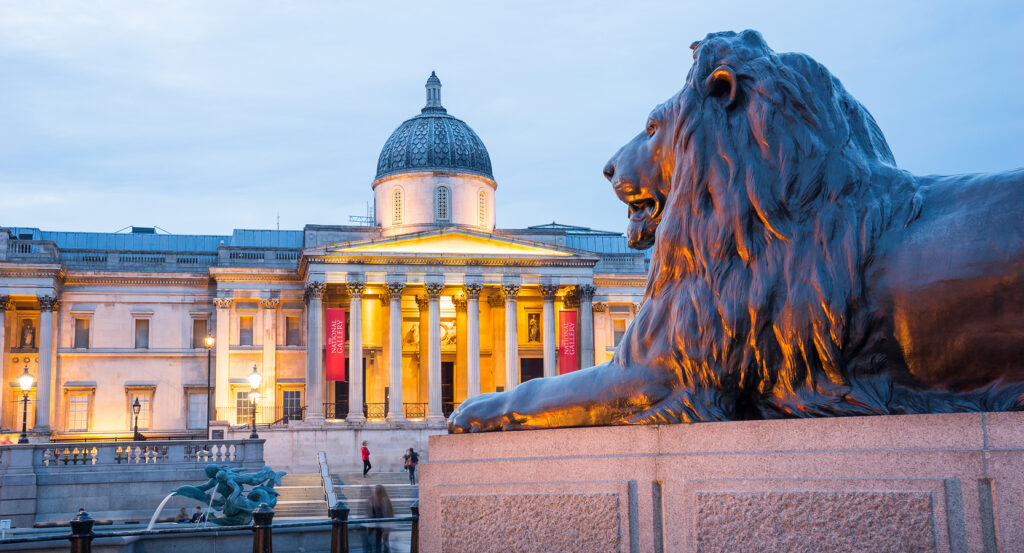
Why Fountains of Trafalgar Square matters.
Fountains of Trafalgar Square are expansive civic fountains where St. James's ceremonial landscape, Victorian engineering, public art, and national character converge within one of London's most celebrated public spaces.
Set at the heart of Trafalgar Square along Whitehall near The Strand and just steps from Nelson's Column, these expansive granite fountains animate the square through soaring water displays, expansive bronze sculptures, broad reflecting basins, and carefully composed sightlines that frame the surrounding architecture of the National Gallery, St. Martin-in-the-Fields, and Admiralty Arch. Constant movement, rhythmic cascades, and the blend of water with one of Britain's most recognizable civic settings create an atmosphere that evolves throughout the day and evening. Every view reinforces Trafalgar Square's role as London's ceremonial center and one of the world's defining public plazas. The result is a fountain ensemble defined by artistic distinction, engineering achievement, and one of the United Kingdom's most recognizable civic landmarks.
What defines Fountains of Trafalgar Square.
Fountains of Trafalgar Square are best known for being installed in 1845 under the direction of eminent architect Sir Charles Barry as part of the comprehensive completion of Trafalgar Square, providing both expansive ornamentation and an ingenious solution to discourage large public gatherings in the open plaza surrounding Nelson's Column. The original fountains featured elegant granite basins supplied by artesian wells before being comprehensively rebuilt between 1937 and 1939 under architect Sir Edwin Lutyens, whose redesign introduced the larger basins seen today together with new hydraulic systems capable of producing dramatically more powerful water displays. The present sculptural centerpiece of each fountain was unveiled in 1948, when celebrated sculptor Sir Charles Wheeler created bronze groups representing mermaids, dolphins, and tritons for the northern fountain, while distinguished sculptor Sir William McMillan designed the southern fountain with expansive figures of tritons, nereids, and dolphins, both commemorating the Royal Navy's decisive victory at the Battle of Trafalgar (1805) through richly symbolic maritime imagery. Each bronze composition was cast from captured Royal Navy gunmetal, reinforcing the fountains' connection to Britain's naval heritage while integrating expansive sculpture into one of Europe's foremost civic spaces. A comprehensive £35 million restoration completed in 2003 modernized the fountains with advanced filtration systems, energy-efficient pumps, underwater lighting, improved accessibility, and new granite paving while carefully preserving Lutyens' historic design. Today the fountains serve as the visual anchor of Trafalgar Square, welcoming millions of visitors annually while providing the ceremonial setting for national celebrations, cultural festivals, sporting commemorations, royal events, political demonstrations, and New Year's festivities that have defined London's civic life for generations.
The artistic composition achieves a remarkable balance between architecture, sculpture, and hydraulic engineering through broad granite basins, precisely calibrated water jets, expansive bronze figures, and carefully proportioned open space that preserves uninterrupted views toward the National Gallery and Whitehall. The maritime iconography reinforces the square's dedication to Admiral Horatio Nelson while Lutyens' restrained classical design allows the fountains to complement rather than define the surrounding civic architecture. Illuminated after dark, the synchronized water displays transform the plaza into one of London's most recognizable urban landscapes while demonstrating how thoughtful planning, expansive public art, and continuous conservation have sustained one of the world's great civic squares for nearly two centuries.
How Fountains of Trafalgar Square fits.
Fountains of Trafalgar Square are best experienced as the civic centerpiece of an exploration through Westminster's ceremonial and cultural heart.
Begin at St. Martin-in-the-Fields Church, where one of London's finest eighteenth-century churches establishes the historic character of Trafalgar Square before continuing to Fountains of Trafalgar Square. Continue to the National Gallery, whose internationally celebrated collection naturally extends the artistic experience overlooking the square. Conclude at The Mall, where the grand ceremonial avenue leading toward Buckingham Palace provides a memorable finale celebrating the expansive planning and national symbolism that define Central London. The progression moves naturally from historic church to expansive civic fountains before concluding along Britain's foremost ceremonial boulevard, revealing why Fountains of Trafalgar Square remain among London's most enduring public landmarks.
Where your story begins.
Foresyte Travel reveals places that feel extraordinary long before you arrive.
Enjoy editorial crafted for luxury travelers.
Foresyte may earn a commission when you book.














































































































