
Why The One Alma Paris matters.
The One Alma Paris is a cultivated hotel where Gros-Caillou's residential character meets midcentury commercial architecture, a collector-driven boutique conversion and H10 Hotels' first luxury foothold in the French capital.
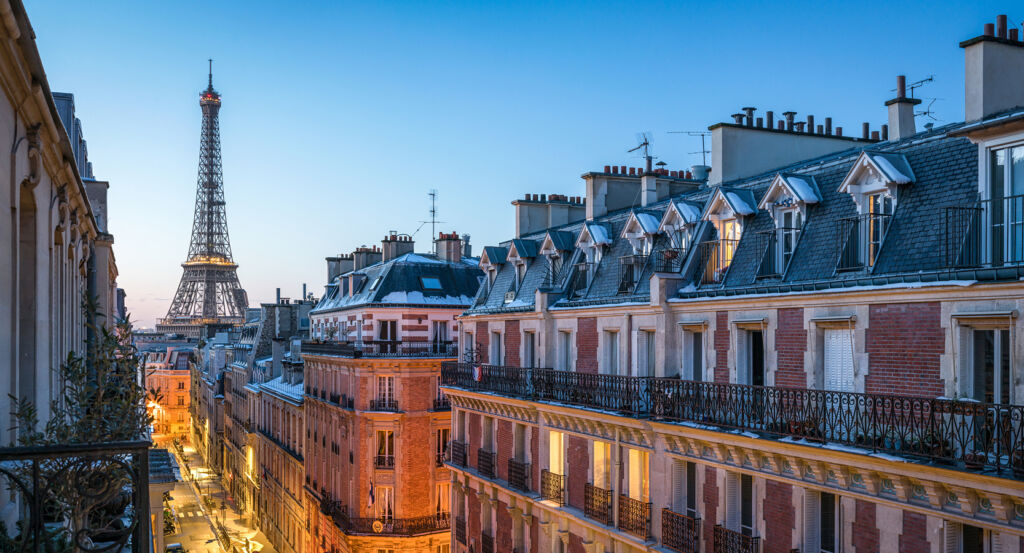
Set along Rue Cognacq-Jay near Avenue Rapp and just steps from Quai d'Orsay, the hotel occupies a quiet Gros-Caillou street where residential blocks extend between the Seine, the Invalides district and the expansive avenues surrounding Champ de Mars. The eight-level building retains the disciplined horizontal windows and pale masonry composition of its midcentury office origins, preserving a markedly different architectural profile from the older apartment houses nearby. Dark woods, patterned stone, metallic detailing and sculptural objects reshape those commercial volumes through interiors developed during the property's conversion to hospitality. A rooftop level crowns the compact structure behind the established street elevation, introducing another architectural layer to a building originally conceived for corporate use. The result is a hotel whose transition from postwar offices to independently conceived hospitality created an unusually layered architectural address within western Paris.
What defines The One Alma Paris.
The One Alma Paris is best known for transforming a midcentury Air Liquide office building into Hôtel Juliana before a 2025 acquisition carried the property into H10 Hotels' highest-tier urban brand. Architect Jean Démaret designed the original building after Air Liquide sought permission in July 1955 to expand its adjoining headquarters onto 10-12 Rue Cognacq-Jay. The completed structure adopted the functional geometry of the Modern Movement and spent subsequent decades connected with the industrial group whose operations already occupied the neighboring property. Conversion work during 2014 preserved the building's external appearance as its commercial interiors were reconstructed for hospitality and a seventh-floor roof terrace was added above the former offices. Hôtel Juliana opened in 2015, establishing the first hotel chapter at an address whose earlier function had been entirely corporate. A family-controlled ownership structure governed Juliana through its first decade, with Éric Cleton assuming the presidency of its operating company in 2017. H10 Hotels acquired the property in May 2025 in a transaction valued at €40 million, marking the Barcelona-based company's entry into Paris. The acquisition also extended The One, H10's luxury urban marque launched with The One Barcelona in 2017 and expanded to Lisbon through The One Palácio da Anunciada two years later. Juliana became The One Alma Paris after the transaction, placing Paris beside Barcelona and Lisbon within the brand. HOTELGEST 10 succeeded Cleton in the operating company that July, with Jordi Espelt Manrique and Marta Espelt Manrique entering its administration as H10 integrated the property. The One Alma Paris compresses three distinct architectural and hospitality periods into one Rue Cognacq-Jay building: Air Liquide's postwar expansion, the 2014-2015 independent hotel conversion and H10's 2025 entry into Parisian luxury hospitality.
How The One Alma Paris fits.
The One Alma Paris works as an anchor for an outing connecting the subterranean engineering that modernized nineteenth-century Paris, an expatriate congregation whose permanent church united French and American craftsmanship and a Franco-American monument transformed by public memory after the death of Diana, Princess of Wales.
Begin at Musée des Égouts de Paris, whose institutional ancestry reaches the public sewer tours inaugurated during the 1867 Exposition Universelle after Eugène Belgrand reshaped Parisian water and sanitation infrastructure under Napoleon III and Baron Haussmann. Early expeditions carried participants through underground collectors aboard boats and later wagon-vannes, turning municipal engineering into a celebrated demonstration of the rebuilt capital. A permanent museum emerged at the Alma works in 1975, embedding the institution inside the functioning network. Its 2021 reconstruction followed a three-year closure and retained direct access to infrastructure including the Avenue Bosquet collector and the Rue Cognacq-Jay sewer. Continue to American Church in Paris, descended from the congregation American Protestants established in 1814 and recognized formally by Napoleon III in 1858. The congregation acquired its Quai d'Orsay site in 1925 and began construction the following year under architects Carrol Greenough and Cram and Ferguson. A steel frame supported the Gothic-inspired church, tower and presbytery completed in 1931, combining modern structural engineering with carved stone. Two Louis Comfort Tiffany windows created for the congregation's earlier church in 1889 were transferred into the new building in 1928, carrying nineteenth-century American decorative art into the permanent riverside sanctuary. Conclude at Flamme de la Liberté, created as a full-scale gilded replica of the Statue of Liberty's flame after French craftspeople participated in the monument's 1980s restoration in New York. The International Herald Tribune supported the project during its centennial, and donations financed the $400,000 work before Jacques Chirac inaugurated it in 1989. Its meaning changed profoundly after Diana, Princess of Wales died beneath Place de l'Alma in 1997 and mourners spontaneously converted the monument into a memorial covered with flowers, photographs and messages. Paris formalized that association in 2019 by naming the surrounding site Place Diana. The progression moves from Second Empire engineering exposed beneath the capital through an expatriate institution joining American decorative craft with Parisian architecture and culminates in a diplomatic monument whose meaning was permanently rewritten through collective commemoration.
Where your story begins.
Foresyte Travel reveals places that feel extraordinary long before you arrive.
Enjoy editorial crafted for luxury travelers.














































































































