Why The Westin Cape Town matters.
The Westin Cape Town is a luxury convention hotel where Foreshore's reclaimed waterfront geography meets post-apartheid commercial redevelopment, international hospitality, and Cape Town's emergence as a major African conference destination.
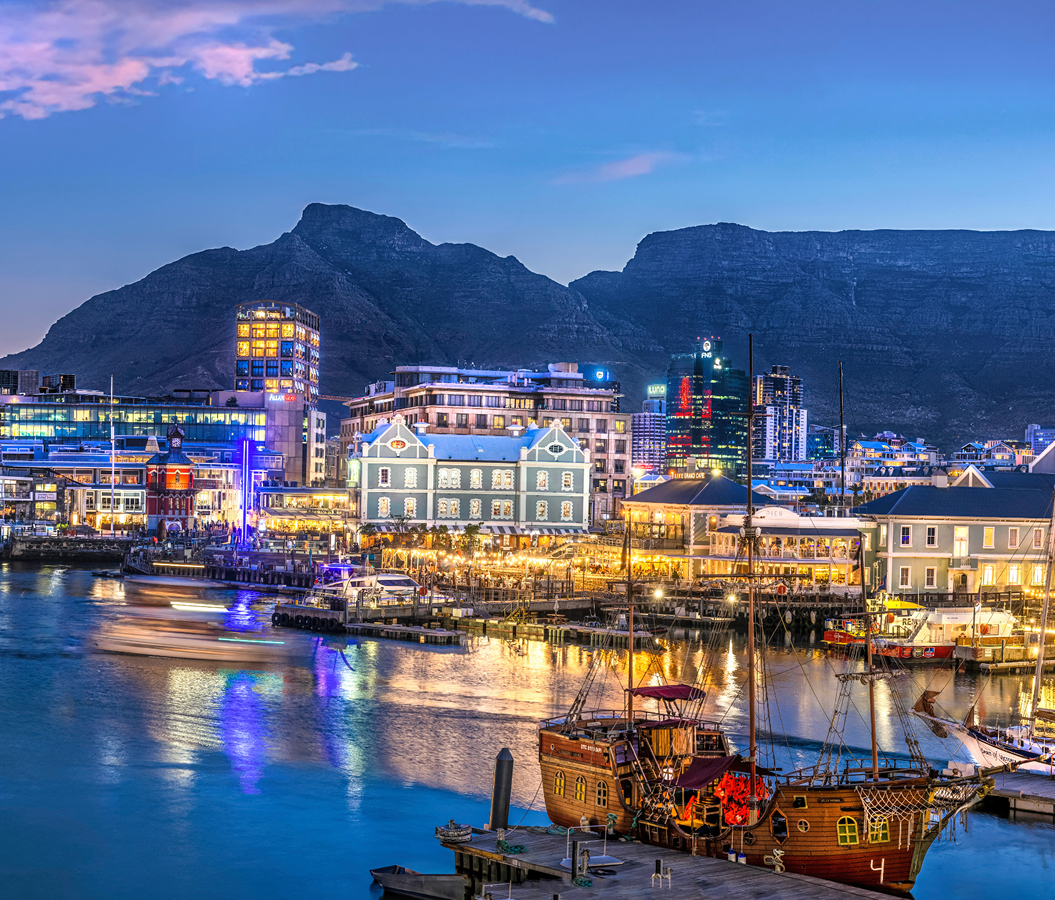
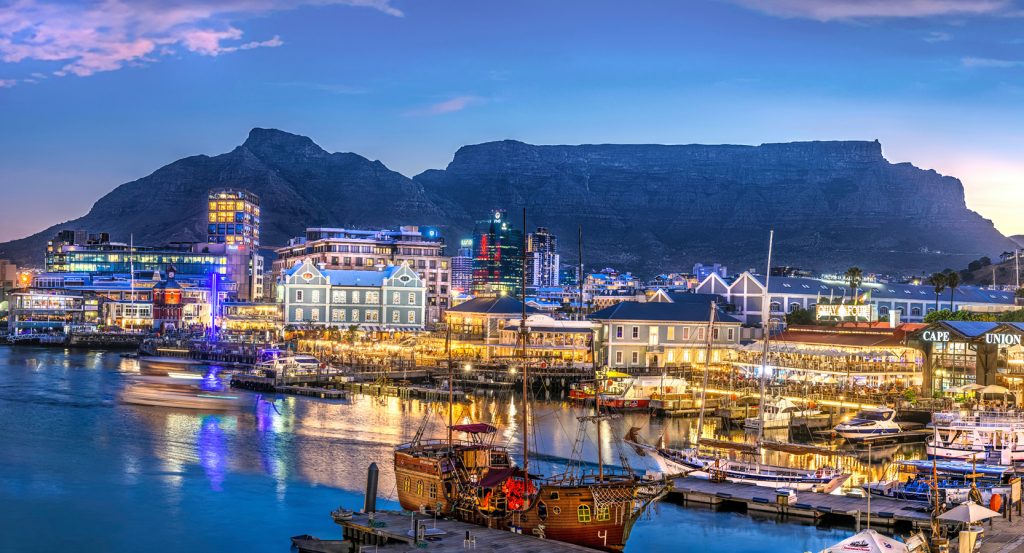
Standing beside Convention Square near the northern end of Lower Long Street, the hotel occupies the corridor between Cape Town's central business district and the harbour, with Table Mountain rising above the historic city to the south. Its contemporary glass tower overlooks the Roggebaai Canal, whose landscaped banks and pedestrian crossings distinguish this section of the waterfront from the surrounding commercial streets. The principal entrance leads into a spacious lobby with extensive glazing, polished architectural finishes, and direct access to the adjoining conference complex. An upper-floor wellness facility provides a second encounter with the setting through an indoor swimming pool and panoramic views extending across Table Bay, the harbour, and the mountain slopes. The result is a metropolitan hotel whose waterfront architecture and elevated public spaces place Cape Town's distinctive geography at the center of an international business hospitality development.
What defines The Westin Cape Town.
The Westin Cape Town is best known for its origins as the ArabellaSheraton Grand Hotel, a major investment conceived alongside the Cape Town International Convention Centre during South Africa's expansion into international business tourism after apartheid. The development occupied part of the Foreshore, an extensive area of reclaimed land created during the twentieth-century expansion of Cape Town's harbour. For decades, the district remained dominated by transport infrastructure, commercial buildings, and vacant development sites separating the historic city from the waterfront. The establishment of the convention centre created an opportunity to reorganize this territory around international meetings, hospitality, and pedestrian public spaces. In May 2001, the ArabellaSheraton Group emerged as the preferred developer and operator of a proposed R380 million hotel adjoining the conference complex. Ian Douglas, chief executive of the Cape Town International Convention Centre Company, coordinated the development arrangements through Convenco, the organization responsible for delivering the convention centre. The hotel was conceived as an integral component of the larger project, providing international accommodation within a conference development intended to strengthen Cape Town's position in the global meetings industry. Architectural planning placed both principal entrances around Convention Square, with the Roggebaai Canal providing a landscaped connection between the buildings. The original hotel opened on August 1, 2003, shortly after President Thabo Mbeki formally inaugurated the adjoining convention centre on June 28. Arabella South Africa Holding, led by chief executive Stefan Braun, also relocated its corporate headquarters into the building, making the development an operational center for the hospitality organization. The opening introduced a major Sheraton-affiliated luxury property into a district undergoing substantial commercial reinvestment. Its early reservation program demonstrated the importance of conference business to the undertaking, with more than 69,000 bookings secured before the opening. A second chapter began in 2007 when the property underwent a R25 million conversion from ArabellaSheraton Grand Hotel to the Westin brand. General manager Heinz Grub directed the transition, which incorporated revised lighting, accommodation furnishings, and the brand's established wellness program. The conversion aligned the property with Westin's international emphasis on restorative accommodation and health-oriented hospitality. Its development links two periods of investment: the original creation of a major convention hotel during South Africa's democratic transition and the subsequent incorporation of that property into Westin's international operating system.
How The Westin Cape Town fits.
The Westin Cape Town works as the starting point for a walk from the Foreshore into the historic city, connecting the transformation of apartheid-era cultural institutions with the preservation of colonial architecture and the memory of forced removals under racial segregation.
Begin at Artscape Theatre Centre, reached by walking east along the Foreshore toward the performing arts complex beside the city's principal transport corridors. The institution opened on May 19, 1971, as the Nico Malan Theatre Centre, named for the former administrator of the Cape Province during apartheid. The Cape Performing Arts Board managed its original program through permanent companies devoted to opera, ballet, orchestral music, and drama. Its construction brought a major publicly funded performance institution into the city, although the opening took place within the racially segregated cultural system of the period. South Africa's democratic transition brought fundamental changes to the administration of performing arts organizations, culminating in Artscape's public launch on March 27, 1999. The institution subsequently expanded its educational and community programming, establishing a broader role within the Western Cape's performing arts sector. Continue southeast toward the Castle of Good Hope, the five-bastioned fortress constructed by the Dutch East India Company during the establishment of its Cape settlement. Construction began in 1666 under Commander Zacharias Wagenaer and concluded in 1679, replacing an earlier fortification built after Jan van Riebeeck's arrival in 1652. Its pentagonal plan incorporated bastions named Leerdam, Buuren, Katzenellenbogen, Nassau, and Oranje, providing defensive positions overlooking the original shoreline. The fortress contained administrative offices, military quarters, workshops, and prison facilities, becoming a principal center of colonial government. Its surviving architecture preserves evidence of the military and administrative structures through which Dutch colonial authority operated at the Cape. Conclude by continuing south toward the District Six Museum, where the destruction of a historic residential neighborhood became the foundation of an institution devoted to memory and restitution. District Six developed during the nineteenth century as a community of freed enslaved people, artisans, merchants, and immigrant families living near the commercial center. The apartheid government declared the district a whites-only area under the Group Areas Act on February 11, 1966, initiating the forced removal of more than 60,000 residents. Large sections of the neighborhood were demolished, leaving extensive vacant land where streets, homes, schools, and businesses had stood. Former residents and community organizations established the museum in 1994 within a former Methodist church, preserving photographs, street signs, personal possessions, and oral histories. Its floor map reconstructs the neighborhood's former street network, with displaced residents contributing names and memories to the exhibition. The progression moves from the democratic transformation of a state-funded cultural institution through the surviving architecture of Dutch colonial government and culminates in District Six Museum's preservation of a community destroyed by apartheid, tracing successive struggles over public space, cultural participation, and historical memory in Cape Town.
Where your story begins.
Foresyte Travel reveals places that feel extraordinary long before you arrive.
Enjoy editorial crafted for luxury travelers.