
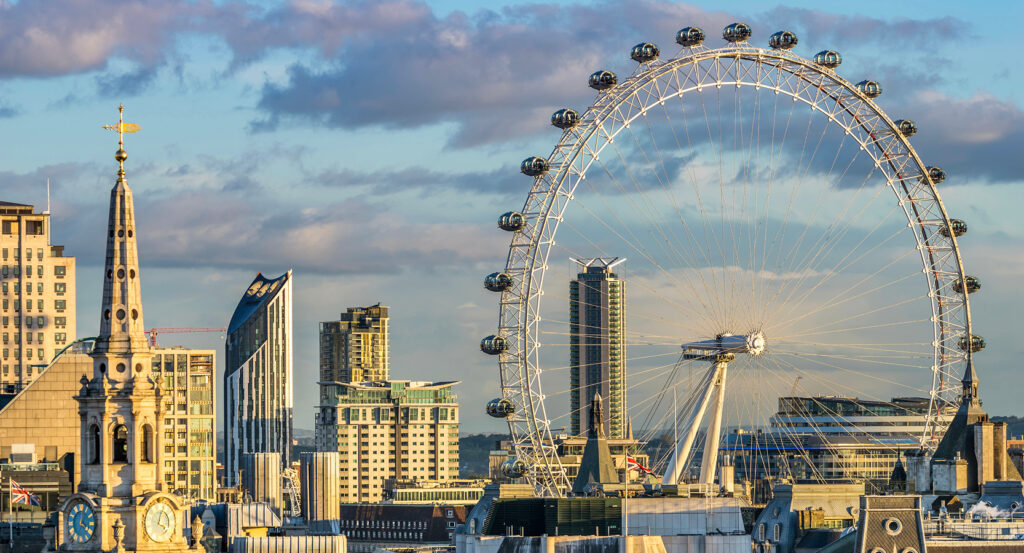
Why you should experience Thistle London Trafalgar Square in London, England.
Thistle London Trafalgar Square is a discreet hotel where Trafalgar Square's artistic prestige, West End theatricality, ceremonial grandeur and relentless cultural energy converge on a remarkably quiet side street between London's great stages and galleries.
Set along Whitcomb Street near Orange Street and just steps from the National Gallery, the hotel occupies an unusually sheltered position behind the grand public spaces linking Trafalgar Square with Leicester Square, Piccadilly Circus and the West End. The building's compact urban footprint turns inward from that metropolitan intensity, while its upper levels rise above the surrounding streetscape toward a district shaped by John Nash's nineteenth-century vision for a great public route between Charing Cross and Portland Place. Contemporary interiors carry a restrained palette through the guestrooms and public spaces, while the terrace creates an open-air counterpoint to the tightly packed streets immediately beyond Whitcomb Street. The result is a hotel whose quiet setting and intensely connected position create an unusual sense of retreat within one of London's densest concentrations of art, theater and civic performance.
What you should know about Thistle London Trafalgar Square.
Thistle London Trafalgar Square is best known for operating a 108-room hotel immediately between Trafalgar Square and Leicester Square, an address previously marketed as The Royal Trafalgar and Royal Trafalgar by Thistle before assuming its current identity. The accommodation collection progresses from 15-square-meter Standard Double and Standard Twin rooms to 24-square-meter Deluxe King, Deluxe Twin and Executive King categories, with the Executive King adding a sofa bed for three occupants. Junior Suites expand to 32 square meters with a king bed, separate lounge area and sofa bed, creating the largest currently published configuration within the property's room hierarchy. That progression from 15 to 32 square meters allows the relatively compact 108-key property to support distinctly different spatial formats within a building positioned on one of the most constrained blocks between the West End's major public squares.
Squares Restaurant develops the property's social character through a dining room and bar focused on contemporary British and European cooking, with seasonal dishes carrying the hotel from breakfast into pre-theater dining and evening drinks. The restaurant can also be converted for private gatherings, extending its role beyond daily service through dedicated catering, lighting and event configurations. An outdoor terrace moves part of that dining experience onto Whitcomb Street, creating an open-air space within the narrow urban seam separating the crowds of Leicester Square from Trafalgar Square. Together, the 108-room scale, unusually broad room-size progression and Squares Restaurant establish Thistle London Trafalgar Square as a compact West End hotel whose character derives primarily from the extraordinary cultural geography compressed around its Whitcomb Street address.
How to fold Thistle London Trafalgar Square into your trip.
Thistle London Trafalgar Square works as the anchor for an afternoon tracing national painting, British portraiture and the architectural creation of Trafalgar Square through the institutions immediately surrounding Whitcomb Street.
Begin at National Gallery, whose collection originated when Parliament paid £57,000 for banker John Julius Angerstein's 38 paintings in 1824 before commissioning a permanent Trafalgar Square building that opened in 1838; the museum expanded with the Sainsbury Wing, opened by Queen Elizabeth II on July 9, 1991, before Selldorf Architects and Purcell reworked that wing as the gallery's principal entrance for its May 2025 reopening. Continue to National Portrait Gallery, founded in 1856 around the then-rebellious principle of collecting portraits according to the historical significance of their subjects, an institution whose holdings have grown beyond 215,000 portraits spanning British history and contemporary culture. Conclude at Trafalgar Square, officially named in 1830 before Sir Charles Barry developed its architectural plan, William Railton's Nelson's Column rose in 1843, the fountains arrived in 1845 and Edwin Landseer's four bronze lions joined the composition in 1867. The progression moves from Angerstein's foundational collection through Britain's immense archive of portraiture into the nineteenth-century square that physically united these cultural institutions, revealing the concentration of art, national memory and architectural ambition surrounding Thistle London Trafalgar Square.
Where your story begins.
Foresyte Travel reveals places that feel extraordinary long before you arrive.
Experience premium editorial crafted for luxury travelers.














































































































