
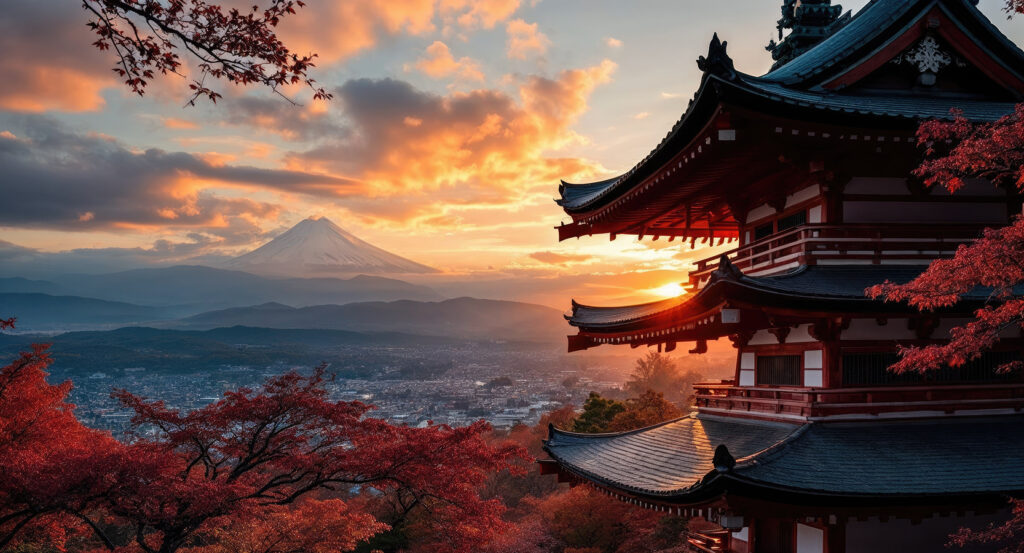
Why you should experience Gojūnotō in Kyoto, Japan.
Gojūnotō (Five Story Pagoda) at Tō-ji Temple is Kyoto's vertical prayer, a wooden flame rising from earth toward the infinite.
Its tiers, perfectly balanced, pierce the sky like a hymn made visible. Standing 55 meters tall, it commands the city's southern horizon, yet radiates stillness. The pagoda's cypress bark rooflines curve gently outward, each layer lighter than the last, as though the structure itself is learning to let go of gravity. When sunlight touches the wood, it glows with a quiet warmth, aging into the same deep amber as temple incense. The reflection in the pond below transforms it from architecture into meditation, earth mirrored as heaven. To stand before it is to feel the pulse of Kyoto's spiritual symmetry: order. The pagoda doesn't reach upward to defy nature. It rises to join it.
What you should know about Gojūnotō.
The pagoda's history mirrors Kyoto's own, burned, rebuilt, and reborn across centuries, yet always standing as a symbol of endurance.
The current structure was completed in 1644 under the patronage of Tokugawa Iemitsu, the third shogun of the Tokugawa dynasty. Its five tiers represent the five cosmic elements central to Buddhist thought: chi (earth), sui (water), ka (fire), fū (wind), and kū (void). These form the foundation of Shingon cosmology, the physical and spiritual dimensions of existence. Inside, a central pillar known as the shinbashira anchors the pagoda, symbolizing the axis between heaven and earth. Around it, four Buddha statues gaze outward in cardinal directions, embodying wisdom extending to all realms. The interior paintings, rarely open to the public, depict celestial deities in swirling gold and vermilion, remnants of a vision once meant to envelop the senses in transcendence. Few realize that the pagoda's structural design has kept it standing through countless earthquakes. Its wooden joints, built without nails, flex with movement, transforming fragility into resilience. The pagoda is not only a monument of faith but a masterpiece of engineering, the spiritual and practical intertwined in perfect rhythm. Its spire, topped with a bronze finial shaped like a lotus and flame, represents enlightenment, the moment where form dissolves into formlessness.
How to fold Gojūnotō into your trip.
To experience Gojūnotō fully, you must slow your pace to match its stillness.
Enter Tō-ji Temple through the South Gate and follow the gravel path until the pagoda appears through the trees, tall, graceful, inevitable. Walk the perimeter first; from each angle, the structure reveals a new proportion of light and shade. Visit in early morning when the air is cool and the wooden tiers glow softly in gold, or at twilight when the last light ignites the bronze spire like a candle flame. The surrounding pond offers the perfect vantage point for reflection, literally and spiritually, especially in spring when cherry blossoms frame the tower, or in autumn when red leaves ripple across its mirrored image. On rare occasions when the interior is open to visitors, step inside and breathe in the scent of cedar and centuries. The silence feels weightless, anchored only by the heartbeat of the earth beneath your feet. Before leaving, stand once more at a distance and look up: the pagoda aligns perfectly with the sky, its peak vanishing into blue. It is not a structure built to be admired. It is a path built to be ascended, one that leads not upward, but inward.
Where your story begins.
Foresyte Travel reveals places that feel extraordinary long before you arrive.
Experience premium editorial crafted for luxury travelers.

















































































































