
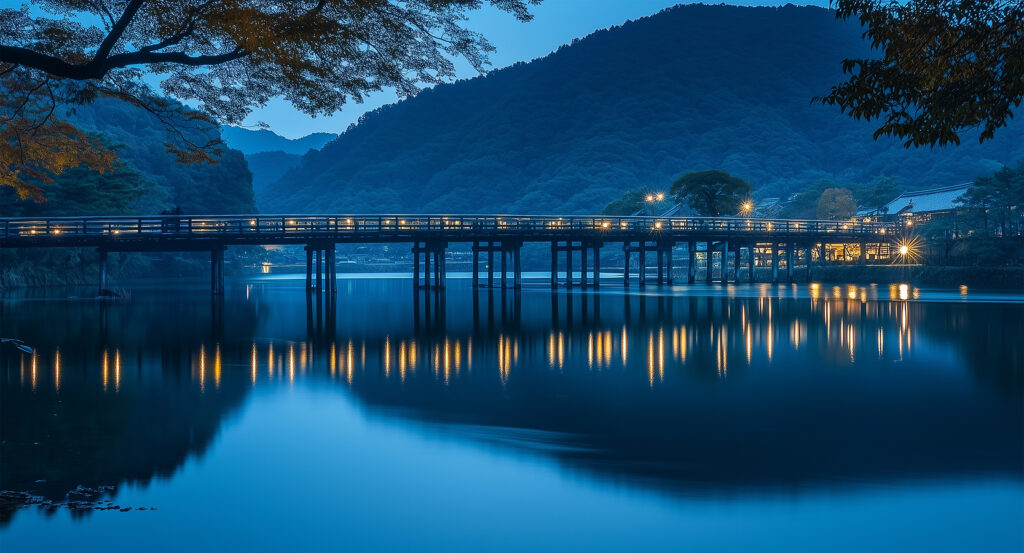
Why you should experience Arashiyama Park Viewpoint in Kyoto, Japan.
Arashiyama Park Viewpoint is Kyoto's stillness in elevation, a natural observatory where the mountains, river, and city converge in one vast, breathing panorama.
Tucked into the slopes above Togetsukyo Bridge, this quiet rise rewards those who move slowly. A winding path leads through maple groves and bamboo clusters, the sound of the river fading beneath a chorus of rustling leaves. At the summit clearing, the world opens. Below you, the Katsura River arcs gently through Arashiyama's valley, its surface shifting from silver to green with the light. The bridge stretches across like a brushstroke, its wooden deck connecting history to horizon. Around it, the village stirs, temple roofs glinting between trees, boats drifting lazily, and mountains rolling away in soft blue layers. There is no performance here, only serenity, a perfect balance between perspective and peace.
What you should know about Arashiyama Park Viewpoint.
The viewpoint belongs to Arashiyama Park, which spans both banks of the Katsura River and was formally established in 1887, among Japan's earliest public landscapes preserved for scenic beauty.
The park was designed in the spirit of meisho-zukuri, or “place-making through poetry,” transforming an already beloved vista into a space of shared reflection. The viewpoint itself occupies a natural terrace once favored by nobles of the Heian court, who came here to view the moon and compose verses overlooking the river. Its pathways follow the gentle contours of the slope rather than cutting through them, an early example of ecological design long before the term existed. The stone steps and retaining walls were hand-laid in the Meiji era using local granite, their irregular patterns allowing moss and ferns to take hold naturally over time. Few visitors realize that the trees framing the summit clearing, cherry, maple, pine, and camellia, were selected to ensure year-round variation of color and texture. The view changes: cherry blossoms in spring, deep greens in summer, fiery canopies in autumn, and snow-dusted silence in winter. Even the wooden railing at the top was crafted to align perfectly with the sightline to Togetsukyo Bridge, allowing photographers and poets alike to capture the same timeless perspective. The park remains one of Kyoto's quiet triumphs, a place where design and landscape have merged so seamlessly that the human touch disappears.
How to fold Arashiyama Park Viewpoint into your trip.
Visiting Arashiyama Park Viewpoint is a meditation disguised as a short walk.
Begin from the north end of Togetsukyo Bridge and follow the gently rising path into the park. The climb takes only ten minutes, but each turn offers a new composition, the river flashing between trunks, the bridge framed by low branches, the distant hum of Kyoto softening with every step. Visit in the early morning when the air is cool and the light slides slowly down the hillsides, or at sunset when the entire valley glows in amber reflection. Bring no agenda, just pause when the world opens around you. Sit on one of the stone benches at the summit, and listen: the river's voice below, the wind threading through cedar leaves, the faint ring of a temple bell carried from across the water. If you visit in spring, cherry petals drift through the air like confetti; in autumn, the ground glows red with fallen maples. As dusk settles, the lamps along the riverside begin to shimmer faintly, and the bridge lights up in quiet response. Before descending, look once more toward the western sky, the last sunlight melting over Kyoto's edge. The view doesn't just show the city; it explains it. Arashiyama teaches you what Kyoto means when it breathes.
Where your story begins.
Foresyte Travel reveals places that feel extraordinary long before you arrive.
Experience premium editorial crafted for luxury travelers.

















































































































