
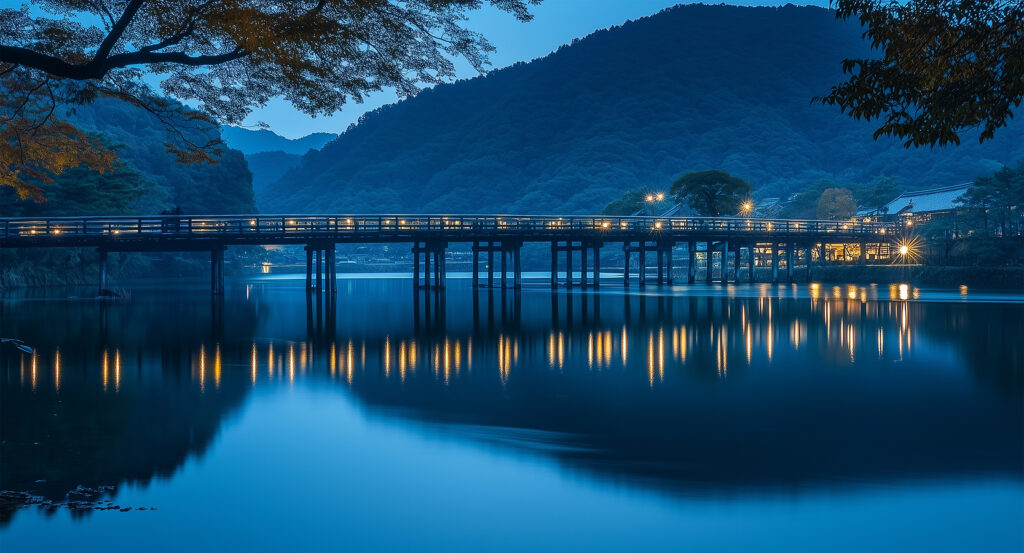
Why you should experience Arashiyama Park Nakanoshima Area in Kyoto, Japan.
Arashiyama Park Nakanoshima Area is Kyoto's breath between water and sky, a living corridor of calm where the Katsura River mirrors the rhythm of the mountains beyond.
Stretching along both sides of Togetsukyo Bridge, it's a path that invites wandering. In the morning, mist curls off the surface of the water like smoke from an ancient incense burner; by afternoon, sunlight scatters across the ripples in sheets of gold. The soundscape is quiet but textured, the rustle of bamboo leaves, the low murmur of current against stone, the laughter of families feeding koi from the shore. Walk slowly, and Arashiyama reveals its layers: temple rooftops peeking through pines, the glint of traditional wooden boats, and the faint chime of bells carried from distant hills. Every step feels composed, not by design, but by nature's patient rhythm. This is Kyoto.
What you should know about Arashiyama Park Nakanoshima Area.
The promenade traces the same riverbanks that poets and nobles of the Heian court once strolled more than a millennium ago.
Arashiyama, meaning “Storm Mountain,” has long been a place of retreat and renewal, celebrated in waka poetry for its “flowing moonlight” and “whispering maples.” The promenade as it exists today was developed in the early 20th century, blending scenic preservation with subtle modern landscaping. Its design follows the principle of shakkei, “borrowed scenery”, drawing the mountain's reflection into the experience of the path itself. The retaining walls along the banks are constructed from local stone, layered in irregular patterns to echo the movement of the river. Wooden benches and low lanterns were added in the postwar years, designed to blend invisibly into the landscape. Few visitors realize that the river's gentle pace is the result of centuries of quiet engineering, a system of locks and diversions originally created to feed the Katsura irrigation network, still maintained today to preserve the promenade's tranquility. In spring, cherry trees along the northern bank bloom in cascading arcs, creating natural tunnels of pink and white; in autumn, the hills blaze in scarlet and amber. Each season reshapes the view, the same path, endlessly reborn. The promenade is not an attraction; it's an act of continuity, a thread connecting all who have walked it across time.
How to fold Arashiyama Park Nakanoshima Area into your trip.
To walk Arashiyama Park Nakanoshima Area is to experience Kyoto in its most natural rhythm, slow, contemplative, and awake.
Begin near Togetsukyo Bridge, where the river widens into soft reflection. Follow the path westward toward the foot of Arashiyama Park, passing small boats tied loosely to wooden posts and herons standing motionless in the shallows. Visit in early morning when the mountains glow pale green and the air carries the scent of wet cedar. Pause along the way, sit on the stone ledges and watch the river flow beneath the bridge's shadow. In summer, you'll hear the soft call of cormorant fishermen downstream; in winter, the snow settles quietly on the handrails, turning the world monochrome. Continue north toward the bamboo groves or east toward the temples of Sagano, both directions flow naturally from the path, like tributaries of the same experience. If you visit near sunset, stay until the sky turns rose and violet; the reflection of the mountains will seem to dissolve into water. The promenade offers no endpoint, only return, a circular journey where each step feels familiar, and every moment, fleetingly eternal.
Where your story begins.
Foresyte Travel reveals places that feel extraordinary long before you arrive.
Experience premium editorial crafted for luxury travelers.

















































































































