
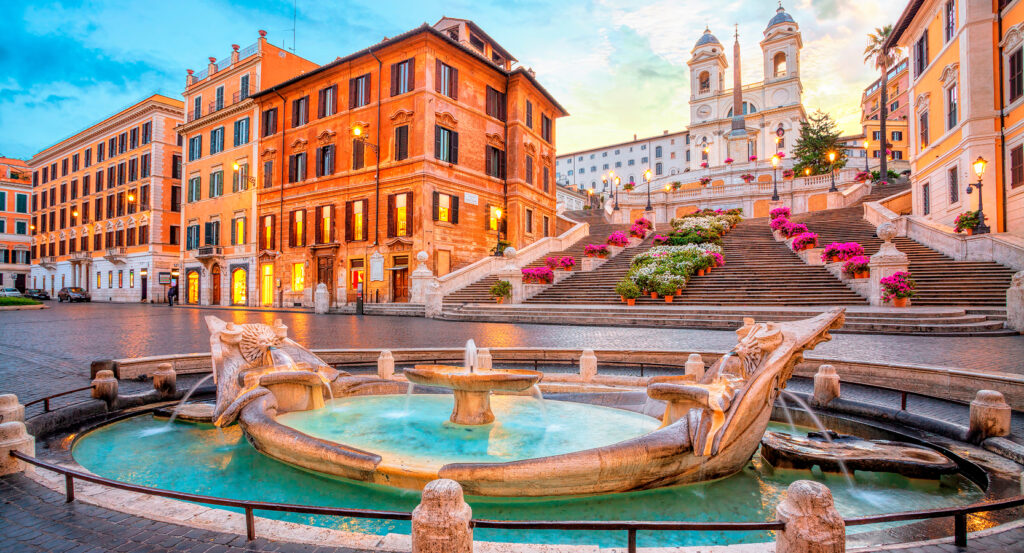
Why you should experience Trinita dei Monti Staircase in Rome, Italy.
The staircase rising to Trinità dei Monti is not simply steps, it's a breath drawn between heaven and earth, a slow crescendo in stone.
Likely better known as the Spanish Steps (Scalinata di Trinità dei Monti), this stairway connects Piazza di Spagna below to the church of Trinità dei Monti above, folding the city's social, political, and spiritual life into one architectural gesture. Composed of 135 travertine steps and punctuated by terraces, ledges, and small landing retreats, the stairway draws you upward in measured rhythm. From the base, the sweep is theatrical, a flaring amphitheater in stone that becomes progressively intimate as you climb. The steps whisper to you of centuries: flirtations, duels, pilgrim passages, poets pausing on a landing. The folds of stone shape your momentum, they slow your pace, coax your senses to track the city ascending ahead of you, the church above framed by sky.
What you should know about Trinita dei Monti Staircase.
Beneath its familiarity lies a rebellious heart: the staircase was conceived not as civic utility, but as symbolic diplomacy, a grand link between Spain, France, and the Papacy.
Early in the 17th century Pope Gregory XIII dreamed of a stair to complete the façade of the French-supported church above, but political turbulence delayed its birth. In 1723, a French diplomat, Étienne Gueffier, bequeathed funds that revived the project under the eyes of Papal Rome, the steps would solidify a visual alliance between the Spanish Embassy in the piazza and the French church above. Francesco de Sanctis (with inputs from Alessandro Specchi) designed the stairway between 1723 and 1725, striking a balance of grand gesture and human scale. De Sanctis' original vision included shaded tree lines and fountains that never fully made it into construction, hints of an even more theatrical ascent. Each terrace and niche was intentional, a pause, a frame, a moment to reflect both the climb and the city below.
How to fold Trinita dei Monti Staircase into your trip.
Begin in Piazza di Spagna just before dawn, when the cobbles are cool and the steps await your ascent.
Approach from Via dei Condotti so the staircase unfurls before you like a stage curtain. Climb slowly, letting each terrace pause you, rest at each landing, look back, let the city spread beneath your feet. At mid-level, glance at the façades, the quiet courtyards to the side, these passages once echoed with carriages, conversations, and poetry. As you near the top, the church of Trinità dei Monti and its twin bell towers begin to frame your sky; time your arrival so that the first light spills across the façade, gilding every cornice. From the summit, linger on the balustrade and let Rome stretch before you, rooftops, narrow calle, domes, the distant Tiber, a panorama earned step by step. Then descend via the opposite side or linger in the piazza below for coffee at Babington's, letting the steps unwind behind you like memory in reverse.
Where your story begins.
Foresyte Travel reveals places that feel extraordinary long before you arrive.
Experience premium editorial crafted for luxury travelers.




















































































































