
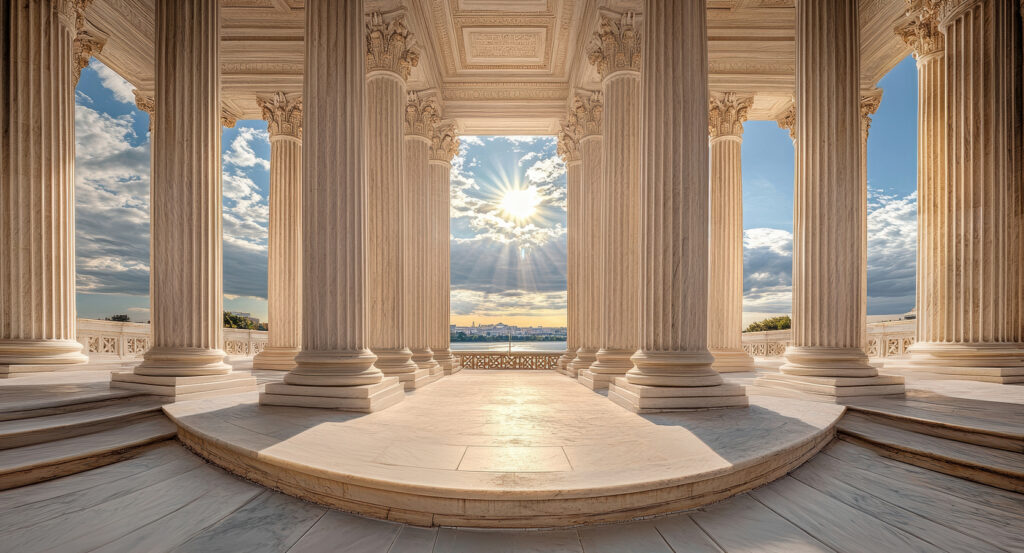
Why Supreme Court of the United States matters.
Supreme Court of the United States, standing just east of United States Capitol in Washington, D.C., is more than a marble temple to the law, it's a monument to the ideals that define the nation itself.
From its grand Corinthian columns to its stately bronze doors, the Court radiates an austere majesty that captures the gravity of justice and the balance of democracy. Designed by architect Cass Gilbert and completed in 1935, it's both a place of silence and thunder, where arguments echo in the courtroom beneath friezes depicting Moses, Confucius, and Hammurabi, and where decisions have reshaped the course of American life. Visitors arriving at the steps often pause, awed by the building's sheer presence, a reminder that law, for all its complexity, ultimately serves the human pursuit of fairness. Inside, the atmosphere hums with reverence; every detail, from the mahogany benches to the intricate marble carvings, reinforces a sense of permanence. This isn't just a building, it's the living conscience of the republic, where words become precedent and ideas become law.
What defines Supreme Court of the United States.
The Supreme Court's physical home may appear eternal, but its history is one of movement, growth, and evolving identity.
For 150 years, the Court had no building of its own, it met in various chambers, including the basement of the Capitol, until Chief Justice William Howard Taft championed the idea of constructing a permanent home worthy of the institution's stature. Gilbert's neoclassical design symbolized judicial independence, intentionally positioned apart from both the legislative and executive branches, yet close enough to remind visitors of their interdependence. The phrase engraved above the entrance, “Equal Justice Under Law,” became more than a motto; it's the moral compass of the American judiciary. Inside, the Courtroom itself is lined with Italian marble and crowned by a coffered ceiling that amplifies every word spoken during oral arguments. The building also houses Supreme Court Library, with more than half a million volumes, and the Justices' private conference room, the heart of deliberation where landmark cases are decided in absolute confidentiality. Few realize that each Justice's chair is assigned by seniority and that before sessions begin, the Justices shake hands, a tradition reinforcing collegiality even amid dissent. Beyond its walls, the Court's history is written in the names of its cases, Brown v. Board of Education, Roe v. Wade, Obergefell v. Hodges, moments where principle met progress. Even the surrounding grounds reflect symbolic care: two marble figures, the Contemplation of Justice and the Guardian of Law, stand watch, embodying the tension between reason and enforcement that defines the American legal spirit.
How Supreme Court of the United States fits.
Visiting Supreme Court of the United States offers a glimpse into the soul of American governance, a chance to step inside one of the nation's most sacred institutions.
Start the visit early, ideally on a weekday when the Court is in session. Free admission and public lectures are offered on non-argument days, where trained docents explain the history, architecture, and inner workings of the Courtroom. If you're visiting during oral arguments (typically October through April), arrive by dawn, seating is limited, and watching the Justices question attorneys in real time is a rare privilege that few forget. The building's interior tour leads you through the Great Hall, lined with busts of former Chief Justices, and into the marble corridors where portraits and historical artifacts trace the evolution of the Court's authority. Don't miss the lower-level exhibition galleries, which feature rotating displays about landmark rulings and judicial milestones. Afterward, step outside to the Court's broad steps for a view back toward the Capitol dome, a visual discussion between the branches of power. Across the street, the Library of Congress and U.S. Capitol Visitor Center deepen the experience, offering complementary insights into the nation's legislative and cultural structure. Plan an hour or two for your visit, and remember that respectful decorum is expected throughout. Whether you come to witness a session, explore the art and architecture, or simply stand where history has unfolded for nearly a century, Supreme Court of the United States invites reflection on the enduring promise of justice, a promise that, like the marble it's built from, is meant to stand the test of time.
Where your story begins.
Foresyte Travel reveals places that feel extraordinary long before you arrive.
Enjoy editorial crafted for luxury travelers.
Foresyte may earn a commission when you book.







































































































