Why Vinkeles matters.
Vinkeles is a two-MICHELIN-starred fine-dining restaurant where Grachtengordel's seventeenth-century canal heritage meets Amsterdam's theatrical past, the charitable traditions of its Catholic community and Jurgen van der Zalm's accomplished interpretation of modern French gastronomy.
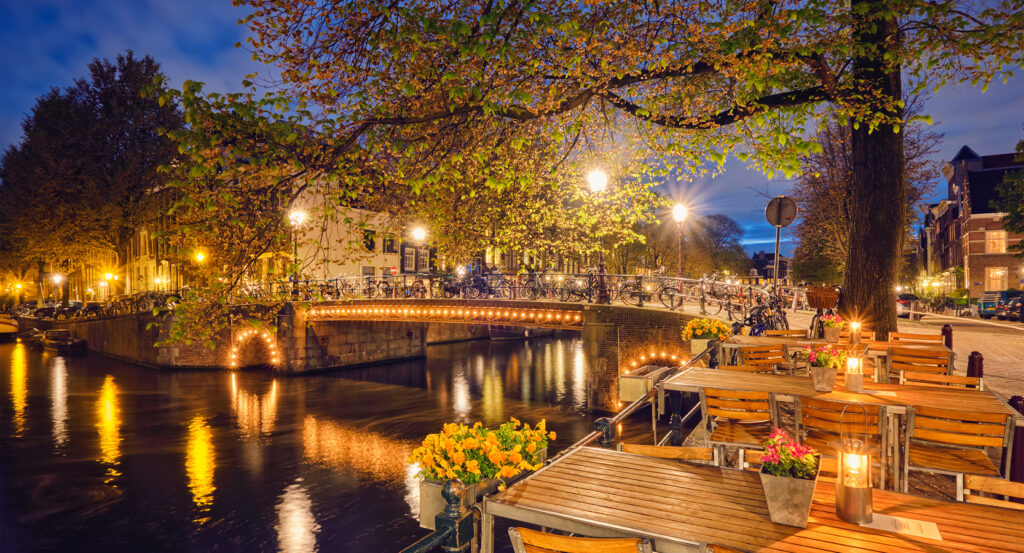
Set along Keizersgracht near the Huidenstraat crossing and a short walk from the Nine Streets shopping district, the restaurant occupies a secluded position within The Dylan Amsterdam, between the canal's expansive merchant houses and the narrow commercial streets connecting Herengracht with Prinsengracht. Its entrance leads through a historic gateway into an intimate hotel courtyard, establishing a quiet transition from the surrounding canal district. The dining room occupies a former eighteenth-century bakery, where exposed timber beams, original masonry and carefully integrated contemporary furnishings preserve the character of the historic interior. Warm lighting, elegantly dressed tables and views toward the enclosed garden create a restrained atmosphere, with a glass-enclosed conservatory providing a complementary setting for private gatherings. The result is an intimate fine-dining destination whose preserved architectural fabric, secluded courtyard and sophisticated contemporary interiors establish an unusually direct connection between Amsterdam's historic institutions and its modern restaurant culture.
What defines Vinkeles.
Vinkeles is best known for transforming a former charitable bakery into one of Amsterdam's leading gastronomic institutions, connecting a remarkable sequence of historical uses with the professional development of two generations of MICHELIN-starred chefs. The property's cultural history began with the establishment of Amsterdam's first permanent municipal theater, designed by Jacob van Campen and inaugurated on January 3, 1638, with Joost van den Vondel's Gysbrecht van Aemstel. The theater became a central institution of Dutch dramatic culture, attracting audiences from different social backgrounds and influencing artists including Rembrandt van Rijn. A substantial reconstruction in 1665 expanded the auditorium, strengthening its position within the city's theatrical life. On May 11, 1772, a fire originating in the theater's lighting destroyed the building and killed eighteen spectators and a firefighter, bringing more than a century of performances to a catastrophic conclusion. The surviving entrance gate preserved Vondel's celebrated inscription comparing the world to a stage, maintaining a physical connection with the property's theatrical origins. In 1773, the Roman Catholic Old and Poor People's Office acquired the site and developed a charitable institution serving Amsterdam's Catholic community. The organization established a bakery in 1787 to produce bread for people receiving assistance, introducing the function that would eventually determine the restaurant's distinctive architectural setting. During restoration work in 1975, the former bakery was rediscovered substantially intact, preserving a significant element of the complex's charitable history. The buildings subsequently entered a new chapter of hospitality development, culminating in their transformation into The Dylan Amsterdam in 1999. Restaurant Vinkeles emerged as the hotel's fine-dining establishment in 2008, taking its name from Reinier Vinkeles, the eighteenth-century Amsterdam draftsman and engraver whose depictions of the city included its historic theatrical institutions. The name connected the restaurant's contemporary purpose with the artistic record of the neighborhood's earlier cultural life. Chef Dennis Kuipers established its initial gastronomic reputation through modern French cooking grounded in classical technique, leading the restaurant to its first MICHELIN star in the 2010 guide. The distinction positioned Vinkeles among Amsterdam's recognized fine-dining establishments and initiated a sustained period of MICHELIN recognition. Kuipers subsequently developed the restaurant's culinary character through increasingly refined preparations, supported by the hotel's commitment to personalized service and an extensive wine program. Jurgen van der Zalm joined the kitchen as an apprentice in 2008, beginning a professional progression that would ultimately reshape the restaurant's leadership. His advancement through the kitchen culminated in the position of chef de cuisine, giving him extensive responsibility for the technical standards and creative development of its menu. When Kuipers departed in August 2022 after sixteen years with the restaurant, Van der Zalm assumed executive leadership and introduced a more personal interpretation of the established culinary program. The transition proved decisive on April 24, 2023, when MICHELIN awarded Vinkeles its second star, recognizing the chef's mastery of classical sauce construction and his creative treatment of premium ingredients. The achievement established Van der Zalm among the Netherlands' leading contemporary chefs and confirmed the restaurant's successful progression through a substantial change in culinary leadership. The expanded recognition also reflected the contributions of maître-sommelier Natasja Noorlander, whose work connected the kitchen's technical ambitions with an equally demanding standard of hospitality. Van der Zalm subsequently developed a kitchen organization supported by chef Bart Kalfsterman, who joined Vinkeles in 2018 and advanced into responsibility for coordinating its principal cooking sections. The restaurant's contemporary wine program came under the direction of head sommelier Jasper van Amerongen, continuing the emphasis on individualized pairings and professional service. Vinkeles' historical significance emerges from this progression through theatrical culture, charitable food production and contemporary gastronomy, culminating in a restaurant whose two MICHELIN stars recognize a distinctive culinary achievement within one of Amsterdam's most historically layered properties.
Jurgen van der Zalm's culinary program develops the technical foundations of classical French gastronomy through concentrated sauces, exceptional ingredients and carefully selected influences from Japanese and other international cooking traditions. His principal strength lies in constructing preparations whose complexity emerges from the relationship between the central ingredient and its accompanying sauce, establishing a coherent structure through stock preparation, reduction and precise control of flavor. The kitchen's treatment of turbot provides a particularly revealing expression of this approach, with the fish glazed in garlic and accompanied by a smoked citrus sauce developed from a substantial fish fumet. The sauce concentrates the marine character of the principal ingredient, introducing smoke and acidity into a preparation whose technical foundation remains recognizably French. Artichoke, mustard seeds and crisp potato contribute contrasting textures, supporting the central relationship between the fish and its deeply developed sauce. This emphasis on classical foundations extends into the kitchen's treatment of shellfish, where lobster à l'Américaine connects a traditional French preparation with ingredients selected for their aromatic complexity. The technique draws upon the established practice of developing a concentrated shellfish sauce from the crustacean's own materials, establishing substantial depth through careful extraction and reduction. Japanese ingredients enter the repertoire through preparations incorporating dashi, miso and fermented soy, contributing savory concentration to sauces constructed through European techniques. Tomasu soy sauce, brewed in the Netherlands, introduces a particularly significant relationship between local production and the Japanese fermentation traditions that have influenced contemporary European gastronomy. Its incorporation alongside yuzu and Japanese wasabi in a sea bream preparation demonstrates the kitchen's interest in balancing the natural sweetness of seafood with acidity, fermentation and aromatic heat. The restaurant's treatment of vegetables follows the same technical discipline, with Jerusalem artichoke and porcini mushrooms developed through concentrated reductions and carefully structured accompaniments. These preparations establish a substantial role for vegetable cookery within the broader repertoire, extending the kitchen's attention to ingredient quality beyond its seafood and meat courses. A dedicated vegetable tasting menu develops this direction through seasonal produce and sauces that draw upon the same professional foundations as the principal signature menu. Van der Zalm's interpretation of poultry contributes another expression of classical technique through Anjou pigeon, whose preparation incorporates the rich flavors traditionally associated with French game cooking. Sour cherry and rose introduce aromatic and acidic contrasts, with carefully selected chocolate contributing additional complexity to the accompanying sauce. The restaurant's pastry program continues this approach through preparations centered on bergamot and lychee, using citrus, floral ingredients and carefully controlled textures to develop desserts of comparable technical precision. Dutch cheeses matured by Amsterdam's Kaaskamer preserve a regional dimension within the concluding stages of the meal, connecting the international culinary repertoire with the country's specialist dairy traditions. The wine program extends the restaurant's technical ambitions through individualized selections developed in consultation with the service team, establishing a close relationship between the structure of the menu and the sequence of accompanying wines. Vinkeles' culinary distinction rests on this sustained mastery of classical sauce construction, with international ingredients contributing depth and precision to a fundamentally French interpretation of contemporary fine dining.
How Vinkeles fits.
Vinkeles works as the culinary culmination of an exploration of Amsterdam's western canal district, connecting the preservation of photographic art with the intellectual ambitions of the Enlightenment and the engineering achievements that created the city's celebrated canal landscape.
Begin at Huis Marseille, Museum for Photography, the institution occupying two historic canal houses at Keizersgracht 401 and 399. The original residence dates to 1665 and was developed for French merchant Isaac Focquier, whose connection to Marseille survives through a carved stone depicting the Mediterranean port. The property became Amsterdam's first museum dedicated to photography when it opened in September 1999, establishing an institution concerned with the artistic possibilities and historical development of the photographic medium. An expansion into the adjoining canal house in September 2013 introduced additional exhibition spaces, bringing the complex to fourteen galleries. Its interiors preserve historic ceiling paintings, stucco work, marble and a Louis XIV-style period room, creating a distinctive relationship between contemporary photographic exhibitions and seventeenth-century domestic architecture. Continue to Felix Meritis, the expansive cultural institution occupying Keizersgracht 324. The society was founded in 1777 by watchmaker Willem Writs and thirty-nine associates who sought to advance the independent study of the arts and sciences. Architect Jacob Otten Husly designed its purpose-built headquarters, which opened in 1788 with facilities devoted to music, drawing, physics, commerce and literature. The building incorporated a concert hall, lecture spaces, scientific collections and an astronomical observatory, establishing an unusually comprehensive center for intellectual exchange during the Dutch Enlightenment. Its expansive Louis XVI-style façade preserves the architectural ambitions of the society, whose activities contributed to Amsterdam's development as a center of scientific and cultural inquiry. Conclude at Grachtenmuseum Amsterdam, the Museum of the Canals occupying a historic residence at Herengracht 386. The museum opened on April 1, 2012, following the inclusion of Amsterdam's seventeenth-century canal ring on the UNESCO World Heritage List in 2010. Its permanent exhibition examines four centuries of urban development through architectural models, historical maps, projections and carefully constructed audiovisual presentations. The sequence explains the engineering and financial organization required to excavate the waterways, establish new residential districts and create the expansive merchant houses that transformed Amsterdam during the Dutch Golden Age. Preserved period rooms and a landscaped canal garden extend the historical narrative into the domestic environments created by the city's expanding commercial wealth. The progression connects the artistic reinvention of historic canal houses with Amsterdam's Enlightenment institutions and concludes with the engineering and mercantile history that shaped the surrounding urban landscape.
Where your story begins.
Foresyte Travel reveals places that feel extraordinary long before you arrive.
Enjoy editorial crafted for luxury travelers.
Foresyte may earn a commission when you book.