Why Wabash Avenue matters.
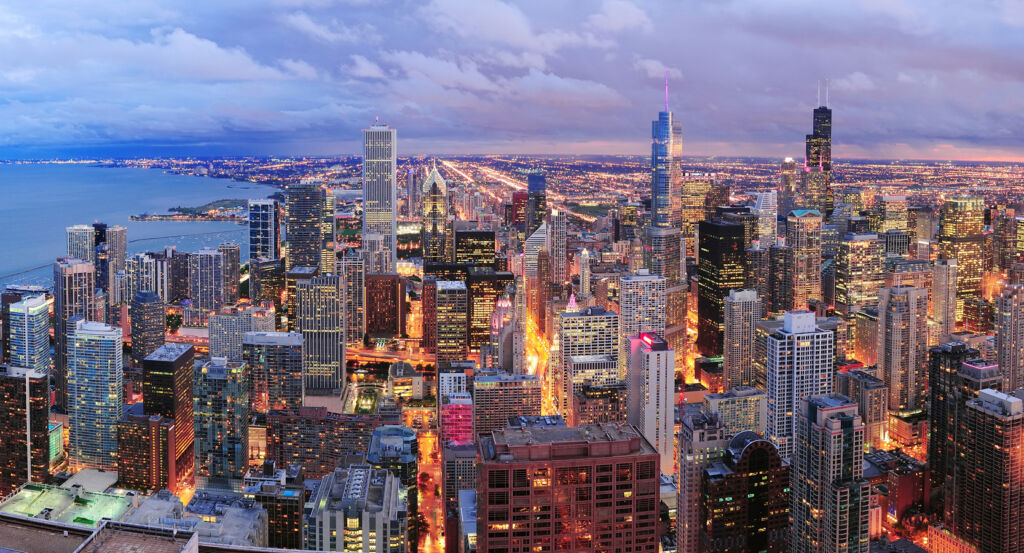
Wabash Avenue is a spirited corridor where the Loop's commercial legacy, Chicago's architectural innovation, and the city's transportation history converge along one of downtown's defining streets.
Running through the Loop between Near South Side and River North, the corridor links celebrated skyscrapers, historic theaters, elevated railway infrastructure, educational institutions, and landmark commercial buildings that collectively trace Chicago's rise as a global metropolis. Steel-framed high-rises, Beaux-Arts façades, terra-cotta ornamentation, and the unmistakable structure of the CTA Loop Elevated preserve a streetscape that has continuously evolved since the late nineteenth century. Walking along Wabash Avenue reveals how engineering innovation, commercial enterprise, and civic ambition combined to shape one of America's most recognizable urban corridors. The result is a corridor whose enduring character continues to embody the architectural and cultural character of the Loop.
What defines Wabash Avenue.
Wabash Avenue is best known for serving as the historic spine of Chicago's central business district following reconstruction after the Great Chicago Fire of 1871, when advances in structural steel construction transformed the corridor into one of the nation's earliest concentrations of modern skyscrapers. Completion of the Union Loop Elevated in 1897 established Wabash Avenue as the eastern edge of Chicago's elevated rapid transit system, introducing steel viaducts and closely spaced stations that permanently reshaped the avenue's commercial and pedestrian environment. Architects including Daniel Burnham, Holabird & Roche, Jenney & Mundie, and Graham, Anderson, Probst & White contributed office buildings, hotels, department stores, and institutional structures that established Wabash Avenue as a showcase of the Chicago School and subsequent architectural movements. Ongoing preservation, adaptive reuse, and restoration projects have retained the corridor's historic commercial fabric while allowing it to remain one of Downtown's busiest urban streets.
Completed in 1893, the Fine Arts Building, designed by Solon S. Beman, became one of Chicago's earliest mixed-use cultural buildings by providing permanent studios, performance spaces, and classrooms for artists, musicians, and arts organizations that continue occupying the building today. The establishment of Roosevelt University in the Auditorium Building beginning in 1945 introduced a lasting academic presence that expanded Wabash Avenue's institutional character beyond commerce while preserving one of Dankmar Adler and Louis Sullivan's greatest architectural achievements. Successive rehabilitation of historic department stores, office towers, and loft buildings throughout the late twentieth and early twenty-first centuries encouraged new residential development, higher education, hospitality, and cultural investment without disrupting the avenue's historic street wall or architectural continuity. Together, these cultural institutions, educational investments, and preservation initiatives demonstrate how Wabash Avenue evolved beyond its commercial origins into one of Chicago's most enduring civic and architectural corridors.
How Wabash Avenue fits.
Wabash Avenue is best experienced through an exploration of Chicago's architecture, performing arts, and public spaces.
Begin at Chicago Cultural Center, where extraordinary Beaux-Arts architecture, rotating exhibitions, and the world's largest Tiffany stained-glass dome introduce the civic and artistic traditions surrounding the Loop. Continue to Millennium Park, whose acclaimed public art, gardens, and performance venues demonstrate the continuing evolution of Downtown's cultural landscape. Conclude at The Art Institute of Chicago, where internationally renowned collections provide a fitting finale that reflects the artistic legacy long associated with Wabash Avenue and the Loop. The progression moves naturally from civic architecture to public space before concluding with one of the world's premier art museums, revealing how Wabash Avenue connects many of Downtown's defining cultural experiences.
Where your story begins.
Foresyte Travel reveals places that feel extraordinary long before you arrive.
Enjoy editorial crafted for luxury travelers.
Foresyte may earn a commission when you book.