Why Wacker Drive matters.
Wacker Drive is an iconic corridor where the Loop's architectural ambition, Chicago's engineering innovation, and the city's riverfront character converge along one of America's most influential urban streets.
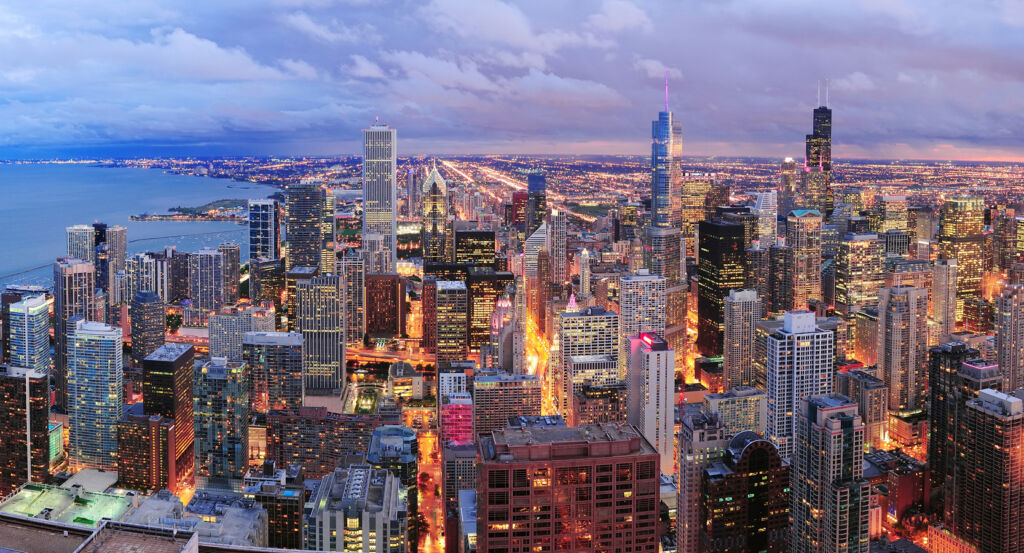
Running through the Loop between Near North Side and West Loop, the corridor follows both branches of the Chicago River while linking celebrated skyscrapers, civic landmarks, transportation infrastructure, and riverfront public spaces that collectively define Downtown. Multi-level roadways, movable bridges, Art Deco towers, and continuous riverfront development demonstrate nearly a century of engineering ingenuity and urban transformation. Walking along Wacker Drive reveals how transportation planning, architectural excellence, and civic investment reshaped Chicago's downtown into one of the world's most recognizable urban environments. The result is a corridor whose enduring character reflects Chicago's reputation as a global center of architecture and engineering.
What defines Wacker Drive.
Wacker Drive is best known for opening in 1926 as the centerpiece of the Plan of Chicago, following recommendations advanced by Daniel H. Burnham and Edward H. Bennett in 1909 to modernize downtown circulation while separating commercial freight traffic from passenger vehicles through a pioneering double-deck roadway. Designed under the direction of engineer William C. Cusack and named for former mayor Charles H. Wacker, the boulevard introduced upper and lower roadway levels that efficiently connected warehouses, commercial buildings, bridges, and riverfront industries throughout the central business district. The corridor incorporates numerous bascule bridges maintained by the Chicago Department of Transportation, while successive reconstruction projects between 2001 and 2012 modernized utilities, structural systems, sidewalks, lighting, and roadway infrastructure. Continued investment has preserved Wacker Drive as one of Chicago's defining engineering achievements and a principal transportation artery serving the Loop.
Completed in 1928, the 333 North Michigan Building, designed by Holabird & Roche, responded directly to Wacker Drive's new riverfront alignment by orienting its Art Deco massing toward the boulevard and establishing a precedent for subsequent commercial development overlooking the Chicago River. Construction of the Merchandise Mart in 1930, designed by Graham, Anderson, Probst & White, reinforced Wacker Drive's importance as a commercial spine by concentrating wholesale trade, office space, and riverfront distribution within one of the world's largest buildings at the time of its completion. Subsequent skyscrapers including 150 North Michigan, 311 South Wacker Drive, and 150 North Riverside Plaza demonstrate how successive generations of architects adapted structural engineering, foundation systems, and riverfront planning to the boulevard's evolving urban structure while preserving its role as Chicago's principal civic address. Together, these architect-designed buildings, commercial investments, and engineering milestones demonstrate how Wacker Drive became the physical structure through which Chicago expressed its international leadership in architecture, planning, and urban design.
How Wacker Drive fits.
Wacker Drive is best experienced through an exploration of Chicago's architectural heritage, public riverfront, and civic landmarks.
Begin at Chicago Riverwalk, where landscaped promenades, public art, and riverfront overlooks provide an immersive introduction to the engineering achievements that define Downtown. Continue to Chicago Architecture Center, whose exhibitions and river cruise programming deepen appreciation for the architectural innovation surrounding the boulevard. Conclude at Willis Tower, where panoramic observation decks provide a fitting finale overlooking the Loop, the Chicago River, and the remarkable cityscape shaped in part by Wacker Drive. The progression moves naturally from the river's edge to architectural interpretation before concluding above one of the world's great urban skylines, revealing how Wacker Drive serves as the connective spine of Downtown.
Where your story begins.
Foresyte Travel reveals places that feel extraordinary long before you arrive.
Enjoy editorial crafted for luxury travelers.
Foresyte may earn a commission when you book.