
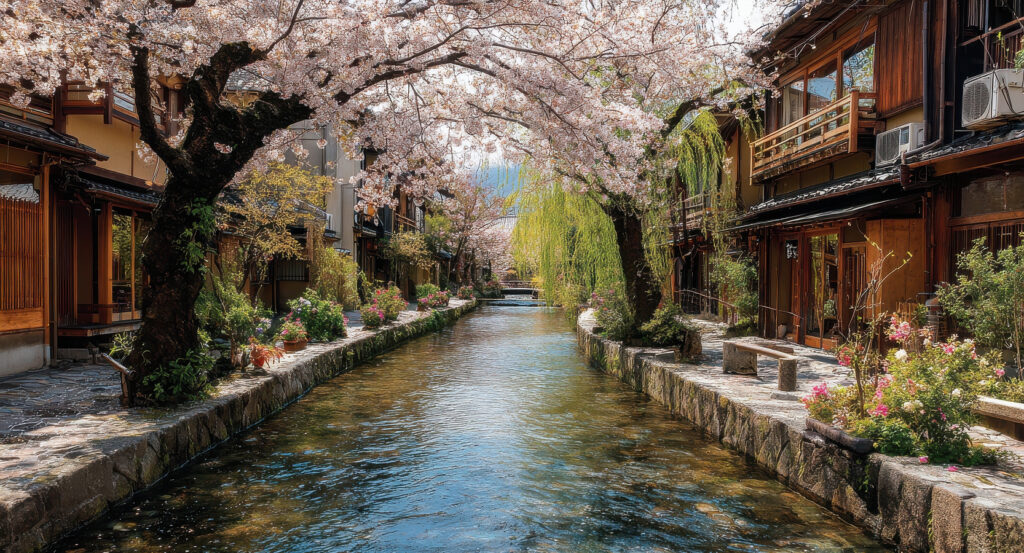
Why you should experience Yachiyo in Kyoto, Japan.
Yachiyo is Kyoto lived through gardens, seasons, and calm ritual, a ryokan-inspired sanctuary that gives rhythm to the city's subtler pleasures rather than offering performance or high-volume luxury.
Set a short walk from Nanzen-ji Temple and the Philosopher's Path in the eastern hills of Kyoto, Yachiyo occupies a neighborhood defined by shrine precincts, moss gardens, and quiet streets where residents and visitors pass in gentle stride. Arrival here feels like descent into composure. You step off the city's busier arteries and into an environment shaped by wood, paper, stone, and light, where proportion and texture matter more than ornament or effect. Public spaces, whether a entry hall, lounge, or corridor, feel composed, warm, and calming. There is coherence rather than clutter, material logic rather than display, and a spatial rhythm that supports pause and orientation rather than distraction. Guest rooms at Yachiyo Kyoto exemplify this quiet authority. They blend Western hospitality comfort with Japanese spatial intelligence, creating spaces that feel both restful and deeply connected to place. Beds are generous and supportive, designed for genuine, restorative sleep after long days walking temple gardens, moss valleys, and Kyoto's hidden precincts. Windows frame garden views, quiet side streets, or distant treetop slopes, making the city outside feel present. Furniture is thoughtful and unobtrusive. Desks support real use, seating invites lingering reflection, and storage accommodates extended stays. Lighting is warm and layered, calibrating smoothly from morning to evening with ease. Bathrooms emphasize comfort and simplicity. Whether traditional or modern in finish, they are arranged for ease of daily routine, with strong showers, clean lines, and materials chosen for tactile warmth. Nothing distracts; everything supports rhythm. Dining at Yachiyo Kyoto is rooted in Kyoto's culinary character, graceful, seasonal, and deeply tied to context. Meals are presented as composed moments rather than theatrical events, inviting appreciation of detail, balance, and ingredient quality. Shared spaces extend the hotel's calm presence. Lounges, garden views, and transitional zones function as pauses rather than stages, places where you can think, read, write, or plan without physical pressure. The hotel's location itself becomes part of the experience. Walking toward Nanzen-ji, Eikan-dō, the Philosopher's Path, and nearby shrines feels like entering an everyday Kyoto that rewards slow movement and calm attention, not checklist touring. Service at Yachiyo Kyoto is attentive, grounded, and quietly supportive. Interactions feel human and sincere. Staff offer guidance rooted in local understanding: when to visit a quiet garden corner, the best route to avoid crowds, or how light shifts in a particular teahouse as the day moves. Assistance supports your presence in the city rather than managing your motions through it. The hotel draws travelers who value coherence over spectacle: cultural explorers, repeat visitors to Kyoto, couples seeking calm rather than cliché, and anyone who wants the city to feel inhabited and bottom-up rather than consumed from above.
What you should know about Yachiyo.
Yachiyo Kyoto's character emerges from a deep engagement with the East Mountain precincts, a historic zone marked by temple compound gardens, tree-lined paths, and seasonal change, and its architecture and interior spaces were developed to resonate with that condition.
Rather than grafting generic hotel language onto a historic context, the designers embraced Japanese spatial principles: horizontality, subtle enclosure, and carefully controlled transitions between interior and exterior. Materials were chosen for texture and endurance, timber that warms with use, stone that absorbs light without glare, and soft textiles that age with presence rather than trend. Public spaces were arranged as sequences of calm rather than destinations, with sightlines and circulation paths that guide attention gently from one moment to the next. Guest room planning was informed by how people actually live in space during extended stays. Designers considered how guests rest, unpack, work briefly, and transition between sleep and activity. This behavioral grounding resulted in layouts that feel intuitive. Storage, work surfaces, and seating were integrated early in the design. Lighting was woven into spatial logic from the outset, supporting circadian rhythm. Bathrooms were conceived as private pauses, spaces for physiological reset. Culinary spaces were calibrated to support nourishment and conversation without physical noise, aligning with Kyoto's broader culinary philosophy of balance, seasonality, and presence. Operational culture reinforces this architectural intent. Staff training emphasizes contextual awareness, local knowledge, and adaptive responsiveness. Interactions feel practical, warm, and situationally intelligent. Over time, Yachiyo Kyoto has gained loyalty among travelers who return not for novelty but for coherence, spaces that feel consistently calibrated under repeated use, service that supports autonomy, and an environment rooted in place. In Kyoto's hospitality landscape, where both heritage dramatization and international generic styles are common, Yachiyo stands apart for its attentive restraint and grounded presence.
How to fold Yachiyo into your trip.
Yachiyo Kyoto works best when you treat it as a rhythmic anchor, a base of presence from which Kyoto's layered spatial and temporal textures can unfold.
Begin mornings slowly, stepping toward Nanzen-ji Temple or along the Philosopher's Path before crowds gather. Let light and shadow shape your pace. Because the hotel sits near quieter precincts, returning midday feels restorative. Come back to rest, read, or spend quiet time in shared spaces before venturing out again. Afternoons lend themselves to deeper exploration: temple gardens, side streets, and smaller shrines reveal themselves when you move. Take time to notice material details, stone lanterns, moss edges, timber joints, that reward slow motion. Evenings unfold with coherence. Dine thoughtfully here or nearby, attend music events or nighttime temple illuminations, or walk garden-lined lanes as lights soften. Returning late feels natural because the hotel's tone absorbs energy. Yachiyo Kyoto pairs especially well with extended stays, repeat visits, cultural immersion, and itineraries where resonant presence matters as much as sights. By the time you leave, Kyoto will feel less like a sequence of destinations and more like a lived environment, and the hotel will feel like the quiet structure that made that embodied experience possible, not softened, not diluted, but deeply present in both structure and rhythm. In a city defined by nuance, seasonal flux, and contemplative spatial logic, Yachiyo Kyoto offers a hospitality experience that connects with the city's deepest patterns.
Where your story begins.
Foresyte Travel reveals places that feel extraordinary long before you arrive.
Experience premium editorial crafted for luxury travelers.

















































































































