
Why Yanaka matters.
Yanaka is a contemplative historic neighborhood where Tokyo's shitamachi character meets an Edo temple district, narrow residential lanes and a concentration of religious ground that preserves the smaller physical scale of the prewar city.
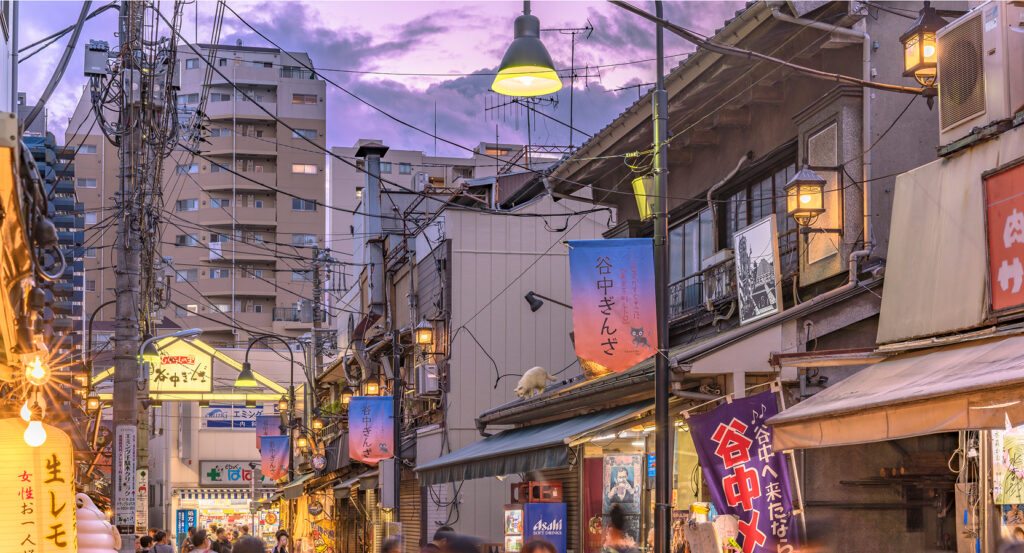
Set along the upland between Ueno and Sendagi near Nippori and just steps from the slopes descending toward Nezu, the neighborhood occupies a close-grained landscape where temple compounds, cemeteries, wooden houses, small shops and walled gardens break the residential fabric into short streets and irregular passages. Stone steps and sloping lanes repeatedly negotiate the elevation between the Ueno plateau and lower ground toward Sendagi, making topography unusually visible within the street network. Temple gates interrupt rows of compact houses as tiled roofs, graveyards and planted courtyards create openings inside blocks that otherwise retain an intimate scale. Yanaka Ginza introduces a denser commercial corridor beneath the Yuyake Dandan steps, extending the district from quiet religious precincts into a surviving neighborhood shopping street. The result is a remarkably coherent fragment of older Tokyo where topography, temples, residential streets and small commerce preserve a physical intimacy erased across much of the modern capital.
What defines Yanaka.
Yanaka is best known for developing into one of Edo's great temple districts as Tokugawa urban expansion pushed religious institutions toward the northern edge of the growing capital. The name refers to the valley territory between the Ueno and Hongo uplands, a topographic position that preceded the neighborhood's transformation under the shogunate. Kan'ei-ji was established on Ueno Hill in 1625 with Tokugawa support, strengthening the religious importance of the adjoining territory and drawing smaller temples into Yanaka. Only four of the neighborhood's surviving temples predate Edo's establishment in 1603, demonstrating how strongly the present concentration belongs to seventeenth-century urban change. Relocations accelerated during the middle decades of that century as Edo's expanding population placed increasing pressure on central land. The Great Fire of Meireki in 1657 intensified the redistribution of temples away from the crowded center, with former religious parcels serving new fire-prevention and urban-reorganization purposes. Yanaka accumulated temples transferred from districts including Kanda, and associated stonemasons, craftspeople and businesses followed the religious institutions into the growing temple town. Monzencho developed around the compounds, giving the district a residential and commercial structure tied directly to religious activity. Kan'ei-ji's enormous precinct on neighboring Ueno Hill was devastated during the 1868 Battle of Ueno and subsequently reduced under the Meiji government, yet many of Yanaka's smaller temples remained embedded within their established streets. The district suffered comparatively limited destruction during both the 1923 Great Kanto Earthquake and the wartime bombing that transformed large portions of Tokyo, allowing its concentration of temples, slopes and older streets to survive into the modern city.
Yanaka Cemetery introduced a different institutional order into this inherited religious landscape during the opening years of the Meiji period. Much of its territory had previously belonged to Tennoji and Kan'ei-ji before the new government established a public cemetery there on September 1, 1874. The present burial ground covers 102,537 square meters and incorporates temple cemeteries into a larger complex containing thousands of graves. Tokugawa Yoshinobu, the fifteenth and final Tokugawa shogun, was buried there after living through the political transfer that ended the shogunate, placing one of the principal figures of that transition inside territory deeply shaped by Tokugawa religious patronage. The cemetery also contains graves associated with painters, writers, actors, scholars and statesmen, extending its historical range across modern Japanese public life. Tennoji's five-story pagoda once rose beside the central avenue and later became the model for Koda Rohan's Meiji-period literary work Gojūnotō. Fire destroyed the pagoda in 1957, leaving its foundation stones within the cemetery as the surviving trace of a structure long identified with Yanaka's skyline. Sakura-dori now crosses the burial ground beneath rows of cherry trees, preserving a broad linear opening through a district otherwise characterized by narrow streets and enclosed temple property. Yanaka Cemetery binds the Tokugawa religious landscape to Meiji institutional reform and the cultural history of modern Tokyo within the same ten-hectare precinct.
How Yanaka fits.
Yanaka works as the anchor for a daytime exploration through its temple streets and adjoining uplands using three nearby sites that move from an artist-designed home and teaching studio through a bathhouse converted for contemporary art into a medieval temple whose Edo fortunes and lost pagoda span several centuries of the district's history.
Begin at ASAKURA Museum of Sculpture, where sculptor Fumio Asakura established his studio and residence after graduating from Tokyo School of Fine Arts in 1907 at age twenty-four. Repeated expansion culminated in the present building in 1935, designed by Asakura himself as an integrated residence, studio and school known as the Asakura Private School. Its architectural program combines a high concrete sculpture studio with Japanese domestic rooms and a courtyard garden, bringing artistic production, teaching and private life into one complex. Asakura also used the rooftop garden for horticultural instruction, connecting cultivation with his students' observation of natural form. His family opened the property in 1967 after his death, Taito City assumed management in 1986, the building became a National Tangible Cultural Property in 2001 and the former Asakura Fumio Garden received national scenic designation in 2008. Continue to SCAI THE BATHHOUSE, established in Yanaka in 1993 inside Kashiwayu, a former public bathhouse with a history extending back two centuries. Conversion retained the tall volume and overhead natural light of the bathhouse but recast the interior as a contemporary gallery, inserting an international art program into Yanaka's inherited building stock. James Lee Byars inaugurated the Yanaka location, and subsequent exhibitions and projects have involved Natsuyuki Nakanishi, Lee Ufan, Tatsuo Miyajima, Mariko Mori, Kohei Nawa, Anish Kapoor and Apichatpong Weerasethakul. Public commissions developed through the gallery have extended its activity beyond Yanaka, including work by Miyajima and Louise Bourgeois at Roppongi Hills. Conclude at Tennoji, a temple with origins in the Kamakura period whose later history became inseparable from Yanaka's Edo-period popularity. Its grounds hosted one of the lotteries celebrated as the Edo San-tomi alongside Meguro's Ryusenji and Yushima Tenjin, drawing crowds into a religious precinct that also possessed the five-story pagoda later immortalized by Koda Rohan. The temple suffered heavily during the fighting around Ueno in 1868, and the subsequent reorganization of its former land contributed to the territory occupied by Yanaka Cemetery. The pagoda survived those transformations until the 1957 fire, and its foundation remains within the cemetery beside the reduced temple precinct. The progression moves from Asakura's fusion of sculpture, teaching and domestic architecture through the reuse of Kashiwayu for contemporary art into Tennoji's passage from medieval foundation through Edo lottery culture and Meiji territorial change, revealing how Yanaka repeatedly absorbed new cultural functions without losing the religious and residential fabric that preceded them.
Where your story begins.
Foresyte Travel reveals places that feel extraordinary long before you arrive.
Enjoy editorial crafted for luxury travelers.
Foresyte may earn a commission when you book.

















































































































