Why you should experience Nine-Turn Bridge at Yu Garden in Shanghai, China.
The Nine-Turn Bridge is the threshold between the clamor of the city and the serenity of Yu Garden, a winding passage of reflection where every step feels like crossing from one world into another.
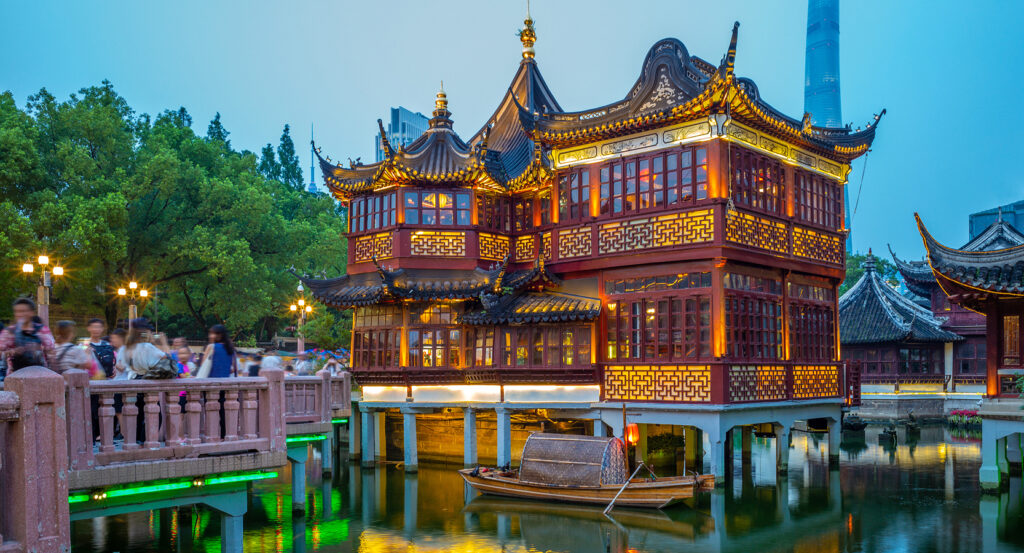
Its zigzag path of nine sharp angles stretches across a tranquil pond, each turn offering a new composition of water, willow, and pavilion. The bridge's design isn't arbitrary; in traditional Chinese belief, evil spirits can only travel in straight lines, so the turns protect all who cross. But beyond symbolism, there's poetry in its geometry. Beneath your feet, the jade-colored water mirrors the skyline of old Shanghai, rippling clouds, glints of koi, and the silhouette of the Huxinting Teahouse, which seems to float at its center like an island of stillness. Lanterns line the railings in soft reds and golds, and the air hums with life, the rustle of leaves, the chatter of visitors, the creak of wood underfoot. Crossing the bridge is both ritual and revelation, a gentle surrender to the slower rhythm of Yu Garden's world.
What you didn't know about Nine-Turn Bridge at Yu Garden.
The Nine-Turn Bridge, or Jiuqu Bridge, is one of Shanghai's most enduring Ming dynasty designs, a structure that weaves together philosophy, protection, and play.
Constructed in the 16th century under Pan Yunduan's original vision for Yu Garden, the bridge was inspired by Suhzhou garden architecture, where water and motion form the backbone of contemplation. Its nine turns, the highest odd number in Chinese numerology, symbolize ultimate completeness and longevity, attributes associated with heaven and the emperor. The bridge originally connected the Bazaar Gate to a private teahouse at its center, now the Huxinting Teahouse, built in 1784, making it Shanghai's oldest surviving teahouse. The bridge itself is crafted from stone and wood in alternating segments, designed to reflect light differently at each angle, creating the illusion of movement even when the pond is still. During the Qing dynasty, officials and merchants held evening gatherings here, lighting hundreds of paper lanterns that cast shimmering reflections across the water. The bridge also carries subtle feng shui significance: its zigzag form disperses stagnant energy, ensuring harmony between the water element of the pond and the wood element of the teahouse. In modern Shanghai, the bridge remains a cultural symbol, a rare survivor of centuries of change, embodying the city's ability to evolve while holding its soul intact.
How to fold Nine-Turn Bridge at Yu Garden into your trip.
Crossing the Nine-Turn Bridge is an essential prelude to experiencing Yu Garden, a ritual that prepares both mind and senses for what lies within.
Begin at the Yuyuan Bazaar entrance, where the bridge first extends over the lotus pond, guiding you toward the Huxinting Teahouse. Arrive early in the morning or late in the evening to catch it in quieter moments, early light reveals its mirrored symmetry, while dusk cloaks it in lantern glow. Pause at each turn; each one is intentionally composed to frame a unique vista of the garden and its surrounding pavilions. From the fourth bend, look back toward the entrance, the perspective aligns perfectly with the teahouse's curved eaves, a centuries-old trick of balance and harmony. Step inside Huxinting Teahouse midway through your crossing to sip jasmine tea or oolong as the water shimmers below; it's one of Shanghai's most atmospheric settings, unchanged since the 1700s. After tea, complete the remaining turns and step through the garden gate, a symbolic transition from motion to stillness, commerce to contemplation, outer noise to inner peace. The Nine-Turn Bridge isn't merely a path; it's an initiation, a measured choreography of steps leading you into the timeless heart of Yu Garden.
Where your story begins.
Start your planning journey with Foresyte Travel.
Experience immersive stories crafted for luxury travelers.