Why Zeitz Museum of Contemporary Art Africa matters.
Zeitz Museum of Contemporary Art Africa is a major cultural institution where V&A Waterfront's industrial maritime heritage meets the architectural innovation of Heatherwick Studio, the artistic achievements of contemporary Africa and its diaspora, and Cape Town's emergence as an international center for African visual culture.
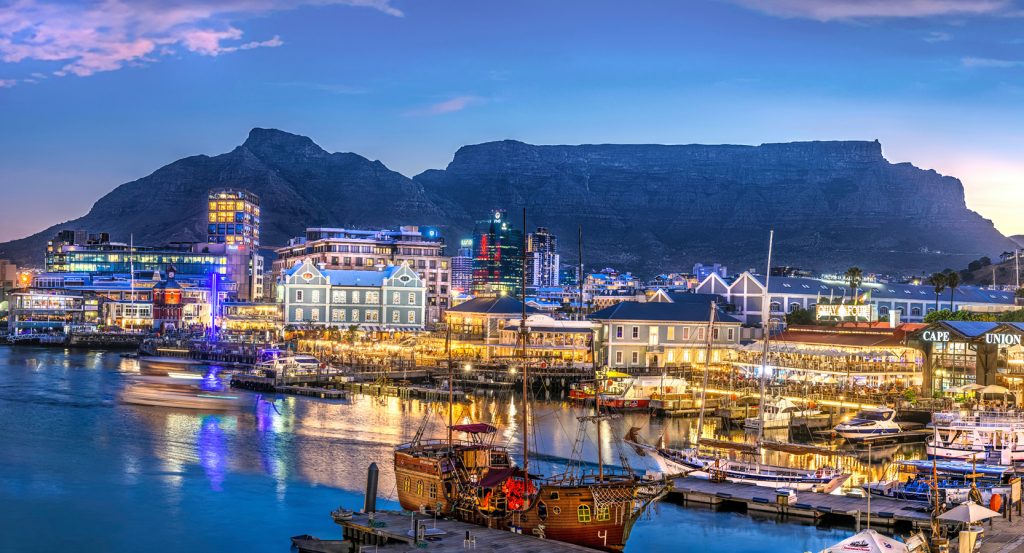
Rising above Silo Square at the eastern edge of Cape Town's historic harbour, the museum occupies the former grain elevator complex between the working docks and the pedestrian precinct extending toward the Clock Tower, with the Foreshore's commercial towers and Table Mountain forming its broader urban backdrop. Its imposing concrete exterior preserves the cylindrical forms of the original industrial silos, contrasting with the faceted glazing of the adjoining tower and the contemporary buildings surrounding the square. A substantial vertical entrance opens into an immense interior atrium, where curved concrete surfaces rise through the former grain-storage structure beneath a glazed roof. The upper levels incorporate expansive windows overlooking the harbour, connecting the museum's interior spaces to the surrounding maritime landscape. The result is a commanding cultural building whose sculpted industrial structure, dramatic central atrium and elevated waterfront position establish one of Cape Town's most distinctive architectural achievements.
What defines Zeitz Museum of Contemporary Art Africa.
Zeitz Museum of Contemporary Art Africa is best known for transforming Cape Town's historic grain silo into a major institution dedicated to contemporary art from Africa and its diaspora, establishing an important cultural destination through the convergence of industrial preservation, private collecting and public museum development. The original grain elevator was constructed by South African Railways and Harbours between 1921 and 1924, creating a substantial storage and processing facility connected to the country's agricultural export economy. Its completion established a 57-meter industrial structure that became the tallest building in South Africa during its early operating years. The complex processed grain arriving through the national railway network, connecting agricultural production in the interior to international shipping routes through Table Bay. Wheat, maize, sorghum and other crops passed through its mechanical grading and storage facilities, establishing the building as an important component of Cape Town's commercial infrastructure. The introduction of containerized shipping and changes in agricultural distribution gradually reduced the facility's importance, leading to its decommissioning in 1990. Its subsequent preservation became a significant question during the redevelopment of the Victoria and Alfred Waterfront, whose transformation introduced commercial, residential and cultural functions into the former industrial harbour. Business executive Jochen Zeitz had begun assembling a substantial collection of contemporary African art in 2002, developing a philanthropic ambition to establish an institution capable of preserving and presenting the work of artists across the continent and its diaspora. The V&A Waterfront independently explored possibilities for adapting the disused industrial complex, seeking a substantial public cultural function suited to its historical significance. Creative entrepreneur Ravi Naidoo introduced British designer Thomas Heatherwick to the grain silo in 2006, initiating the architectural relationship that subsequently shaped the redevelopment project. Heatherwick returned to the building in 2011, when the possibility of creating a dedicated museum had become central to discussions concerning its future. The partnership between the V&A Waterfront and Zeitz was formally announced in November 2013, establishing a nonprofit institution supported by the collector's founding art holdings and a substantial investment in architectural redevelopment. The waterfront committed R500 million to the conversion, creating one of the most ambitious cultural construction projects undertaken in South Africa during the early twenty-first century. Heatherwick Studio directed the architectural transformation in collaboration with South African architectural practices including Van Der Merwe Miszewski Architects, Rick Brown Associates and Jacobs Parker Architects. The construction program required extensive structural engineering to preserve the industrial complex during the removal of substantial portions of its original concrete interior. The project developed through four years of specialized construction, adapting the former agricultural infrastructure to the environmental and spatial requirements of an international art museum. Mark Coetzee became the institution's founding executive director and chief curator, developing its initial exhibition program and organizational structure. Zeitz Museum of Contemporary Art Africa opened to the public on September 22, 2017, establishing a major cultural institution within the redeveloped waterfront. Its inaugural program included works from the Zeitz Collection and the museum's developing institutional holdings, introducing a broad presentation of contemporary African artistic production. The opening attracted international attention to Cape Town's cultural infrastructure and established an important institutional counterpart to the commercial galleries and independent art organizations operating across the continent. Coetzee resigned in 2018, initiating a leadership transition that preceded the appointment of curator Koyo Kouoh as executive director and chief curator in March 2019. Kouoh brought extensive international experience through her founding leadership of RAW Material Company in Dakar and her participation in major international exhibition programs. Her tenure strengthened the museum's curatorial direction through ambitious exhibitions, artistic commissions and collaborations connecting African artists to international institutions. A defining achievement arrived in November 2022 with the opening of When We See Us: A Century of Black Figuration in Painting, a substantial exhibition examining Black self-representation across generations and geographical regions. The project assembled 200 paintings by 154 artists from 28 countries, establishing an extensive historical investigation of Black figurative painting. Its development incorporated loans from 73 institutional and private collections across 26 countries, demonstrating the international scale of the museum's curatorial relationships. The exhibition subsequently traveled internationally, extending its influence beyond Cape Town and contributing to the wider presentation of African and diasporic artistic production. The institution celebrated the centenary of its historic grain silo on September 24, 2024, connecting the preservation of industrial architecture to the continued development of its public cultural program. Kouoh's death in May 2025 marked a significant institutional transition following six years of leadership. The museum subsequently appointed Elvira Dyangani Ose as artistic director, effective October 1, 2026, introducing a new phase of curatorial leadership informed by her previous direction of the Museu d'Art Contemporani de Barcelona. Zeitz Museum of Contemporary Art Africa's significance rests on its transformation of a major industrial structure into a public cultural institution, the development of an internationally connected African art collection and its sustained contribution to contemporary artistic production across the continent.
Thomas Heatherwick's architectural intervention established the museum's distinctive character through the transformation of a densely organized industrial structure into a sequence of substantial public spaces and specialized exhibition galleries. The original complex incorporated forty-two cylindrical concrete storage chambers, each 33 meters high and 5.5 meters in diameter, creating an architectural arrangement designed for agricultural storage and mechanical processing. The design team developed a complex method of cutting through the existing concrete, removing selected sections of the storage chambers to create an immense central atrium. Its sculptural geometry follows the enlarged form of a grain kernel, establishing an organic composition through the surviving curved surfaces of the original silos. The resulting interior extends vertically through the building, creating a substantial public gathering space surrounded by galleries and circulation routes. Exposed concrete preserves the texture of the industrial structure, with cut surfaces revealing the considerable thickness and strength of the original construction. The atrium's upper glazing incorporates a pattern developed by West African artist El Loko, introducing a substantial artistic contribution into the architectural structure. Its laminated glass surface permits daylight to penetrate the interior and contributes to the rooftop sculpture garden above. The surrounding galleries occupy former storage chambers adapted through extensive structural alterations, creating exhibition spaces with contrasting proportions and ceiling heights. The museum encompasses 9,500 square meters distributed across nine floors, incorporating galleries, educational facilities, conservation spaces and public gathering areas. Approximately 6,500 square meters were allocated to exhibition facilities at the institution's opening, establishing substantial capacity for permanent collection presentations and temporary exhibitions. The galleries accommodate painting, sculpture, photography, film, installation and performance, supporting artistic practices across multiple contemporary disciplines. The museum's collection focuses on work produced by artists from Africa and its diaspora, incorporating different geographical, historical and cultural perspectives within a common institutional program. Its exhibitions examine questions of representation, migration, memory, social history and artistic experimentation through individual and collective creative practices. The institution's approach incorporates major retrospective exhibitions alongside presentations devoted to emerging artists, connecting established international figures to developing artistic careers. Its photography program contributes to the preservation and interpretation of photographic practices associated with the African continent, including documentary, conceptual and experimental approaches. Moving-image installations extend the exhibition program through film, video and multimedia presentations, supporting artistic work that develops through time-based forms. The Costume Institute introduces another dimension through fashion, textile production and the relationship between clothing and contemporary visual culture. Educational facilities support workshops, school programs and public engagement with contemporary art, connecting the museum's exhibitions to broader cultural learning. The BMW Centre for Art Education contributes to this institutional program through structured activities designed for children, families and school groups. The Koyo Kouoh Atelier provides a dedicated platform for artistic development, supporting Cape Town-based practitioners through residency programs and exhibitions. Participating artists have included Kemang Wa Lehulere, Haroon Gunn-Salie, Thania Petersen, Igshaan Adams, Unathi Mkonto and Berni Searle, establishing a substantial concentration of contemporary South African artistic talent. The museum's 2026 exhibition Were It Not for Shadows brings these six artistic practices into a collective presentation, extending the institutional importance of the residency program. The upper-level sculpture garden introduces an additional relationship between art and the surrounding landscape, incorporating outdoor exhibition space within the former industrial complex. The adjoining Ocular Lounge establishes a substantial social space overlooking the waterfront, with elevated perspectives toward the harbour and the surrounding mountains. The building's circulation system incorporates elevators and connecting passages that provide access to the exhibition levels, establishing a coherent relationship between the central atrium and the surrounding galleries. Zeitz Museum of Contemporary Art Africa's distinctive achievement emerges from the coordination of industrial preservation, specialized exhibition architecture and a substantial cultural program devoted to the artistic production of Africa and its diaspora.
How Zeitz Museum of Contemporary Art Africa fits.
Zeitz Museum of Contemporary Art Africa works as the starting point for an exploration connecting Cape Town's nineteenth-century maritime administration, the defensive infrastructure of its colonial harbour and the conservation of southern Africa's distinctive marine ecosystems.
Begin at Clock Tower, the historic harbour administration building completed in 1882 beside the original Alfred Basin. Its three-story red exterior incorporates Gothic Revival windows, decorative brickwork and a prominent clock imported from Edinburgh, establishing a distinctive example of Victorian port architecture. The ground floor accommodated a tidal gauge used to measure changing water levels, providing important information for vessels entering and leaving the harbour. An upper observation room incorporated mirrors that enabled the port captain to monitor activity across the surrounding docks. Architects Gwen and Gawie Fagan directed a substantial restoration during 1997 and 1998, preserving the building's historic appearance and reinstating its distinctive red exterior. Continue to Chavonnes Battery Museum, the surviving coastal fortification constructed by the Dutch East India Company during the early eighteenth century. Work began in 1714 under Governor Maurits Pasques de Chavonnes, establishing a defensive installation along the original shoreline of Table Bay. The battery was inaugurated in 1726, incorporating a curved masonry structure designed to accommodate sixteen cannon protecting the harbour approaches. Its military purpose connected the settlement's maritime trade to the defensive requirements of the Dutch colonial administration. Subsequent harbour expansion concealed substantial sections of the original fortification, and archaeological excavation exposed surviving stonework that subsequently became part of a historical museum. Conclude at Two Oceans Aquarium, the major marine conservation institution established at the V&A Waterfront on November 13, 1995. Its development followed eight years of planning and eighteen months of construction, introducing a substantial educational facility devoted to the marine ecosystems surrounding southern Africa. The aquarium's exhibition program examines the contrasting environmental characteristics of the Atlantic and Indian Oceans, incorporating marine habitats associated with the country's extensive coastline. Its conservation activities include the rehabilitation of sea turtles, marine research and educational programs supporting the protection of vulnerable ocean environments. The institution's development has contributed to public understanding of the ecological significance of the waters surrounding the Cape Peninsula. The progression moves from Clock Tower's Victorian maritime administration through Chavonnes Battery Museum's colonial defensive architecture and culminates in Two Oceans Aquarium's marine conservation program, connecting the historical and environmental foundations of Cape Town's working harbour.
Where your story begins.
Foresyte Travel reveals places that feel extraordinary long before you arrive.
Enjoy editorial crafted for luxury travelers.
Foresyte may earn a commission when you book.