
Why Zojoji matters.
Zojoji is a commanding Buddhist temple where Shiba's layered historic character meets the Tokugawa shogunate's dynastic memory, a vast Jodo-shu precinct and one of Edo's strongest surviving relationships between religion and political authority.
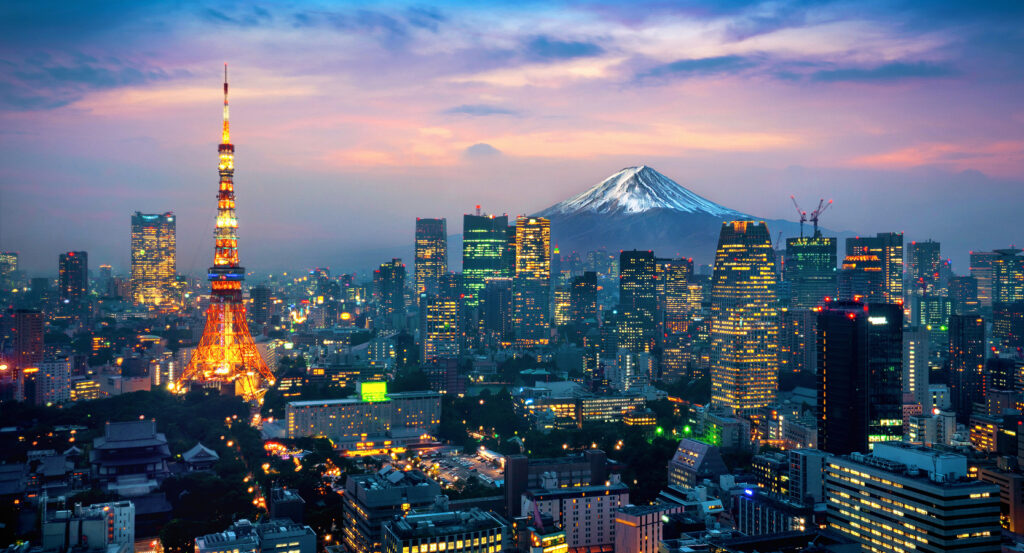
Set along Hibiya-dori near Onarimon-dori and just steps from Shiba Park, the temple occupies a broad precinct where the vermilion Sangedatsumon, expansive forecourt, tiled temple roofs and wooded burial grounds create a low historic foreground beneath Tokyo Tower. The main approach passes through the immense gate before opening toward the elevated Daiden, whose wide stair and deep roof establish the principal architectural axis through the grounds. Trees and smaller religious buildings extend along the sides as the terrain rises toward the Tokugawa cemetery and the green slopes behind the complex. Tokyo Tower appears directly above this layered roofline, sharpening the physical contrast between Edo-period religious ground and the vertical city surrounding modern Shiba. The result is an unusually powerful Tokyo precinct where grand Buddhist architecture, wooded terrain and metropolitan scale remain visually inseparable.
What defines Zojoji.
Zojoji is best known for becoming the Tokugawa family temple and one of the principal religious institutions of Edo after Tokugawa Ieyasu established his government in the city. Yuyo Shoso founded the temple in 1393 at Kaizuka in the territory now extending around Hirakawacho and Kojimachi, establishing an important Jodo-shu center for eastern Japan. Ieyasu entered Edo in 1590 and formed a close relationship with Zojoji's twelfth abbot, Genyo Zonno, after which the temple became associated with the Tokugawa house. Ieyasu moved Zojoji to its present Shiba site in 1598 as the developing castle city expanded, and major construction began in 1605 under shogunal patronage. Imperial recognition followed through authorization of permanent purple robes in 1608 and the title Fuko Kanchi Kokushi for Zonno in 1610, strengthening the temple's standing within both religious and political hierarchies. Ieyasu also presented Song, Yuan and Korean editions of the Buddhist canon by 1613, connecting Tokugawa patronage with Zojoji's role as a center of Jodo scholarship. At its Edo-period height, the precinct reached 826,000 square meters and contained 48 subsidiary temples, 150 educational establishments and as many as 3,000 priests and novices. Six of the fifteen Tokugawa shoguns were ultimately buried at Zojoji: Hidetada, Ienobu, Ietsugu, Ieshige, Ieyoshi and Iemochi, accompanied by wives and children that included Imperial Princess Kazunomiya. Zojoji developed beside the expanding shogunal capital as a religious institution whose educational scale, dynastic burials and direct Tokugawa patronage placed it near the center of Edo's political order.
The surviving Sangedatsumon concentrates another chapter of that history into the sole original building remaining from Zojoji's early Edo-period construction. Tokugawa support funded an earlier gate in 1611 under shogunal master carpenter Nakai Masakiyo and his craftsmen, but a powerful wind destroyed that structure in 1621. Reconstruction followed in 1622, producing the vermilion two-story gate that survived subsequent fires and the destruction of the twentieth century. Its three-bay composition uses a hip-and-gable roof above a lower pent roof, combining architectural forms derived from Chinese Buddhist construction with Japanese treatment of the balustrade. The upper story contains Edo-period statues of Shakyamuni, two bodhisattvas and sixteen arhats. Air raids in 1945 destroyed most of the temple complex and the Tokugawa mausoleums, leaving Sangedatsumon as the principal architectural survivor of the shogunate-era precinct. A temporary main hall appeared in 1952 before the present Daiden was constructed between 1971 and 1974 at a cost of 3.5 billion yen, beginning another large phase of rebuilding. The Daiden now enshrines a Muromachi-period Amida Buddha, with images of Shandao and Honen on the flanking altars, reconnecting the rebuilt complex with the Jodo tradition that preceded its Tokugawa patronage. Sangedatsumon entered a major conservation campaign in 2025 scheduled through June 2032, extending the physical survival of the structure that most directly preserves Zojoji's seventeenth-century architectural scale.
How Zojoji fits.
Zojoji works as the anchor for a daytime exploration through Shiba using three nearby sites that move from an ancient burial mound through a shrine centered on Tokugawa Ieyasu into a hilltop sanctuary commissioned to protect the new shogunal capital.
Begin at Shiba Maruyama Kofun, a keyhole-shaped burial mound extending more than 100 meters across the elevated ground now incorporated into Shiba Park. Constructed around the fifth century on the edge of a plateau standing 16 meters high, it is the largest surviving keyhole-shaped tumulus in Tokyo. Tsuboi Shogoro of Tokyo Imperial University investigated the site in 1898 and found that its burial facilities had already disappeared, with construction around the later Zojoji precinct and subsequent development having altered the mound's original form. Postwar research by Meiji University also separated it chronologically from a vanished group of ten smaller round tumuli once found nearby, placing those burials some two centuries later. Continue to Shiba Toshogu Shrine, centered on a seated wooden image of Tokugawa Ieyasu that the first shogun personally commissioned. Ieyasu's posthumous cult produced Toshogu shrines across Japan, and the Shiba sanctuary developed from the memorial architecture associated with Zojoji after his death in 1616. Much of the surrounding religious complex disappeared through later destruction, yet the Ieyasu figure survived and is now a designated cultural property. A large ginkgo at the shrine entrance reinforces the historic separation of this wooded enclave from the surrounding metropolitan streets. Conclude at Atago Jinja, founded on Tokugawa Ieyasu's order in 1603 atop 26-meter Atago Hill as a shrine protecting Edo against fire and disaster. Shogunal patronage financed its main sanctuary, subsidiary shrines, Niomon and entrance gate by 1610, establishing the hill as a religious guardian of the developing capital. The steep approach later acquired its famous association with Magaki Heikuro, whose celebrated horseback ascent to retrieve flowering plum branches for Tokugawa Iemitsu entered Edo lore and gave the 86 steps their enduring connection with advancement. The progression moves from a fifth-century burial monument through the posthumous cult surrounding Tokugawa Ieyasu into a shrine he commissioned to protect Edo, carrying Shiba across more than a millennium of sacred and political history.
Where your story begins.
Foresyte Travel reveals places that feel extraordinary long before you arrive.
Enjoy editorial crafted for luxury travelers.
Foresyte may earn a commission when you book.

















































































































