
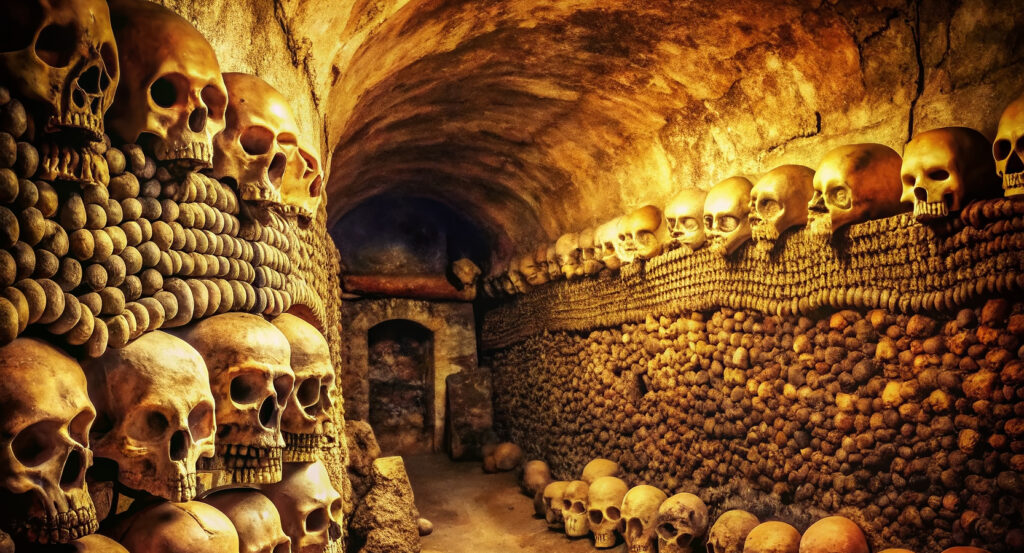
Why you should experience Paris Catacombs in Paris, France.
Paris Catacombs are an extraordinary underground ossuary where Petit-Montrouge's geological heritage, funerary history, engineering ingenuity, and centuries of urban evolution preserve one of the world's most compelling subterranean environments.
Set along Avenue du Colonel Henri Rol-Tanguy near Rue Rémy Dumoncel and just steps from Place Denfert-Rochereau, this vast underground complex guides visitors through former limestone quarries, vaulted galleries, sculpted chambers, and meticulously arranged ossuary walls that reveal the hidden foundations upon which much of Paris was built. Quarry inscriptions, reinforced tunnels, exposed geological strata, and carefully illuminated passageways create an atmosphere where archaeology, architecture, and remembrance converge beneath the modern city. Originally excavated to supply the limestone that constructed generations of Parisian monuments before being transformed into the capital's municipal ossuary, the Catacombs embody one of Europe's most extraordinary adaptations of historic infrastructure. The result is a destination defined by historical depth, engineering excellence, and one of France's most distinctive cultural experiences.
What you should know about Paris Catacombs.
Paris Catacombs are best known for becoming the city's municipal ossuary beginning in 1786 after centuries of overcrowded cemeteries, most notably the Cemetery of the Innocents, created severe public health crises that prompted authorities under King Louis XVI to relocate the remains of more than six million people into abandoned limestone quarries whose origins date to the Roman era, establishing the world's largest organized underground ossuary while preserving nearly two thousand years of Parisian history beneath the streets of the capital. The subterranean network itself developed between the twelfth and eighteenth centuries as quarrymen extracted prized Lutetian limestone used to construct Notre-Dame Cathedral, the Louvre, Pont Neuf, Sainte-Chapelle, the Sorbonne, and countless churches, bridges, monasteries, and civic buildings across Paris. Following dangerous ground collapses caused by abandoned excavations, King Louis XVI established the Inspection Générale des Carrières in 1777 under engineer Charles-Axel Guillaumot, whose pioneering geological surveys, stabilization methods, structural reinforcements, and comprehensive underground mapping laid the foundation for modern urban geotechnical engineering. Beginning on 7 April 1786, nightly processions discreetly transferred human remains from overflowing cemeteries into the former quarries, where inspectors later arranged skulls and bones into the carefully ordered walls, pillars, crosses, and decorative compositions that characterize the ossuary today. During the nineteenth century, Inspector Louis-Étienne Héricart de Thury transformed sections of the Catacombs into an educational and commemorative environment by introducing geological cabinets, quarry exhibits, sculpted chambers, inscriptions, and memorial monuments while preserving the solemn dignity of the site. Although the complete quarry system extends for more than 300 kilometers beneath Paris, 1.5 kilometers are accessible to visitors at depths approaching 20 meters below street level, making the Catacombs simultaneously an archaeological archive, geological record, engineering achievement, and enduring monument to the generations who shaped the French capital.
Beyond their immense historical significance, the Paris Catacombs provide one of Europe's most immersive encounters with the hidden infrastructure that enabled Paris to flourish above ground. Original quarry tool marks, stabilized vaults, carved inspection tablets, geological formations, and precisely ordered ossuary displays demonstrate the extraordinary relationship between natural resources, urban expansion, public health reform, and heritage conservation across successive centuries. Every chamber reveals how medieval quarrying, Enlightenment civic planning, nineteenth-century engineering, and modern preservation continue to coexist beneath one of the world's great capitals. Together, exceptional stewardship, historical authenticity, and engineering foresight have established the Paris Catacombs among the world's most important subterranean heritage sites.
How to fold Paris Catacombs into your trip.
Paris Catacombs are best experienced as part of an exploration through southern Paris's celebrated historical, scientific, and commemorative institutions.
Begin at Place Denfert-Rochereau, where the imposing Lion of Belfort introduces one of the Left Bank's most historically significant gateways before descending into the Paris Catacombs for one of the city's most unforgettable historical experiences. Continue to Montparnasse Cemetery, where the graves of writers, philosophers, scientists, and artists extend the neighborhood's enduring connection to memory and cultural history. Conclude at Paris Observatory, whose pioneering contributions to astronomy, cartography, and scientific discovery provide a fitting finale celebrating the intellectual foundations of southern Paris. The progression moves naturally from historic civic square to subterranean ossuary before concluding through two defining institutions of remembrance and scientific achievement, revealing why the Paris Catacombs remain among the capital's most compelling cultural experiences.
Where your story begins.
Foresyte Travel reveals places that feel extraordinary long before you arrive.
Experience premium editorial crafted for luxury travelers.














































































































