
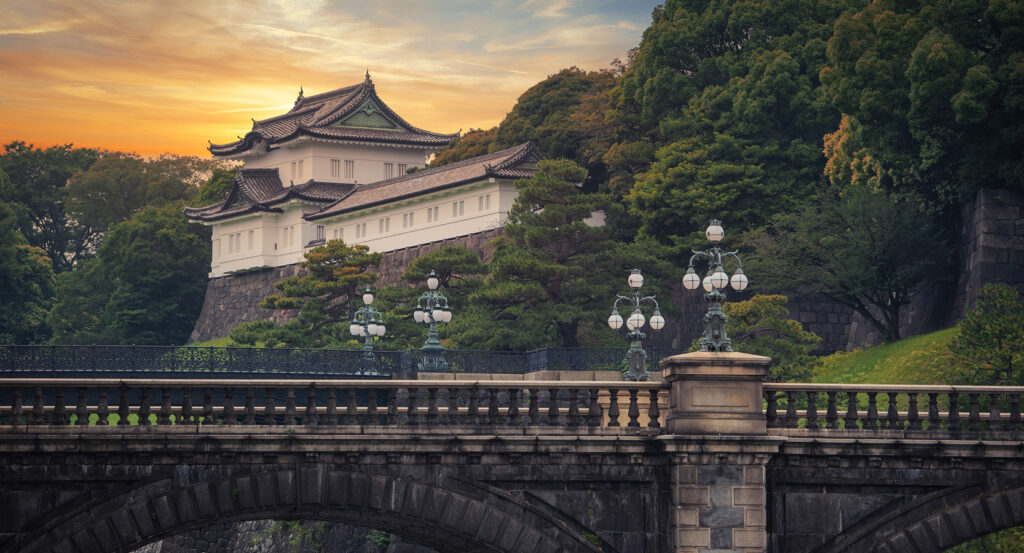
Why you should experience Nijubashi Bridge in Tokyo, Japan.
Nijubashi Bridge is the soul of the Imperial Palace's mystique, a vision of symmetry, grace, and restrained majesty. Stretching elegantly across the palace moat, its dual arches shimmer like a mirage in the reflecting waters below, linking the Imperial domain to the outer world with a quiet sense of ceremony. Visiting here is less about movement and more about reverence; even the air feels hushed, as if the stones themselves are conscious of their history. The bridge has become one of Tokyo's most photographed scenes, not because of grandeur, but because of what it represents: the union of past and present, of authority softened by beauty. Beneath the weight of its arches, time seems to hold its breath. The scene unfolds most poetically at dawn or dusk, when golden light glances off the water and the distant palace hints at secrets it will never fully reveal.
Nijubashi, often mistakenly believed to be a single bridge, is actually a pair, the stone Seimon Ishibashi and the iron Seimon Tetsubashi, each layered in meaning and myth. Standing before them, one senses the precision of Japanese aesthetic philosophy: the power of symmetry, the reverence for perspective, the deliberate blend of reflection and reality. It's a view that anchors Tokyo's skyline, a portrait of calm amid modern motion. Here, the Imperial Palace feels close enough to touch, yet intentionally distant, reminding every visitor that beauty, at its highest form, always preserves a little mystery.
What you should know about Nijubashi Bridge.
What many don't realize is that the name “Nijubashi” translates to “Double Bridge,” a nod to its original wooden form that once had two levels, an architectural rarity even by Edo-era standards.
In those centuries, the bridge served a defensive purpose, a literal and symbolic barrier between the shogunate's power and the public's curiosity. Over time, that symbolism evolved; the wooden structure gave way to stone and iron, yet the sense of duality endured, power and peace, formality and openness, history and renewal. The bridge's present incarnation dates back to the Meiji Restoration, a period of rebellious modernization when Japan redefined its character for a new era. The balance of Western engineering and Japanese artistry here captures that transition perfectly, echoing an age when the country straddled two worlds. Even today, the bridge is opened only on rare imperial occasions, a tantalizing reminder that the mysteries of the palace remain intentionally out of reach, preserving the sanctity of a living monarchy that has endured for over a millennium.
How to fold Nijubashi Bridge into your trip.
To fold Nijubashi Bridge into your trip, time your visit for early morning, when the air is crisp and the light turns the moat into liquid gold.
Start the approach from the Sakuradamon Gate, tracing the same path taken by generations of envoys and dignitaries. Pause before the bridge to watch its reflection ripple, a natural mirror that captures both the grandeur of the palace and the pulse of the city beyond. Nearby, the Imperial Palace Outer Grounds offer tranquil walking paths lined with ancient pines, ideal for continuing the journey in quiet contemplation. From here, it's only a short walk to Hibiya or Marunouchi, where modern Tokyo rises in glass and steel, a visual metaphor for the bridge itself, spanning tradition and transformation. The moment you stand at Nijubashi, you're not just seeing Tokyo's heart, you're standing at the delicate intersection of its past and its promise.
Where your story begins.
Foresyte Travel reveals places that feel extraordinary long before you arrive.
Experience premium editorial crafted for luxury travelers.

















































































































