
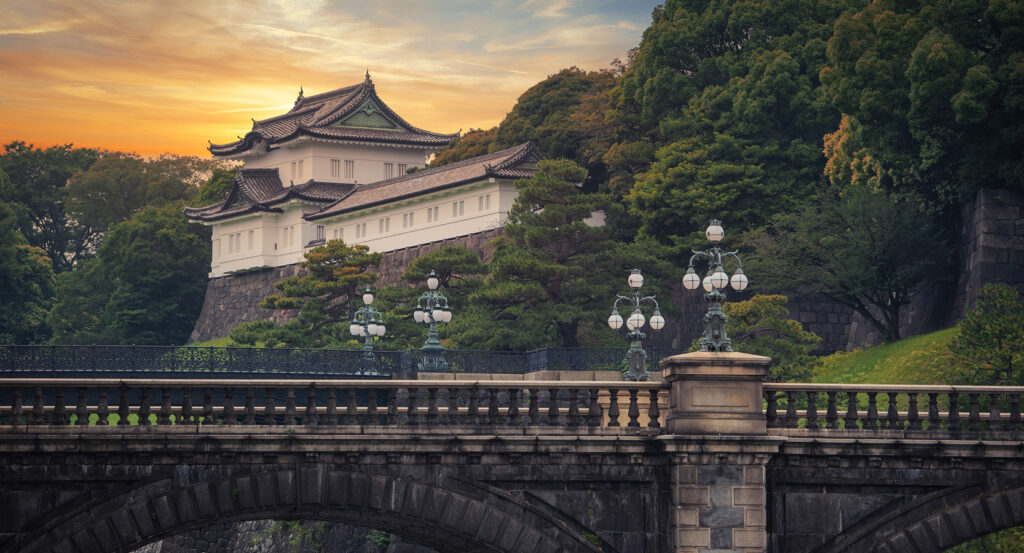
Why you should experience Imperial Palace Outer Grounds in Tokyo, Japan.
Imperial Palace Outer Grounds are a distinguished civic landscape where Marunouchi's imperial heritage, grand architecture, expansive green spaces, and centuries of Japanese history preserve the ceremonial heart of modern Tokyo.
Set along Uchibori-dori near Hibiya-dori and just steps from Nijūbashi Bridge, these expansive public grounds combine sweeping lawns, centuries-old stone ramparts, historic moats, pine-lined promenades, ceremonial plazas, and commanding views of the Imperial Palace that create one of Japan's most significant public landscapes. Meticulously maintained gardens, imposing defensive architecture, and broad open vistas provide an extraordinary contrast to the surrounding skyscrapers of Central Tokyo. The result is a destination defined by imperial history, civic grandeur, and exceptional urban design.
What you should know about Imperial Palace Outer Grounds.
Imperial Palace Outer Grounds are best known for preserving the ceremonial approaches to the Imperial Palace across 115 hectares of publicly accessible parkland surrounding the former Edo Castle, safeguarding some of Japan's most important surviving feudal fortifications while serving as the symbolic civic forecourt to the residence of the Emperor of Japan. The landscape occupies the outer defensive zone of Edo Castle, the immense fortress established by Ōta Dōkan in 1457 before its dramatic expansion under Tokugawa Ieyasu after 1590, when the castle evolved into the administrative center of the Tokugawa shogunate and the largest fortified complex in Japan. Following the Meiji Restoration of 1868, the castle became the Imperial Palace, while its outer compounds were gradually transformed into public ceremonial grounds that preserved the original moats, massive granite ramparts, defensive gates, and strategic spatial organization dating back more than four centuries. Today the Outer Grounds encompass internationally recognized features including the Nijūbashi bridges, the Kokyo Gaien National Garden, the Kusunoki Masashige equestrian statue, Sakuradamon Gate, and extensive gravel plazas used for state ceremonies and national celebrations. The surrounding stone walls, some exceeding 20 meters in height and assembled without mortar from enormous granite blocks transported from across feudal Japan, remain among the finest surviving examples of early Edo-period military engineering. The grounds also serve as one of Tokyo's most important ecological landscapes, supporting thousands of mature pine trees, seasonal cherry blossoms, carefully managed lawns, and extensive biodiversity while accommodating millions of visitors annually. Their position between the Imperial Palace, Marunouchi, Hibiya, and Otemachi creates a remarkable transition where Japan's political history, modern financial district, and grand public landscape converge within one of the world's most influential capital cities.
The architectural experience unfolds through grand stone fortifications, broad ceremonial axes, meticulously preserved moats, restrained landscape design, and carefully protected sightlines that emphasize the Imperial Palace. Every bridge, gate, retaining wall, and open plaza reflects centuries of refinement in Japanese military engineering, imperial planning, and landscape architecture. Ongoing conservation by the Imperial Household Agency and the Ministry of the Environment preserves the grounds as both a functioning ceremonial landscape and one of the world's finest surviving castle precincts, demonstrating how historic preservation, environmental stewardship, and civic planning have maintained an extraordinary balance between imperial tradition and the modern metropolis.
How to fold Imperial Palace Outer Grounds into your trip.
Imperial Palace Outer Grounds are best experienced as part of an exploration through Central Tokyo's celebrated civic landmarks.
Begin at Nijūbashi Bridge, where the Imperial Palace's most celebrated ceremonial entrance introduces the historic landscape before exploring the Imperial Palace Outer Grounds. Continue to the Imperial Palace East Gardens, whose beautifully preserved castle remains reveal the former heart of Edo Castle. Conclude at Marunouchi Naka-dori Street, where elegant architecture, luxury retail, and sophisticated public spaces provide a memorable finale celebrating Tokyo's remarkable fusion of imperial history and contemporary urban design. The progression moves naturally from Japan's imperial heritage to the preserved castle grounds before concluding within one of the world's foremost commercial districts, revealing why the Imperial Palace Outer Grounds remain the symbolic center of modern Tokyo.
Where your story begins.
Foresyte Travel reveals places that feel extraordinary long before you arrive.
Experience premium editorial crafted for luxury travelers.

















































































































