
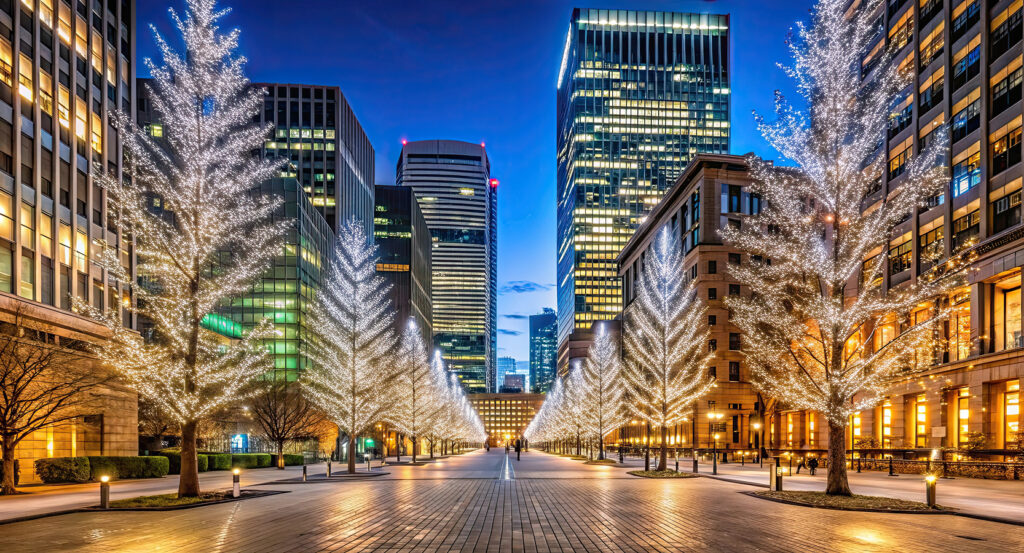
Why Marunouchi Naka-dori Street matters.
Marunouchi Naka-dori Street is an urbane pedestrian corridor where Marunouchi's financial gravity meets mature street trees, modern sculpture and a decades-long transformation of the roadway into one of Central Tokyo's most carefully cultivated public spaces.
Set along the spine of Marunouchi between Harumi-dori near Hibiya and Eitai-dori toward Otemachi and just steps from the Imperial Palace, the street runs parallel to Tokyo Station through the center of the district. Cobblestone paving, broad sidewalks and continuous rows of trees give the corridor a physical consistency even as its frontage shifts among postwar office blocks, preserved masonry and contemporary towers. Ground-floor boutiques, restaurants and cafes turn building edges toward the pavement, strengthening a street-level scale beneath architecture that rises far above it. Traffic restrictions periodically transfer substantial portions of the roadway to pedestrians, allowing tables, food trucks and seasonal installations to occupy space originally reserved for vehicles. The result is a central business street whose architecture, planting and changing use of the carriageway make walking part of Marunouchi's contemporary urban character.
What defines Marunouchi Naka-dori Street.
Marunouchi Naka-dori Street is best known for evolving from the principal roadway of a corporate office district into a pedestrian-oriented public corridor through more than half a century of physical redesign and cultural programming. Mitsubishi's relationship with the surrounding ground began in 1890, when it acquired more than 350,000 square meters of former Ministry of the Army property and began developing Marunouchi as a coordinated district. Mitsubishi Ichigokan followed in 1894 as the first office building in that project, initiating the red-brick business quarter later nicknamed Iccho London. An eight-year comprehensive reconstruction campaign completed in 1967 substantially altered the district and widened Naka-dori from 13 to 21 meters, expanded each sidewalk from four to six meters and moved electrical lines underground. A further shift began on September 16, 1970, when the section between the Kokusai and Marunouchi buildings closed to vehicles from noon until 1 p.m. as a luncheon promenade for local workers. Mitsubishi Estate and the Hakone Open-Air Arts Foundation introduced Marunouchi Street Gallery in 1972, initially placing only four or five sculptures along the corridor. Redevelopment around Marunouchi Building in 2002 widened pedestrian space again and accompanied a strategic change at street level as restaurants and international retail entered lower floors previously dominated by offices. The sculpture program expanded with that change, reached its fiftieth anniversary in 2022 and currently distributes works by artists including Jim Dine, Katsura Funakoshi, Kohei Nawa, Magdalena Abakanowicz and Henry Moore along and around Naka-dori. The Japan Society of Civil Engineers awarded Marunouchi Naka-dori its highest Civil Engineering Design Prize in 2013, recognizing a street whose successive redesigns had turned circulation infrastructure into a defining public realm for the district.
Marunouchi Street Park pushed that transformation beyond permanent paving and planting by testing the roadway itself as temporary civic space. The project began in May 2019 with a 100-hour vehicle restriction that converted part of Naka-dori into a park, laying natural grass across a strip seven meters wide and 100 meters long and adding tables, chairs, swings and a piano. The Peninsula Tokyo and Tokyo Station Hotel supplied food through the accompanying picnic program, and pianist George Nagata performed on the street, demonstrating how hospitality and live programming operated inside the former traffic lane. The first edition drew 100,000 participants, and subsequent iterations expanded from a single experiment into recurring spring, summer and winter programs. The initiative has continued through 2026, with the summer edition running from July 24 through August 23 and using greenery, picnic installations, street music and nighttime yoga as part of the seasonal program. A street first adapted for lunchtime pedestrian use in 1970 now supports a recurring experiment in how Central Tokyo roadway space operates when human occupation becomes its principal function.
How Marunouchi Naka-dori Street fits.
Marunouchi Naka-dori Street works as the anchor for a Marunouchi route through three nearby institutions that move from an Iwasaki family collection of Asian art through a museum created by one of twentieth-century Japan's major industrialists and into a railway gallery embedded inside Tatsuno Kingo's restored Tokyo Station.
Begin at Seikado Bunko Art Museum, whose collection originated with Iwasaki Yanosuke, Mitsubishi's second president and younger brother of founder Iwasaki Yataro. Yanosuke began collecting 1892 amid concern that Japanese and Chinese books and artworks were dispersing during the rapid embrace of Western culture, assembling paintings, calligraphy, ceramics, lacquerware, Buddhist sculpture, swords and tea utensils; his son Iwasaki Koyata expanded the holdings with particular strength in Chinese ceramics. Koyata established the Seikado Foundation in 1940, and the collection now encompasses 200,000 books and documents and 6,500 artworks, including seven National Treasures and 84 Important Cultural Properties. Its exhibition galleries moved into Meiji Seimei Kan in Marunouchi in 2022, returning the Iwasaki collection to the district profoundly shaped by Mitsubishi development. Continue to Idemitsu Museum of Arts, founded in 1966 by Idemitsu Kosan founder Idemitsu Sazo to present artworks he had assembled across more than 70 years. Architect Yoshiro Taniguchi designed its 2,531-square-meter ninth-floor setting inside the Teigeki Building with three exhibition rooms, a ceramic sherd room and a tea room; the collection grew to 15,000 objects spanning Japanese painting and calligraphy, Chinese, Japanese and Korean ceramics, Georges Rouault and archaeological ceramic fragments from sites extending to Fustat in Cairo. The institution reached five million admissions in 2016 after five decades of exhibitions, lectures and international scholarly exchange, connecting Marunouchi's corporate history with a major private collecting tradition. Conclude at Tokyo Station Gallery, established inside the Marunouchi Station Building in 1988 and reopened in 2012 following the station's major preservation project. Tatsuno Kingo designed the original 335-meter station building, which opened in December 1914 with a steel frame and millions of structural bricks; wartime bombing in May 1945 burned its interiors and destroyed the original roof, leaving carbonized wooden blocks and altered brick surfaces still visible within the gallery. Preservation work between 2007 and 2012 restored the lost third floor, and the museum now exposes original structural brick and steel alongside later reconstructed fabric, turning the station building itself into part of the collection encounter. The progression moves from Seikado Bunko Art Museum's preservation of the Iwasaki family collection through Idemitsu Museum of Arts' conversion of an industrial founder's private holdings into a public institution into Tokyo Station Gallery's union of art with the surviving fabric of Tokyo's 1914 central station, extending Marunouchi Naka-dori Street through three cultural institutions inseparable from the district's emergence as modern Tokyo.
Where your story begins.
Foresyte Travel reveals places that feel extraordinary long before you arrive.
Enjoy editorial crafted for luxury travelers.
Foresyte may earn a commission when you book.

















































































































