Why Hall of the Prisoners matters.
Hall of the Prisoners at Galleria dell'Accademia di Firenze in Florence is among the most powerful spaces in Renaissance art, a corridor where unfinished marble seems to breathe, struggle, and awaken before the eyes.
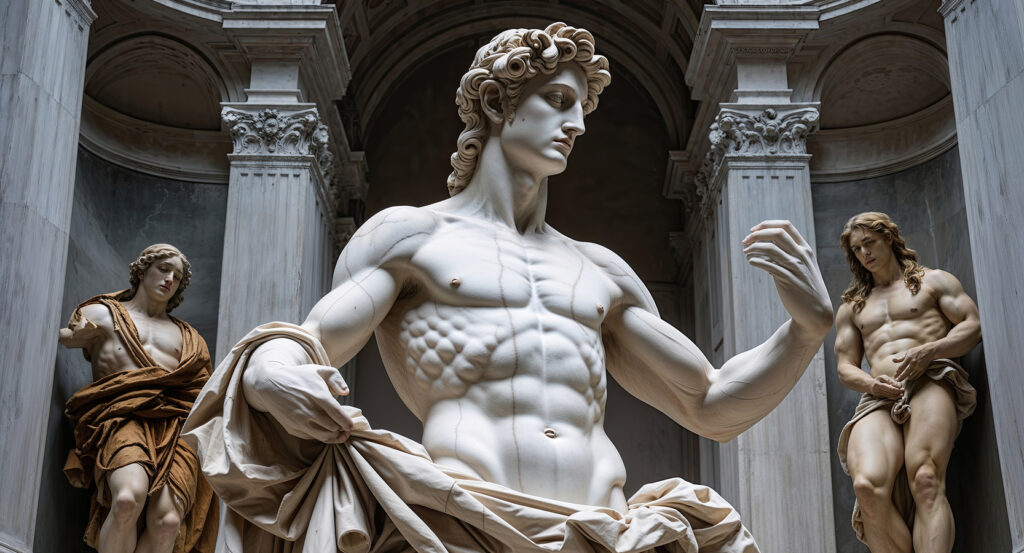
This long, luminous hall leads toward Michelangelo's David, but it's the journey itself that captures the soul. On both sides stand his Prisoners, also known as The Slaves, half-formed figures emerging from rough-hewn stone, their bodies twisting as if wrestling against their own creation. Their incomplete state isn't a flaw; it's Michelangelo's philosophy made visible. He believed the sculptor's task was not to build form but to liberate it, to release the spirit trapped within marble. Each Prisoner captures this idea in a visceral way: muscles strain, torsos twist, faces emerge from shadow, all suspended between existence and eternity. As light filters through the skylight above, it grazes the stone's texture, smooth flesh beside untouched rock, and the gallery becomes a meditation on freedom, struggle, and divine creation. Few experiences in Florence are as haunting or transcendent.
What defines Hall of the Prisoners.
Hall of the Prisoners was designed specifically to frame the resonant and artistic evolution of Michelangelo, to lead visitors from creative struggle to divine perfection.
The Prisoners were originally intended for the grand tomb of Pope Julius II, a project that consumed decades of Michelangelo's life and was never completed as planned. The four colossal figures, The Atlas Slave, The Bearded Slave, The Young Slave, and The Awakening Slave, date from different stages of that turbulent commission, each revealing the artist's shifting approach to form and expression. Their unfinished nature wasn't merely circumstantial; it became the visual language of Michelangelo's genius, the eternal tension between the human and the divine, the material and the spiritual. The Hall itself was constructed in the late 19th century to house David after his transfer from Piazza della Signoria, and the placement of the Prisoners along its length was deliberate. As visitors move down the corridor, they follow Michelangelo's path from incompletion to revelation, from the marble's resistance to the triumph of the fully realized David at the end. Few realize that the corridor's lighting was engineered to evoke the transition from shadow to light, echoing the soul's ascent toward enlightenment.
How Hall of the Prisoners fits.
Hall of the Prisoners works as a slow passage, a sacred prelude to David, but a masterpiece in its own right.
When you enter the Accademia Gallery, resist the instinct to rush toward the famous statue. Instead, let yourself linger among the Prisoners. Walk slowly from one figure to the next, observing how Michelangelo's chisel marks shift from rough gouges to delicate contours. Stand beside The Bearded Slave and trace the light as it moves across the marble's ridges, the tactile evidence of the artist's hand frozen in time. Visit early in the morning or late in the afternoon when the crowds thin, and the corridor's hush amplifies its meditative power. If you listen closely, the silence seems to vibrate with Michelangelo's own words: “I saw the angel in the marble and carved until I set him free.” After spending time here, when you finally turn the corner and see David bathed in light, you'll feel the full resonant arc of Michelangelo's vision, from creation to completion, from struggle to transcendence. Hall of the Prisoners at Galleria dell'Accademia di Firenze in Florence is not a mere gallery, it's a revelation in stone, where art becomes the act of liberation itself.
Where your story begins.
Foresyte Travel reveals places that feel extraordinary long before you arrive.
Enjoy editorial crafted for luxury travelers.
Foresyte may earn a commission when you book.