Why you should experience Grand Courts at Art Gallery of New South Wales in Sydney, Australia.
Grand Courts is where Sydney's Art Gallery of New South Wales reveals its classical soul, an awe-inspiring series of halls that bridge centuries of artistry and empire, philosophy and form.
Stepping into Grand Courts feels like crossing into another age. Vaulted ceilings soar above marble floors, and sunlight streams through clerestory windows to bathe Renaissance saints, Victorian muses, and marble gods in warm, reverent light. The atmosphere is hushed yet alive, each echo of a footstep carrying a sense of ceremony. Here, the great narrative of Western art unfolds in sweeping succession, from the religious passion of the Italian masters to the romantic drama of the 19th-century painters who sought to capture the sublime. Yet, despite its grandeur, this space never feels distant or elitist. The arrangement is human, designed for dialogue: between artist and viewer, between tradition and interpretation. Every corridor, every sculpture-lined alcove, tells the story of how beauty once defined civilization, and how that same ideal continues to evolve in Sydney's cosmopolitan present.
What you should know about Grand Courts at Art Gallery of New South Wales.
Behind the elegance of Grand Courts lies a curatorial triumph, a century-long effort to craft one of the Southern Hemisphere's most significant collections of European art.
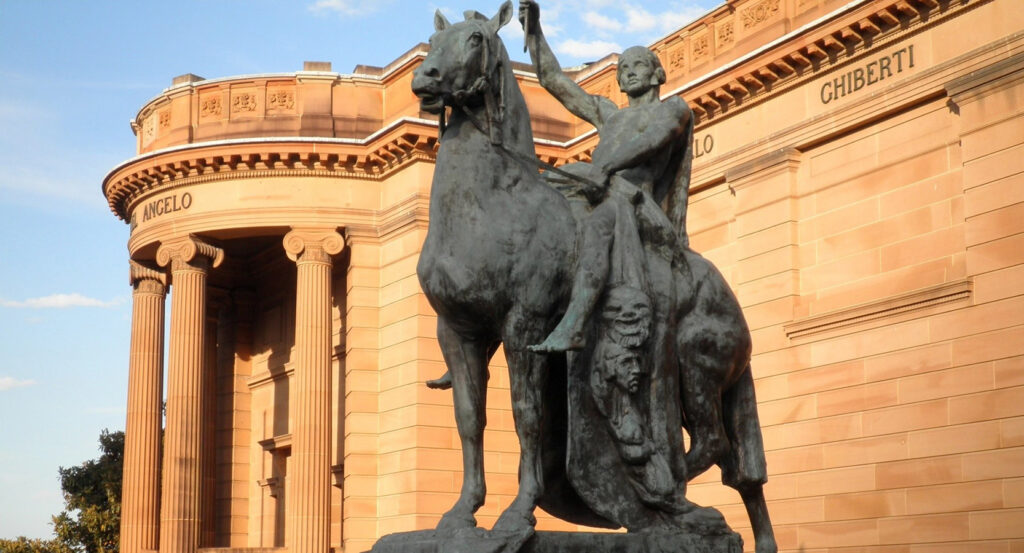
When the original Gallery building opened in 1897, its design was intentionally neoclassical: a civic temple of culture to reflect a young nation's cultural aspirations. Grand Courts became the stage for that vision. Here you'll find works by Goya, Rubens, and Tiepolo, alongside British luminaries like J.M.W. Turner and John Constable. But what distinguishes this collection is its curatorial evolution. Over time, the Gallery has reinterpreted Grand Courts, shifting from a purely Eurocentric canon toward a more inclusive narrative that acknowledges colonial history and the global circulation of artistic ideas. The sculptures and paintings, many of them gifts from early benefactors like Sir Edmund Barton and Sir William Dixson, reveal the ambitions of a colonial society seeking validation through European aesthetics. Yet today, these same works are read with new eyes, as part of a larger, complex story of cultural exchange, migration, and reinterpretation. The galleries also house a remarkable collection of decorative arts, religious iconography, and neoclassical sculpture that offer insights into craftsmanship as philosophy: how artisans once imagined divinity, virtue, and form through chiselled stone and luminous pigment. Few visitors realize that beneath the surface elegance of these rooms lies an intricate system of conservation engineering, temperature and humidity controlled to the degree, ensuring that centuries-old canvases continue to breathe in the humid Sydney air. Grand Courts have also hosted generations of artists and students, including those from the nearby National Art School, who once came here to sketch plaster casts and absorb technique through observation. Today, digital interpretive screens quietly accompany the old masters, layering context without intruding on atmosphere, a blend of past and present that feels perfectly balanced.
How to fold Grand Courts at Art Gallery of New South Wales into your trip.
Visiting Grand Courts is best approached like entering a cathedral, slowly, attentively, and with a willingness to be moved.
Begin your experience from the Gallery's main sandstone entrance on Art Gallery Road, and ascend the central staircase beneath its marble columns. As you pass through the first archway, the world narrows to color and form, vast canvases rise before you, each one commanding attention. Start on the left side of the courts to trace the Renaissance and Baroque eras, moving chronologically toward the Romantic and Victorian rooms that dominate the later galleries. Pause before the Italian masters, Titian, Canaletto, and Bellini, where chiaroscuro and perspective first learned to shape human emotion. Then drift toward the British landscapes, where Turner's light meets Constable's pastoral serenity, both capturing something of nature's divinity. Don't rush, the acoustics themselves encourage reflection, the faint hum of air conditioning echoing like distant chant. Around mid-gallery, pause near the marble sculptures: the drapery, carved so delicately it seems to move, is best admired under the midday light that filters through the skylights above. Plan the visit between 10 a.m. and 2 p.m., when the natural light enhances the paintings' textures. Take advantage of the benches placed throughout, sit for a few minutes before a favorite piece and simply let it work on you. If you're visiting on a weekday, guided tours often explore Grand Courts in conversation with Indigenous and contemporary galleries, offering context on how these classical ideals contrast with, and influence, Australia's visual evolution. Afterward, wander into the Gallery café or step out into The Domain gardens just beyond the portico, the breeze and greenery serve as a perfect counterpoint to the marble solemnity you've just left behind. In the quiet after the grandeur, you'll realize what makes Grand Courts timeless: not their opulence, but their humanity, art created in pursuit of the divine, and still speaking to it, centuries later.
Where your story begins.
Foresyte Travel reveals places that feel extraordinary long before you arrive.
Experience premium editorial crafted for luxury travelers.