Why HMAS Vampire matters.
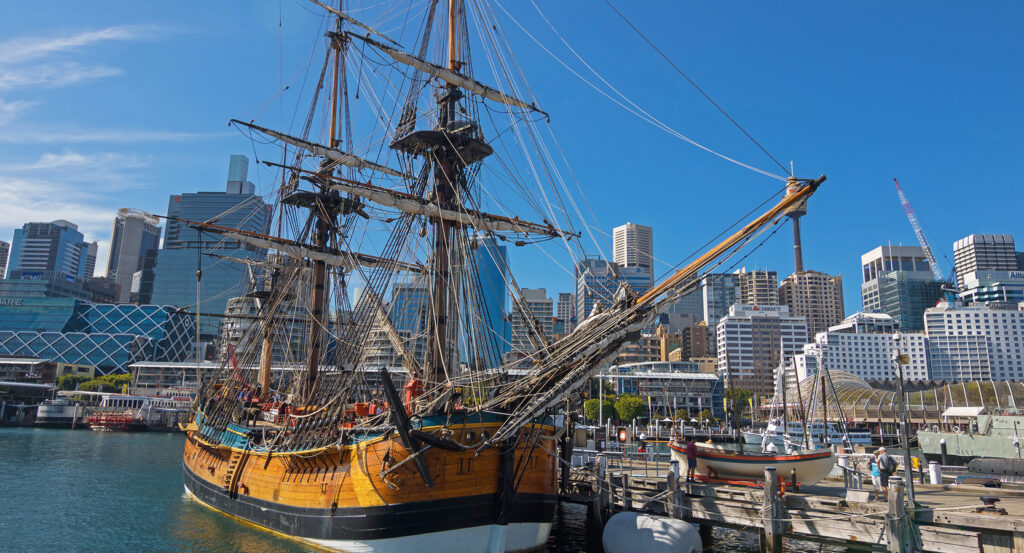
HMAS Vampire at Australian National Maritime Museum in Sydney stands proudly at the Darling Harbour wharf like a steel leviathan from another age, a relic of the Cold War that has shed none of its authority or elegance.
Step aboard, and you feel its purpose. The deck stretches wide beneath your feet, the breeze carries the faint scent of oil and salt, and the city skyline fades behind the towering gun turrets and antennae. HMAS Vampire is the last of Australia's big gun destroyers, a Daring-class warship launched in 1956 and commissioned into service in 1959, and walking her decks feels like crossing from the civilian world into a disciplined floating city. Every space hums with intention: the bridge with its gleaming brass instruments, the mess deck alive with stories of camaraderie, and the gunnery positions that once scanned horizons for threats unseen. Though she never fired in anger, her presence alone was deterrence, a symbol of postwar strength and readiness in an uncertain world. To stand here now is to trace the steel veins of Australia's naval history, feeling both the pride and gravity that come with a life at sea.
What defines HMAS Vampire.
HMAS Vampire is not merely a preserved warship, it's a tribute to engineering mastery, human endurance, and Australia's emergence as a maritime power.
Built in Sydney's Cockatoo Island Dockyard, HMAS Vampire represented the cutting edge of naval design in the 1950s. At 114 meters long and displacing over 3,500 tons, she could reach speeds exceeding 30 knots, powered by steam turbines that thundered with controlled precision. Her armament was formidable for its era: twin 4.5-inch gun turrets, anti-aircraft weaponry, depth charges, and torpedo tubes. She was the last ship of her kind to serve the Royal Australian Navy, marking the transition from conventional artillery warfare to missile-based defense. But beyond her weapons, HMAS Vampire was a living organism, home to a crew of over 320 men. Life aboard was equal parts discipline and endurance: long watches under the red glow of night operations, communal meals that forged unbreakable bonds, and the constant vibration of engines reminding every sailor that vigilance never slept. During the Vietnam War era, HMAS Vampire served as a training and escort vessel, guarding aircraft carriers and testing new naval systems. Later, she played a diplomatic role in regional goodwill tours across Southeast Asia and the Pacific, representing Australia's postwar confidence on the high seas. When decommissioned in 1986, her fate was uncertain, until she found new life as a centerpiece of the Australian National Maritime Museum. Today, she stands alongside the submarine HMAS Onslow, embodying two sides of naval life: one above the surface, commanding visibility; the other below, operating in silence. Few visitors realize that HMAS Vampire still carries many of its original fittings, even the captain's quarters remain untouched, complete with naval charts and photographs from mid-century voyages. Her massive radar array, once able to detect threats miles away, still rotates slowly on display, a ghost of vigilance persisting through time.
How HMAS Vampire fits.
HMAS Vampire works as part of a complete maritime journey, a bridge between the open ocean and the human stories it shaped.
Begin at the Australian National Maritime Museum's main building, where interactive exhibits provide background on Australia's naval heritage. From there, step outside into the sunlight of Darling Harbour and approach HMAS Vampire's grey hull, her name emblazoned in bold white letters. As you climb aboard, the museum's calm atmosphere gives way to the crisp, purposeful geometry of a warship. Follow the self-guided trail or join one of the museum's naval heritage tours, knowledgeable guides bring the vessel to life with stories of sailors who served on long patrols, moments of tension during the Cold War, and daily routines that defined discipline at sea. Spend time on the bridge, where commanding officers once plotted courses across the Pacific, then descend into the mess decks to glimpse the camaraderie of life below. Step into the engine room, a maze of pipes, boilers, and turbines, to feel the pulse that once drove this destroyer through rough seas. The soundscape installations subtly recreate the hum of machinery and the calls of the crew, immersing you fully. Late afternoon visits are especially striking, when the setting sun glints off the ship's steel and paints the harbor gold. Afterward, linger along the waterfront for panoramic views that remind you why Sydney remains one of the world's great maritime capitals. Pair your visit with the HMAS Onslow for contrast, destroyer above, submarine below, and end the day with a quiet drink at the harbor cafés, the ship's silhouette standing proudly against the fading sky. The HMAS Vampire isn't just an artifact of war; it's a living classroom of courage, precision, and endurance, a reminder that even in peace, strength must never sleep.
Where your story begins.
Foresyte Travel reveals places that feel extraordinary long before you arrive.
Enjoy editorial crafted for luxury travelers.
Foresyte may earn a commission when you book.