
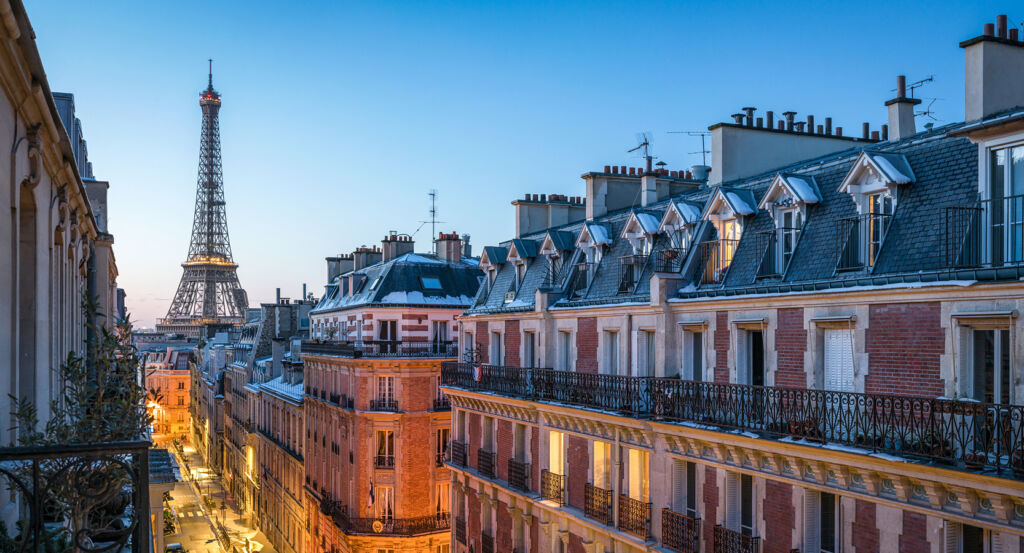
Why you should experience Avenue de la Bourdonnais in Paris, France.
Avenue de la Bourdonnais is an elegant Gros-Caillou corridor where military history, Belle Époque architecture, Parisian refinement, and grand landmarks converge along one of the capital's most distinguished Left Bank avenues.
Running through Gros-Caillou between Champ de Mars and École Militaire, this graceful avenue unfolds through elegant Haussmann residences, refined cafés, luxury hotels, neighborhood boutiques, tree-lined promenades, and beautifully proportioned streetscapes that embody the sophistication of the 7th Arrondissement. Broad sidewalks, stately limestone façades, flourishing chestnut trees, and uninterrupted views toward some of Paris' greatest monuments create an atmosphere where architectural harmony and neighborhood life coexist with remarkable elegance. Every stretch of the avenue reflects another chapter in the evolution of one of Paris' most prestigious residential districts. The result is a corridor defined by architectural distinction, historical significance, and one of the city's most graceful urban avenues.
What you should know about Avenue de la Bourdonnais.
Avenue de la Bourdonnais is best known for honoring Bertrand-François Mahé de La Bourdonnais, the celebrated eighteenth-century French naval commander and Governor-General of the Île de France (Mauritius), whose capture of Madras from the British in 1746 during the War of the Austrian Succession established him among France's greatest colonial military leaders despite his later political downfall. Opened during the nineteenth century as the Champ de Mars district expanded, the avenue became closely associated with the extraordinary transformation of western Paris surrounding the Expositions Universelles of 1867, 1878, 1889, and 1900, each of which reshaped the neighboring Champ de Mars into one of the world's foremost exhibition grounds. The boulevard's architectural character was permanently enhanced by the construction of the Eiffel Tower for the 1889 Exposition Universelle, designed by engineer Gustave Eiffel with chief engineers Maurice Koechlin and Émile Nouguier and architect Stephen Sauvestre, whose 324-meter iron structure revolutionized structural engineering and became the enduring symbol of Paris. The avenue also preserves an exceptional ensemble of late nineteenth-century Haussmannian and Belle Époque residential buildings whose harmonious façades reflect the elegant urban planning that accompanied the capital's international exhibitions and rapid modernization. Together, these military, engineering, architectural, and urban achievements establish Avenue de la Bourdonnais as one of the defining ceremonial corridors bordering the historic Champ de Mars district.
Grand residential architecture, beautifully landscaped promenades, and an enduring relationship with the world's most famous tower continue illustrating how the avenue evolved alongside Paris' emergence as an international center of engineering, architecture, and global exhibitions. The remarkable connection between La Bourdonnais' naval legacy, the succession of Universal Expositions, and the revolutionary construction of the Eiffel Tower demonstrates why the avenue remains one of the capital's most historically significant residential corridors. Few Parisian avenues combine military commemoration, engineering achievement, architectural elegance, and world exhibition history with such remarkable continuity.
How to fold Avenue de la Bourdonnais into your trip.
Avenue de la Bourdonnais works as an exploration through Gros-Caillou's celebrated monuments and historic civic spaces.
Begin at the Eiffel Tower, where the world's most recognizable monument introduces the extraordinary engineering legacy that defines the surrounding district before strolling along Avenue de la Bourdonnais beneath its elegant rows of trees. Continue through the Champ de Mars, whose expansive lawns preserve the historic setting of multiple Universal Expositions that transformed modern Paris. Conclude at the École Militaire, where Ange-Jacques Gabriel's grand eighteenth-century masterpiece provides a memorable finale celebrating the remarkable relationship between military history, architectural excellence, and French national heritage. The progression moves naturally from engineering innovation to exhibition history before culminating in one of France's finest military institutions, revealing why Avenue de la Bourdonnais remains one of Paris' most distinguished Left Bank avenues.
Where your story begins.
Foresyte Travel reveals places that feel extraordinary long before you arrive.
Experience premium editorial crafted for luxury travelers.














































































































