
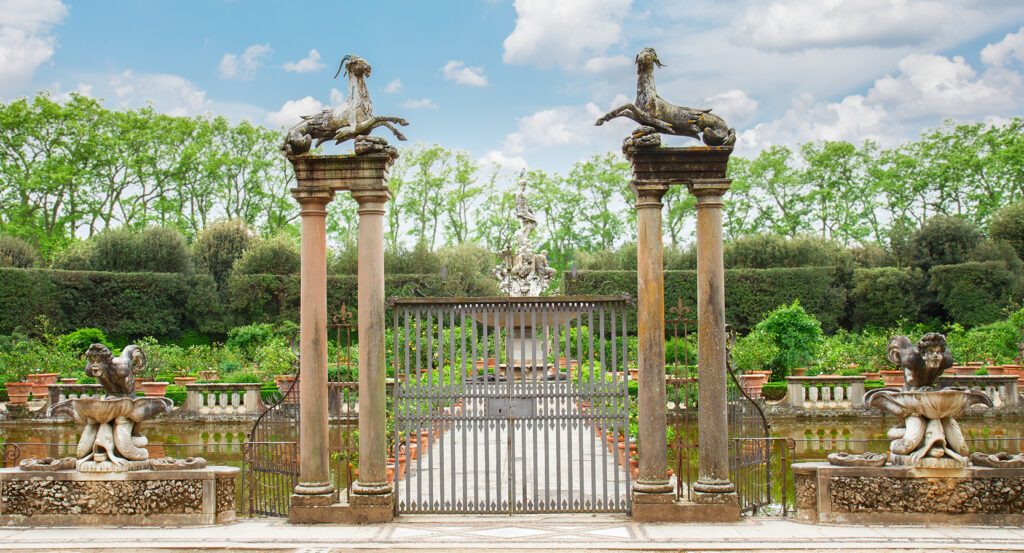
Why you should experience Anfiteatro di Boboli in Florence, Italy.
The Amphitheatre at the Boboli Gardens in Florence is where nature and pageantry converge, a grand stage that once set the scene for Medici splendor and the birth of Renaissance performance.
Carved into the hillside behind Palazzo Pitti, the amphitheatre was designed not merely for performance, but as an architectural metaphor, a theater of power where the Medici family could display their wealth, influence, and devotion to the arts. Standing at its center, you feel the precision of its design: a vast elliptical space ringed by terraces of stone and greenery, adorned with statues of classical gods and mythic creatures. Here, humanism met theatre, masques, ballets, and festivals unfolded under the open Tuscan sky, merging art and politics into living ceremony. Today, the amphitheatre retains that aura of grandeur. The sculpted tiers and central obelisk, brought from Luxor via Rome, draw the eye upward toward the palace façade, creating one of Florence's most cinematic perspectives. It's easy to imagine courtiers in velvet and gold filling the terraces, their laughter echoing through a garden built to immortalize the Medici name.
What you should know about Anfiteatro di Boboli.
The Amphitheatre was among the first permanent outdoor theaters of its kind in Europe, a prototype that would influence courtly entertainment across the continent.
Originally a simple quarry, the site was transformed in the mid-16th century by architect Niccolò Tribolo and later refined by Bartolomeo Ammannati, who used the natural slope of the land to craft a space that felt both organic and regal. Its marble statuary, sourced from Roman ruins, symbolized Florence's self-image as the heir to antiquity. In 1637, when Vittoria della Rovere married Ferdinando II de' Medici, the amphitheatre hosted lavish festivities, complete with fireworks, processions, and music that echoed across the valley. The Central Egyptian obelisk, installed in the 18th century, further elevated the space's symbolic geometry, aligning art, astronomy, and empire. Though time has softened its edges, the amphitheatre remains a profound artifact of Renaissance ideology, where landscape architecture became a form of political theatre, and the Florentine elite performed their power beneath the open sky.
How to fold Anfiteatro di Boboli into your trip.
To truly experience the Amphitheatre, approach it slowly, let the space reveal itself as you ascend from the lower gardens.
Enter through the main Palazzo Pitti gates and follow the central axis toward the amphitheatre's heart, where the symmetry of stone, grass, and sculpture draws you into the Medici world. Visit in the early morning for golden light slanting across the statues, or near sunset when the marble glows warm and the surrounding terraces empty into quiet. Take a seat on the upper steps and absorb the perspective, Florence sprawled below, the palace towering behind, and the obelisk centered like a sundial of history. If you're lucky, you might catch a seasonal performance or art installation that reanimates the space much as it was intended centuries ago. Afterward, continue your walk toward the Viottolone avenue for a shaded descent into the garden's deeper paths. The Amphitheatre at the Boboli Gardens isn't just a relic; it's a living echo of the Medici imagination, proof that art, when given space to breathe, can transform even the earth itself into a stage.
Where your story begins.
Foresyte Travel reveals places that feel extraordinary long before you arrive.
Experience premium editorial crafted for luxury travelers.




















































































































