
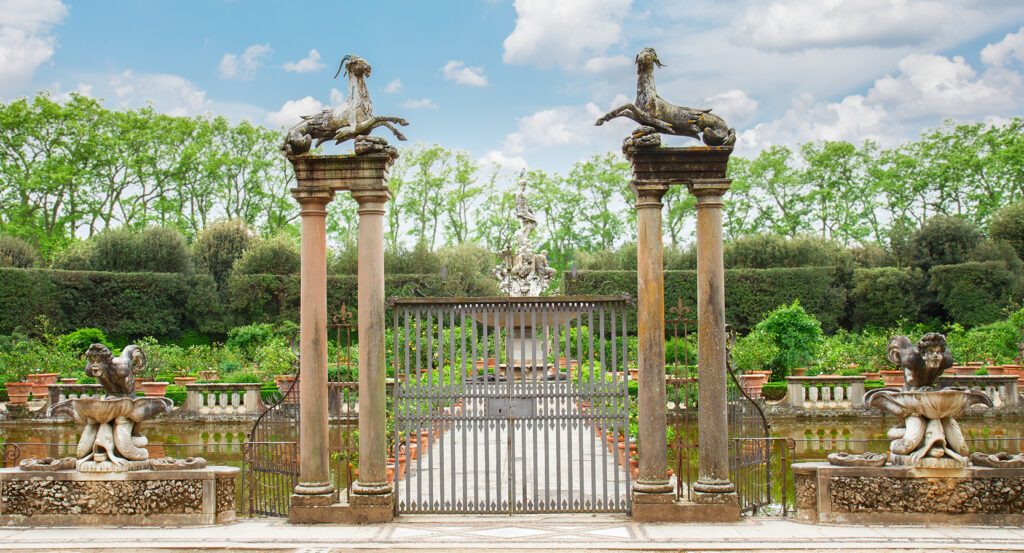
Why you should experience Viale dei Cipressi in Florence, Italy.
Viale dei Cipressi, or Viottolone Avenue, at Boboli Gardens in Florence is among the most majestic garden walks in Europe, a grand, tree-lined axis that feels less like a path and more like a slow descent through time.
Stretching from the upper terraces near the Amphitheatre down toward the Isolotto Basin, Viale dei Cipressi (meaning “large avenue”) captures the Renaissance obsession with geometry, perspective, and control over nature. Each step down the gravel slope feels choreographed, rows of cypresses and statues rhythmically framing your view, light dappling across centuries-old stone, and the faint whisper of the wind weaving through the foliage. The Medici family envisioned this avenue not merely as a walkway, but as a symbolic procession route, a path where courtiers could promenade beneath the living architecture of the landscape. Designed by Niccolò Pericoli and refined by Alfonso Parigi the Younger in the 17th century, it remains an unparalleled example of how landscape design can evoke grandeur through simplicity. Walking it today, you feel what the Renaissance masters understood so deeply: that order itself can be profoundly poetic.
What you should know about Viale dei Cipressi.
Viale dei Cipressi is not just a garden path, it's a masterpiece of spatial illusion, crafted to manipulate perspective and guide the eye toward the horizon.
Its design reflects the influence of both Roman triumphal roads and Baroque scenography, combining disciplined symmetry with theatrical effect. Along its route stand dozens of statues, Roman deities, allegories of the seasons, and personifications of virtues, each chosen to embody the Medici ideal of enlightened rule. The avenue's alignment was carefully calculated to draw the viewer's gaze toward the Isolotto Basin, a man-made island symbolizing paradise reclaimed by art. The gentle descent conceals complex hydraulic systems beneath the ground that once powered fountains and irrigated the garden. During grand festivals, the Viottolone served as the ceremonial route for processions, its perspective amplifying the sense of performance as guests approached the glittering water at its end. Even the trees themselves were once part of this design language, pruned to form living walls that both enclosed and elevated the experience. It's a corridor of history and intention, proof that nature can be shaped into philosophy.
How to fold Viale dei Cipressi into your trip.
Viale dei Cipressi is best experienced slowly, it's a walk meant for contemplation, not haste.
Begin at the Amphitheatre behind Palazzo Pitti, then follow the main axis downward until the noise of Florence fades behind you. The further you walk, the more the garden opens, statues emerge from the shadows, the air cools beneath the canopy, and the geometry of the path begins to reveal its quiet perfection. Visit in the early morning or late afternoon, when the cypress trees cast long shadows and the statues glow softly in angled light. Bring water and take breaks on the stone benches along the way; this is a place to breathe deeply and listen to the garden's rhythm. At the base of the avenue, you'll reach the Isolotto Basin, where the Fountain of the Ocean gleams beneath the open sky, the symbolic destination of this great descent. Before you leave, turn around and look back up the Viottolone: its sweeping symmetry and elevated calm encapsulate the genius of the Boboli Gardens. It's not just a walk, it's a Renaissance sermon written in trees, stone, and light.
Where your story begins.
Foresyte Travel reveals places that feel extraordinary long before you arrive.
Experience premium editorial crafted for luxury travelers.




















































































































