Why Ca' Rezzonico matters.
Ca' Rezzonico is an elegant palace museum where Dorsoduro's aristocratic heritage, Venetian artistry, eighteenth-century splendor, and the grandeur of the Serenissima preserve the city's final golden age in extraordinary detail.
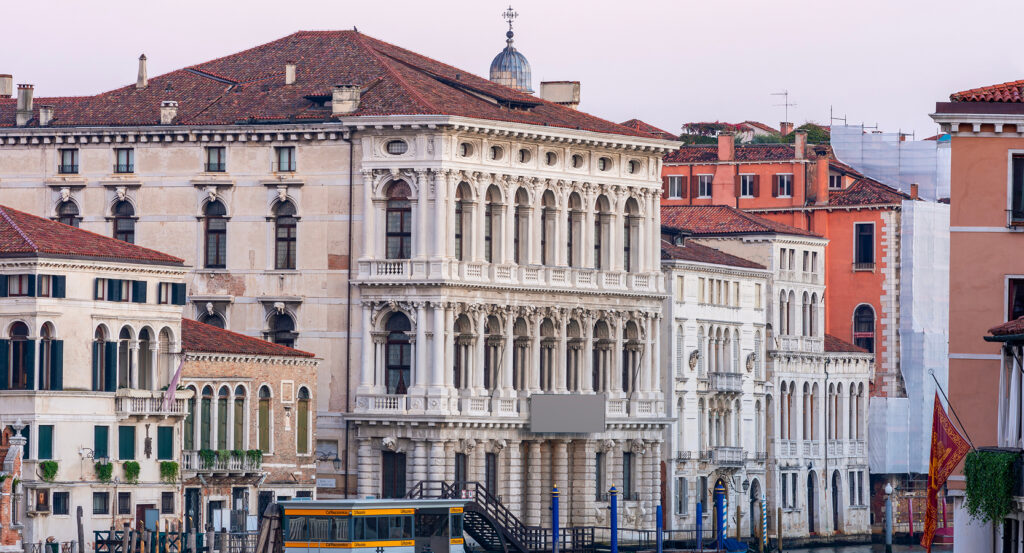
Set along the Grand Canal near Rio di San Barnaba and just steps from Campo San Barnaba, this stately residence welcomes visitors through opulent ceremonial halls, frescoed ceilings, sculpted salons, and richly furnished apartments where the refined world of Venice's patrician elite unfolds across one of the city's finest Baroque palaces. Marble staircases, glittering chandeliers, carved woodwork, and masterful decorative programs immerse every gallery in the elegance of the eighteenth century while canal-front façades continue reflecting across the water as they have for generations. Architecture, painting, sculpture, and decorative arts coexist in harmonious discussion throughout every floor. The experience ultimately unites artistic brilliance, aristocratic life, and Venetian history into one of the city's most rewarding museum experiences.
What defines Ca' Rezzonico.
Ca' Rezzonico is best known for preserving Venice's greatest collection dedicated to eighteenth-century life inside the expansive Grand Canal palace begun by Baldassare Longhena 1649 for the Bon family before construction stalled for decades, later acquired by the Rezzonico family in 1751, completed by Giorgio Massari, and transformed into one of the Republic's most lavish aristocratic residences after Carlo Rezzonico became Pope Clement XIII in 1758. Longhena's original Baroque vision was expanded by Massari through a grand ceremonial staircase, grand ballroom, canal-facing reception rooms, and richly decorated apartments that reflected the immense wealth and political influence achieved by the Rezzonico family during Venice's final century as an independent republic. Following the family's decline, the palace passed through several owners before the City of Venice acquired the building in 1935, opening it as the Museum of Eighteenth-Century Venice in 1936 to preserve the artistic, social, and cultural world of the Serenissima. The museum houses exceptional masterpieces by Giambattista Tiepolo, Giandomenico Tiepolo, Pietro Longhi, Francesco Guardi, Rosalba Carriera, and Canaletto alongside period furniture, Murano chandeliers, lacquered furnishings, porcelain, sculpture, and decorative arts that collectively recreate the sophistication of Venetian noble life. Among its most celebrated spaces are Giambattista Tiepolo's expansive ceiling frescoes, the reconstructed Pharmacy of Ai do San Marchi, exquisitely preserved reception rooms, and Antonio Guardi's decorative ensembles, while the palace's upper floor safeguards the poignant fresco cycle transferred from Giandomenico Tiepolo's Villa Zianigo, including the internationally celebrated scenes of Pulcinella that stand among the final masterpieces of Venetian painting before the fall of the Republic in 1797. Continuing conservation, scholarly research, and meticulous restoration preserve one of Europe's most complete interpretations of eighteenth-century aristocratic culture within its original architectural setting.
Grand reception halls, luminous frescoes, exquisitely crafted furnishings, and richly ornamented interiors reveal how architecture, painting, sculpture, and decorative arts combined to express the prestige of Venice's ruling families during the republic's final century. Historic apartments, ceremonial spaces, intimate galleries, and carefully reconstructed period rooms allow visitors to experience daily life, artistic patronage, and social ritual with exceptional authenticity. Ongoing preservation, curatorial research, and conservation safeguard the palace's collections while continually enriching understanding of Venice's artistic and cultural legacy. Refined architecture, extraordinary collections, and enduring historical significance combine to establish one of Italy's finest palace museums.
How Ca' Rezzonico fits.
Ca' Rezzonico works as the centerpiece of an exploration through Dorsoduro's celebrated artistic and cultural treasures.
Begin at Campo San Barnaba, where one of Dorsoduro's most atmospheric squares introduces the neighborhood's historic character before entering Ca' Rezzonico to experience Venice's aristocratic eighteenth century. Continue to Gallerie dell'Accademia, whose incomparable collection of Venetian painting deepens appreciation for the artists represented throughout the palace. Conclude at Basilica Santa Maria della Salute, where soaring Baroque architecture overlooking the Grand Canal provides a memorable finale celebrating the artistic and architectural achievements that defined Venice at the height of its cultural influence. The progression moves naturally from neighborhood life to noble splendor before concluding through one of the city's greatest sacred monuments, revealing why Dorsoduro remains Venice's foremost district for experiencing art and history together.
Where your story begins.
Foresyte Travel reveals places that feel extraordinary long before you arrive.
Enjoy editorial crafted for luxury travelers.
Foresyte may earn a commission when you book.