Why Castel Sant'Angelo matters.
Castel Sant'Angelo is a commanding fortress where Borgo's papal legacy, imperial ambition, centuries of military power, and Rome's layered history culminate in one of the city's defining experiences.
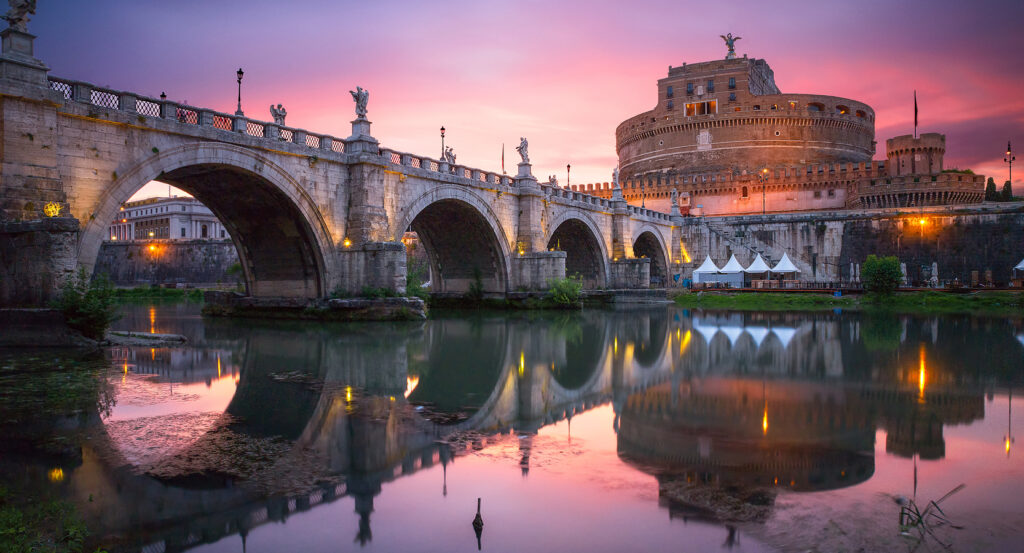
Set along Lungotevere Castello near Ponte Sant'Angelo and just steps from St. Peter's Basilica, this immense stronghold carries visitors through ascending spiral ramps, fortified walls, papal apartments, hidden passageways, frescoed chambers, prison cells, and open terraces before revealing a sweeping view across the Tiber and Rome's historic center. Every level uncovers a different era, shifting seamlessly from Emperor Hadrian's final resting place to a defensive citadel, a papal refuge, and a museum preserving nearly two thousand years of history. Standing beneath the bronze Archangel Michael, the city unfolds as churches, bridges, domes, and ancient streets stretch toward every horizon. The experience is defined by imperial ambition, papal authority, military engineering, and an unmatched sense of historical continuity.
What defines Castel Sant'Angelo.
Castel Sant'Angelo is best known for beginning construction under Emperor Hadrian in AD 123 as his dynastic mausoleum before its completion under Antoninus Pius in AD 139, becoming the burial place of Hadrian, Sabina, Antoninus Pius, Marcus Aurelius, Commodus, and several members of the Nerva-Antonine dynasty before Emperor Caracalla's ashes were interred in AD 217. Incorporated into the Aurelian Walls around AD 271, the structure evolved from an imperial tomb into one of Rome's most strategically important military fortresses before Pope Nicholas III commissioned the fortified Passetto di Borgo in 1277, creating a protected elevated corridor linking the castle directly with the Apostolic Palace. The fortress famously sheltered Pope Clement VII during the Sack of Rome in 1527 while goldsmith and sculptor Benvenuto Cellini claimed to have helped defend its walls, after which Popes Alexander VI, Julius II, Paul III, and Paul IV expanded the complex with angular bastions, Renaissance apartments, ceremonial halls, artillery positions, and defensive works that established it as the papacy's principal refuge, treasury, prison, and military headquarters. Named after the tradition that Pope Gregory the Great witnessed the Archangel Michael sheathing his sword above the mausoleum at the end of the plague in AD 590, the castle preserves one of the world's most complete records of continuous architectural adaptation from Imperial Rome through the Renaissance.
The interior reveals successive building campaigns that remain clearly legible across nearly nineteen centuries of construction. Hadrian's immense cylindrical concrete core still supports Renaissance loggias, papal apartments decorated by Perin del Vaga and artists from Giulio Romano's circle, medieval defensive corridors, prison cells that once confined figures including Giordano Bruno and Giuseppe Balsamo, known as Count Cagliostro, and artillery terraces overlooking the Tiber. Visitors ascend the original helical funerary ramp constructed for imperial funeral processions before passing through military chambers, state apartments, chapels, armories, and panoramic terraces, experiencing Roman engineering, Renaissance patronage, papal politics, military strategy, and urban history within a single structure whose purpose continually evolved.
How Castel Sant'Angelo fits.
Castel Sant'Angelo works as the centerpiece of an exploration through Rome's papal and imperial history.
Begin at Ponte Sant'Angelo, where Gian Lorenzo Bernini's angel sculptures establish a memorable approach across the Tiber before entering Castel Sant'Angelo. Continue to St. Peter's Basilica, whose vast interior and centuries of papal history deepen appreciation for the castle's role as the Vatican's principal refuge during periods of conflict. Conclude at Piazza Navona, where Bernini's Fountain of the Four Rivers, Baroque palaces, and lively cafés provide a fitting finale to a journey shaped by emperors, popes, artists, and the enduring story of Rome. The progression moves naturally from sculptural mastery to imperial history before concluding within one of the city's finest public squares, revealing why Castel Sant'Angelo remains essential to understanding Rome.
Where your story begins.
Foresyte Travel reveals places that feel extraordinary long before you arrive.
Enjoy editorial crafted for luxury travelers.
Foresyte may earn a commission when you book.