Why Ernest Hemingway Home and Museum The Caribbean.
Ernest Hemingway Home and Museum is a historic literary residence where Old Town Key West's nineteenth-century architecture meets the creative legacy of one of America's most influential novelists and the preservation of his island household.
Occupying a walled property along Whitehead Street, directly opposite the Key West Lighthouse and a short distance from Duval Street, the museum stands within the residential blocks connecting Bahama Village with the southern end of Old Town. The two-story limestone house rises above a tropical garden of palms, flowering shrubs, and mature shade trees, with broad verandas, green shutters, and an elevated entrance giving the property a commanding presence along the street. The interior opens into a succession of high-ceilinged rooms furnished with antique furniture, decorative objects, and personal possessions, allowing the arrangement of the household to emerge through its original domestic spaces. Outside, brick and stone pathways connect the residence with secluded garden areas, a separate writing studio, and a large swimming pool whose geometric form contrasts with the surrounding vegetation. The result is an exceptionally preserved literary residence whose architecture and domestic surroundings provide a direct encounter with Hemingway's life during his most productive years in Key West.
What defines Ernest Hemingway Home and Museum.
Ernest Hemingway Home and Museum is best known as the Key West residence where Ernest Hemingway spent much of the 1930s, producing major works of American literature during a period of extraordinary professional achievement and personal upheaval. The property originated in 1851 as the residence of Asa F. Tift, a prosperous marine architect and salvage operator whose commercial activities belonged to the maritime economy that supported nineteenth-century Key West. Tift constructed the substantial Spanish Colonial house using native limestone quarried from the property, creating a durable residence distinguished by its elevated foundations and broad exterior galleries. Its masonry construction departed from the timber houses prevalent throughout the island, giving the building an enduring architectural character. Hemingway first arrived in Key West with his second wife, Pauline Pfeiffer, in April 1928, traveling from Paris through Havana before reaching the island aboard a steamship. The couple initially stayed at the Trev-Mor Hotel on Simonton Street as they waited for a Ford automobile to arrive from the mainland. Hemingway used the unexpected interruption to complete revisions to A Farewell to Arms, the novel whose publication in 1929 secured his position among the leading American writers of his generation. The couple returned to Key West during subsequent winters and developed friendships within the island's fishing and commercial communities. Charles Thompson, proprietor of a local hardware store, became an important companion and introduced Hemingway to the offshore fishing grounds of the Florida Straits. Thompson and his wife Lorine also developed a lasting friendship with Pauline, strengthening the Hemingways' attachment to the island. In 1931, Pauline's uncle Gus Pfeiffer purchased the deteriorating Tift residence for the couple, beginning a substantial restoration that transformed the neglected property into their permanent American household. The renovation incorporated European antiques acquired during the Hemingways' years abroad, combining the building's nineteenth-century architecture with furnishings associated with their earlier life in Paris. Hemingway established a disciplined morning writing schedule in a second-floor studio above a detached carriage house, separating his literary work from the household's social activities. His years at the property coincided with the publication of Death in the Afternoon in 1932, a substantial examination of Spanish bullfighting and its cultural traditions. The short-story collection Winner Take Nothing followed in 1933, extending his exploration of conflict, isolation, and personal endurance through tightly constructed fiction. Hemingway traveled to East Africa during 1933 and 1934, gathering experiences that shaped Green Hills of Africa, published in 1935, and the short stories The Short Happy Life of Francis Macomber and The Snows of Kilimanjaro, both published in 1936. His Key West years also produced To Have and Have Not in 1937, a novel whose central character, Harry Morgan, operates a fishing boat between Key West and Cuba during the economic hardship of the Great Depression. The book incorporated the maritime geography, smuggling economy, and social divisions Hemingway encountered through his relationships with island residents. His growing involvement in the Spanish Civil War brought extended absences from Key West and introduced him to journalist Martha Gellhorn, whose relationship with the writer contributed to the dissolution of his marriage to Pauline. The couple divorced in 1940, ending Hemingway's principal period of residence at the house as he established a new household with Gellhorn. Pauline retained the property until her death in 1951, preserving its association with the family through the following decade. The house subsequently entered a new chapter under Bernice Dixon, whose preservation efforts transformed the former private residence into a public literary institution. Dixon opened the Ernest Hemingway Home and Museum in 1964, establishing a permanent destination devoted to the writer's Key West years and the surviving physical environment of his household. The property's designation as a National Historic Landmark in 1968 recognized its national literary and architectural significance. Its preservation also attracted architectural attention through the Historic American Buildings Survey, which produced measured drawings and photographs of the residence for the Library of Congress. The museum's development transformed a private nineteenth-century house into one of the country's most important surviving literary residences, connecting Hemingway's work with the island community that shaped a consequential period of his career.
How Ernest Hemingway Home and Museum fits.
Ernest Hemingway Home and Museum works as the literary centerpiece for an exploration connecting Key West's maritime navigation history, its nineteenth-century federal institutions, and the development of its twentieth-century literary community.
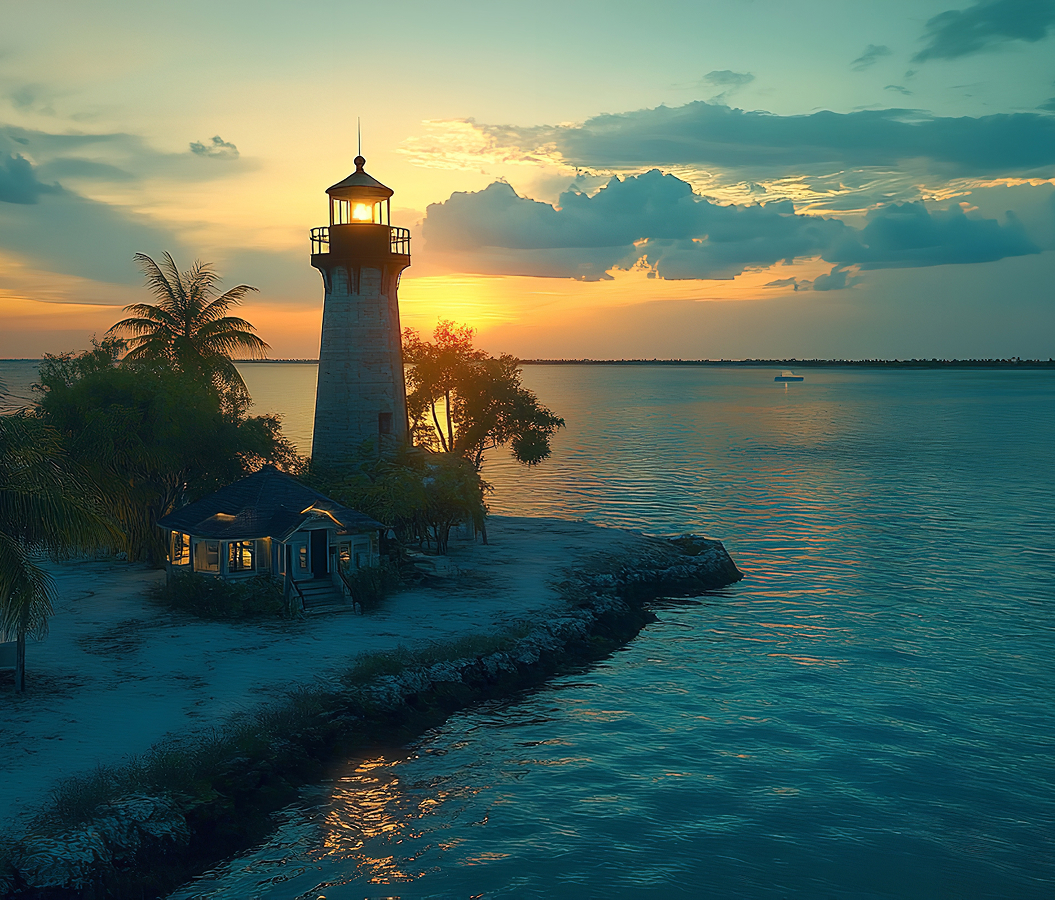
Begin at Key West Lighthouse and Keeper's Quarters Museum, the historic maritime station whose surviving tower stands opposite the Hemingway property. The original Key West lighthouse entered service in 1825, providing navigational guidance for vessels approaching the island through the surrounding reefs and shipping channels. The Great Havana Hurricane of 1846 destroyed that structure, prompting construction of a replacement tower farther inland that entered service in 1848. Barbara Mabrity, who had assumed responsibility for the original light following her husband's death in 1832, continued her service through the rebuilding period and became one of the earliest prominent female lighthouse keepers in American maritime history. The tower received a third-order Fresnel view in 1858 and underwent a substantial height increase in 1894 as surrounding buildings and trees began obstructing its visibility. The station ceased operating as an active lighthouse in 1969, and its preserved keeper's residence subsequently became part of a museum devoted to the island's maritime heritage. Continue to Key West Museum of Art & History at the Custom House, the substantial federal building constructed during the expansion of Key West's nineteenth-century commercial economy. The United States Treasury authorized a larger customs facility in 1885, responding to the demands created by the island's shipping, salvage, and international trade activities. Architect William Kerr designed the Romanesque Revival structure, whose construction began in 1889 and reached completion in 1891. The building accommodated federal customs offices, the United States District Court, and the post office, bringing several important government functions into a single waterfront institution. Proceedings associated with the 1898 sinking of USS Maine in Havana Harbor formed part of the building's federal judicial history. The United States Navy subsequently occupied the property during the twentieth century, and its addition to the National Register of Historic Places in 1973 helped secure its preservation. Conclude at Tennessee Williams Museum, an institution devoted to the playwright whose decades in Key West helped establish the island as an important center of American literary culture. Tennessee Williams first visited Key West in 1941 and developed a lasting attachment to the island following the Broadway success of The Glass Menagerie in 1945. His subsequent play A Streetcar Named Desire premiered on Broadway in 1947, earning the Pulitzer Prize for Drama and strengthening his international reputation. Williams purchased a residence on Duncan Street in 1949, maintaining the property as his principal American home for more than three decades. The museum preserves photographs, first editions, personal correspondence, theatrical memorabilia, and a typewriter associated with his work. A scale model of the playwright's residence provides an architectural connection to the private setting where he pursued his literary career. The progression moves from Key West Lighthouse and Keeper's Quarters Museum's maritime navigation history through the Custom House's federal commercial institutions and culminates at Tennessee Williams Museum, connecting the island's nineteenth-century development with its emergence as an important center of twentieth-century American literature.
Where your story begins.
Foresyte Travel reveals places that feel extraordinary long before you arrive.
Enjoy editorial crafted for luxury travelers.