
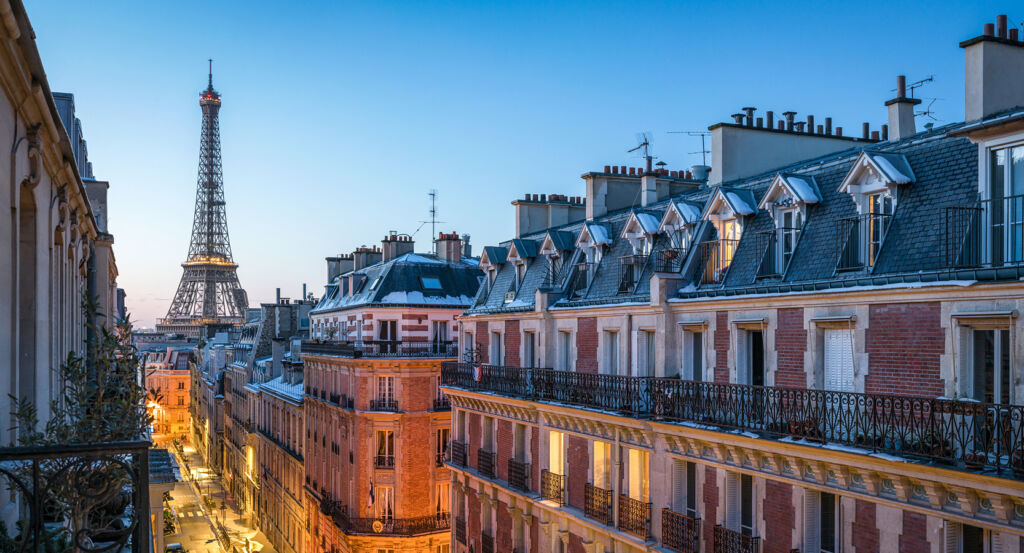
Why Four Seasons Hotel George V matters.
Four Seasons Hotel George V is a cultivated palace hotel where Champs-Élysées's couture authority, Art Deco confidence, transatlantic glamour and culture of exacting craftsmanship converge within a 1928 hotel conceived from its first day for an international Paris.
Set along Avenue George V near Avenue des Champs-Élysées and just steps from Avenue Montaigne, the hotel was financed by American businessman Joel Hillman and designed by Lefranc and Georges Wybo with innovations including telephones connected directly outside the hotel, two bathrooms in suites and dumbwaiters engineered to deliver hot food efficiently from the kitchens. By 1930, the George V even operated a three-seat Farman aircraft connecting guests with London, Madrid and Berlin, while offices in Cherbourg received Americans arriving aboard transatlantic liners before continuing to Paris. Four Seasons reopened the property in 1999 after a two-year renovation, with Pierre-Yves Rochon establishing the classical French interior style he has continued refining across the building for more than a quarter century. The result is a hotel where Hillman's obsession with modern hospitality and Rochon's long creative stewardship allow nearly a century of luxury innovation to feel like one continuously evolving idea.
What defines Four Seasons Hotel George V.
Four Seasons Hotel George V is best known for opening in 1928 as an eight-story Art Deco hotel financed by Joel Hillman, designed by Lefranc and Georges Wybo and originally managed by André Terrail of La Tour d'Argent, before Four Seasons reopened it in 1999 following a two-year renovation led internally by Pierre-Yves Rochon's classical French design language. The contemporary property contains 243 accommodations, including 183 guestrooms and 60 suites, while Rochon recently completed another three-year reinvention of the entire inventory using patinated oak Versailles parquet, Carrara marble, Baccarat crystal, Charles Burger and Dedar textiles, Houlès trimmings and hand-tufted rugs. Beneath those rooms, Cave Roc descends 14 metres into a former limestone quarry associated with stone used for Arc de Triomphe, its six-metre vaults surviving after the cellar was walled up during World War II and now holding one of the property's defining wine collections. Artistic Director Jeff Leatham adds an ephemeral counterpoint to the building's stone and marble through a floral program encompassing 9,000 flowers, turning botanical composition into an unusually consequential component of the George V's visual identity.
Christian Le Squer extends that culture of authorship through Le Cinq, where his three MICHELIN stars reached a tenth consecutive year in the 2026 MICHELIN Guide France after a career that previously included twelve consecutive three-star years at Pavillon Ledoyen. Simone Zanoni leads Le George through a Mediterranean and Italian vocabulary, while Alan Taudon directs L'Orangerie, giving the three restaurants six MICHELIN stars collectively in the 2026 Guide and concentrating three independently recognized culinary identities inside one hotel. Pierre-Yves Rochon's latest accommodation chapter includes the new duplex Parisian Eiffel Tower Suite created from two former technical rooms, alongside a reworked Penthouse Suite with three private terraces, Baccarat lighting and gold-leaf ceilings. Together, Christian Le Squer, Simone Zanoni, Alan Taudon and Pierre-Yves Rochon demonstrate the principle that has kept Four Seasons Hotel George V culturally relevant since 1928: architecture, cuisine and decorative craft are treated as authored disciplines worthy of continual reinvention.
How Four Seasons Hotel George V fits.
Four Seasons Hotel George V works as the anchor for an afternoon tracing how fashion, modern art and technological ambition turned the surrounding Golden Triangle into one of twentieth-century Paris's great laboratories of creative prestige.
Begin at Musée Yves Saint Laurent Paris, where Yves Saint Laurent moved his couture house into a Second Empire hôtel particulier in 1974, directing six or seven studio collaborators and 200 atelier workers there until 2002 before the building became his namesake museum in 2017. Continue to Palais de Tokyo, created for the 1937 Exposition Internationale as two museums divided between eastern and western wings, then repeatedly reinvented until its 2012 rehabilitation made the western wing Europe's largest contemporary-art center. Conclude at Musée d'Art Moderne de Paris with Raoul Dufy's 1937 La Fée Électricité, a 600-square-metre composition assembled from 250 panels for Robert Mallet-Stevens's Palais de la Lumière et de l'Électricité and transferred permanently to the museum in 1964. The progression moves from Saint Laurent's working couture house through the architectural ambitions of the 1937 exposition into Dufy's enormous synthesis of art, science and electricity, revealing the creative seriousness beneath the polished surface surrounding Four Seasons Hotel George V.
Where your story begins.
Foresyte Travel reveals places that feel extraordinary long before you arrive.
Enjoy editorial crafted for luxury travelers.
Foresyte may earn a commission when you book.














































































































