Why Four Seasons Hotel Miami matters.
Four Seasons Hotel Miami is a tropical urban resort where Brickell's financial energy meets a 70-story tower, Fernando Botero sculpture and a two-acre rooftop landscape above Biscayne Bay.
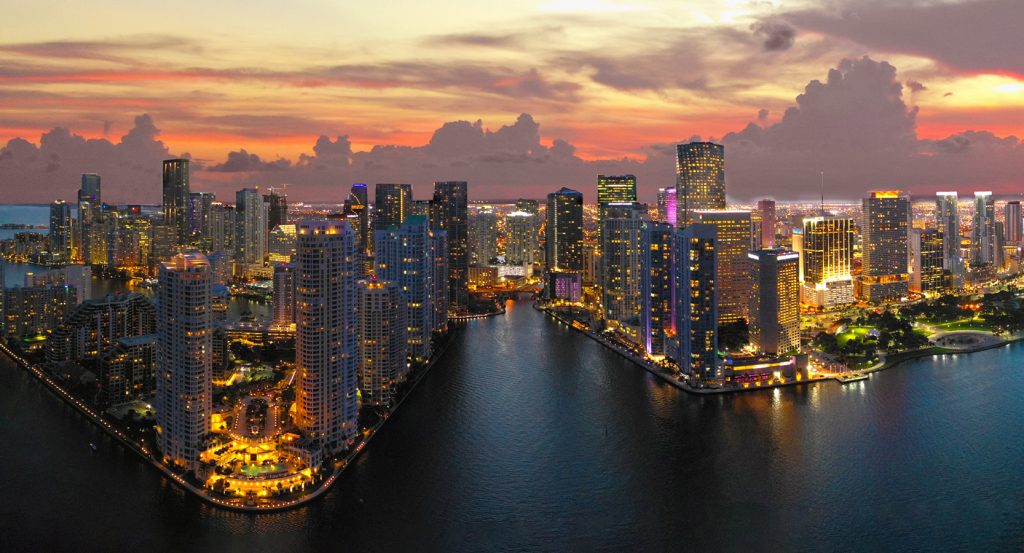
Set along Brickell Avenue near Southeast 14th Street and just steps from Biscayne Bay, the hotel occupies a prominent position between Miami's financial district, Brickell Key and the waterfront routes leading toward Downtown. The tower rises above a district shaped by international commerce, residential development and the subtropical geography of South Florida. Arrival unfolds through bronze sculptures, elevated public spaces and broad views that place the city skyline against palms and open water. A two-acre rooftop sanctuary adds a separate landscape of pools, hammocks and royal palms above the urban grid. The result is a hotel where Miami's vertical development, tropical ecology and international culture converge within one exceptionally concentrated address.
What defines Four Seasons Hotel Miami.
Four Seasons Hotel Miami is best known for establishing a major urban resort within a 70-story tower that opened in October 2003 at the center of Brickell's transformation into Miami's financial district. Gary E. Handel and Associates and Brumello & Partners shaped the building's architecture, placing hotel rooms, residences and public facilities within a vertical composition rising above Brickell Avenue. The hotel contains 221 guestrooms and suites, including 182 rooms and 39 suites, across the eighth through twenty-ninth floors. Eighty-four residential units occupy floors 40 through 70, giving the tower a dual hospitality and residential identity. Four Seasons placed its lobby on the seventh floor, creating an elevated arrival level between the city street and the hotel's rooftop landscape. The property's 70-story height made it one of the most prominent towers in Miami when it opened and tied the hotel to Brickell's emergence as a global business district. Frank Nicholson and Tara Bernerd developed interiors that combine mid-century elegance, polished urban materials and references to Florida's natural landscape. The building operates as a vertical cross-section of Miami, with public dining, hotel rooms, private residences and tropical recreation stacked within one tower. Four Seasons Hotel Miami's significance rests on this combination of high-rise development and resort planning, a structure that turns a dense financial district into a destination with its own landscape and cultural identity.
Fernando Botero gives Four Seasons Hotel Miami its most recognizable artistic presence through three expansive bronze sculptures positioned across the property. Adam and Eve stand in the arrival lobby, each rising close to 12 feet and establishing a human scale within the tower's high-rise entrance. Seated Woman occupies the seventh-floor lobby and weighs 1,985 pounds, giving the elevated arrival level a dense sculptural center. Botero's rounded figures introduce a Colombian artistic voice into a hotel whose design also draws on Miami's Caribbean and Latin American cultural geography. The sculptures change the way the building is encountered by placing art at thresholds, circulation points and gathering spaces rather than confining it to a gallery. EDGE Brasserie and Cocktail Bar extends that cultural program into food through regional dishes shaped by the many communities that fabricate Miami's cuisine. Bahia adds a northern Mediterranean menu beside the pool, connecting olive oil, seafood and rosé with the hotel's subtropical setting. Executive Chef Edouard Deplus oversees the culinary program, joining the hotel's sculpture, dining and landscape into one Miami-centered composition. Four Seasons Hotel Miami treats art, food and tropical space as fundamental parts of its public identity.
How Four Seasons Hotel Miami fits.
Four Seasons Hotel Miami works as the architectural anchor for an outing connecting Miami's civic memory, the migration history preserved in a former newspaper tower and the private Mediterranean estate that shaped the city's cultural landscape.
Begin at Museum of Miami, founded in 1940 as the Historical Association of Southern Florida and developed into the city's principal institution for regional history. Its collections contain more than 40,000 three-dimensional artifacts, from prehistoric archaeology to twentieth-century Afro-Cuban ritual objects, alongside an Archives and Research Center holding more than 2 million historical images. The institution moved into the Dade Cultural Center in 1984, joined the Smithsonian Affiliations Program in 2011 and became Museum of Miami in 2026. Continue to Freedom Tower, completed in 1925 as the headquarters and printing plant of The Miami News. From 1962 to 1974, the building served as the Cuban Refugee Center, assisting hundreds of thousands of Cubans arriving in the United States. Miami Dade College received the tower in 2005, and National Historic Landmark status followed in 2008. Conclude at Vizcaya Museum and Gardens, the Biscayne Bay estate James Deering built between 1914 and 1922 with architect F. Burrall Hoffman, designer Paul Chalfin and landscape architect Diego Suarez. Deering began winter residence in 1916, and the gardens developed over eight years through Italian and French models, coral-stone sculpture, parterres and transplanted royal palms. The progression moves from Museum of Miami's preservation of collective memory through Freedom Tower's transformation from newspaper headquarters into a refuge for Cuban exiles and culminates at Vizcaya Museum and Gardens, connecting Miami's civic archive, migration history and private architectural ambition within one carefully ordered itinerary.
Where your story begins.
Foresyte Travel reveals places that feel extraordinary long before you arrive.
Enjoy editorial crafted for luxury travelers.
Foresyte may earn a commission when you book.