
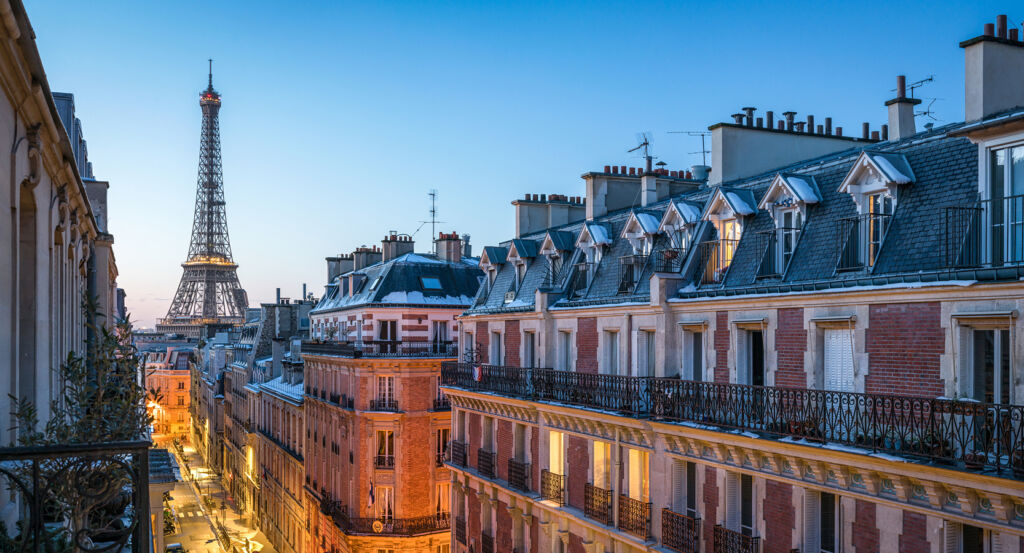
Why Hôtel de Londres Eiffel matters.
Hôtel de Londres Eiffel is a characterful hotel where Gros-Caillou's residential Parisian character meets a building associated with the Eiffel Tower's construction era, three decades of Prigent family stewardship and an unusually personal interpretation of French domestic design.
Set along Rue Augereau near Rue du Gros Caillou and just steps from the shops and food merchants of Rue Cler, the hotel occupies a narrow Left Bank parcel within the compact street network between École Militaire and the Seine. The vertically proportioned building follows the intimate scale of Rue Augereau, placing its traditional Parisian façade directly against a street largely insulated from the expansive dimensions of the surrounding avenues. French wall fabrics, parquet, patterned textiles and individually selected furniture give the interiors a layered residential character shaped through successive interventions by the owning family. Poet-named spaces and carefully differentiated decorative schemes extend that treatment through a building whose constrained historic proportions remain legible beneath its later modernization. The result is a hotel whose small-scale architecture and highly individualized interiors preserve the physical character of a residential Parisian house within the expansive western section of the 7th Arrondissement.
What defines Hôtel de Londres Eiffel.
Hôtel de Londres Eiffel is best known for becoming the second Parisian hotel acquired by Isabelle and Hervé Prigent, whose family hospitality enterprise has governed the Rue Augereau property since 1997. The couple entered Paris hospitality in 1991 through Apollon Montparnasse, establishing the business six years before taking control of Hôtel de Londres Eiffel. Their second acquisition brought them into Gros-Caillou and a building whose history reaches back to the period surrounding construction of the Eiffel Tower, with the structure originally built to house workers associated with Gustave Eiffel's immense iron project. Isabelle Prigent assumed particular responsibility for shaping the property, applying her interest in decoration to a hotel conceived with the intimacy of a French family house. The Prigents subsequently expanded their holdings across the Left Bank through Signature Saint-Germain-des-Prés in 2012, placing Hôtel de Londres Eiffel inside a small collection of individually conceived Paris properties. Their first Montparnasse hotel was sold in 2018, concentrating the family business around Londres Eiffel and its Saint-Germain counterpart. Nos Maisons Parisiennes subsequently formalized the collection and the principles the Prigents had developed through decades of independent hotel ownership. Maison Chomel joined the family group in 2022, extending that model to another historic Left Bank address. Adrien Prigent entered the business after working as a notary, bringing a second generation into ownership alongside Isabelle and Hervé. The Rue Augereau property occupies a foundational position within the Prigent enterprise, connecting the couple's early expansion in the 1990s with a family collection that has developed across multiple Left Bank neighborhoods.
How Hôtel de Londres Eiffel fits.
Hôtel de Londres Eiffel works as an anchor for an outing connecting Paris's oldest surviving American congregation, Louis XIV's extraordinary collection of military topographical models and the national order through which Charles de Gaulle commemorated the people and units central to France's liberation.
Begin at American Church in Paris, whose history began in 1814 when American Protestants organized worship in private Paris residences before moving to the Oratoire du Louvre. Napoleon III formally recognized the congregation in 1858, one year after its first dedicated sanctuary opened near the Champs-Élysées. Expansion eventually carried the institution to Quai d'Orsay, where construction of its permanent church began in 1926. The 1931 sanctuary follows a fifteenth-century Gothic plan and incorporates hand-carved Hungarian oak. The congregation survived the German occupation despite military requisition of parts of the complex, and later speakers included Martin Luther King Jr. and Jesse Jackson. Continue to Musée des Plans-Reliefs, whose collection originated in 1668 when Louis XIV's war minister, the Marquis de Louvois, created three-dimensional models of fortified places for military strategy. Louis XIV transferred the collection to the Louvre's Grande Galerie in 1700, and the surviving models moved to the upper levels of Hôtel des Invalides in 1777. Prussian forces seized 19 models after Napoleon's defeat in 1815, and production of new fortified-city models ended in 1870. Historical and artistic recognition replaced their original strategic purpose, leading to monument protection in 1927 and creation of the museum in 1943. The collection preserves three centuries of fortification, topography and French territorial planning. Conclude at Musée de l'Ordre de la Libération, devoted to the national order Charles de Gaulle created on November 16, 1940 to recognize exceptional contributions to the liberation of France. De Gaulle installed the Order at Hôtel des Invalides in 1967, placing its institutional memory within the military complex begun under Louis XIV. The museum followed in 1970 and organizes its collection around Free France, the internal Resistance and deportation. Personal objects donated by Companions and their families became the foundation of holdings that include uniforms, clandestine publications, flags and wartime communications equipment. A comprehensive reconstruction completed in 2016 reorganized more than 2,000 pieces across 1,200 square meters. The progression moves from an expatriate religious institution shaped across two centuries through the physical tools of Bourbon military strategy and culminates in a national collection preserving individual acts of resistance, wartime service and liberation.
Where your story begins.
Foresyte Travel reveals places that feel extraordinary long before you arrive.
Enjoy editorial crafted for luxury travelers.














































































































