
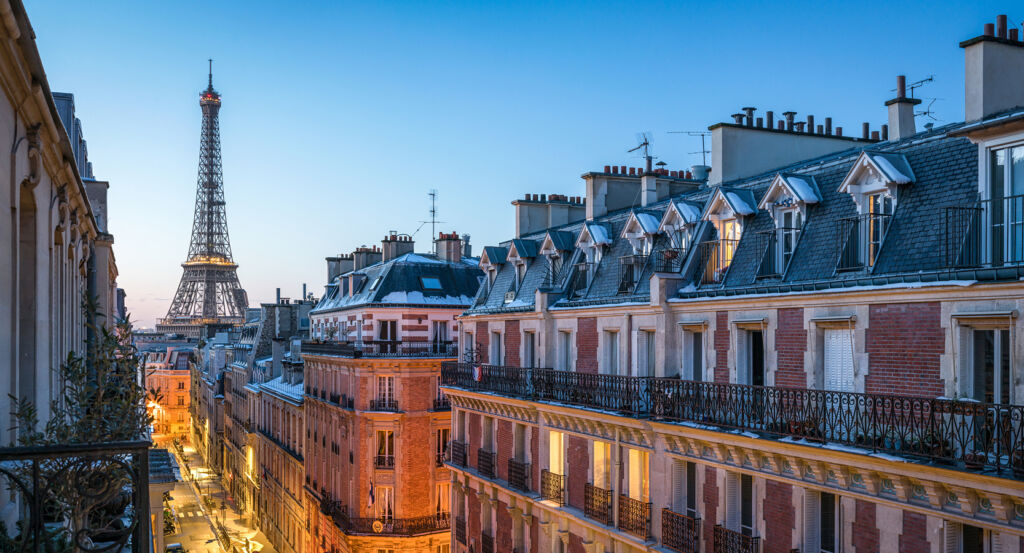
Why Hôtel Le Cercle Eiffel Tower matters.
Hôtel Le Cercle Eiffel Tower is an intimate hotel where Gros-Caillou's residential character meets a late nineteenth-century Parisian building, the former Hôtel Eber Mars and a family hospitality group centered on three independently operated addresses near the Eiffel Tower.
Set along Avenue de la Bourdonnais near Avenue Bosquet and just steps from Rue Cler, the hotel occupies a narrow Gros-Caillou parcel within the rectilinear street network extending between the École Militaire precinct and the Seine. The masonry building belongs to the 1851-1914 construction period and presents the regular vertical window arrangement, iron balcony work and mansard roofline characteristic of the surrounding avenue. A comprehensive 2020 reconstruction brought contemporary interiors into that inherited envelope through pale wall finishes, dark joinery, brass accents and geometric decorative details. Street-facing balconies create a direct architectural relationship with Avenue de la Bourdonnais and the expansive western Paris skyline beyond its rooftops. The result is a compact independent hotel whose physical history joins the nineteenth-century development of Gros-Caillou with a twenty-first-century family hospitality group concentrated around the Eiffel Tower.
What defines Hôtel Le Cercle Eiffel Tower.
Hôtel Le Cercle Eiffel Tower is best known for transforming the longstanding Hôtel Eber Mars into the flagship address of the family-run Frenchotels collection through a complete 2020 reconstruction and new name. The building at 117 Avenue de la Bourdonnais arose during the broad 1851-1914 construction period that gave this section of the 7th Arrondissement much of its surviving masonry streetscape. Hôtel Eber Mars operated from the address for decades and became closely associated with its proprietor, Monsieur Eber, during its independent chapter. Hotels Eber began its corporate life in 2001 with Hôtel Eber Mars as the principal establishment at 117 Avenue de la Bourdonnais and Hôtel Eber Monceau as a second Paris operation. The Monceau establishment left that company in 2007, concentrating the Eber business at the Bourdonnais property. A €3.85 million transaction transferred the commercial property at 117 Avenue de la Bourdonnais in March 2020 during the decisive year of its reinvention. The building underwent a complete reconstruction that same year and emerged under the Hôtel Le Cercle Eiffel Tower name. The change retained the property's three-star positioning and longstanding hospitality function as a new decorative program replaced the Eber Mars presentation. Frenchotels subsequently placed Le Cercle alongside Hôtel de la Paix in Gros-Caillou and Villa Nicolo in Passy, creating a compact collection spanning both banks of the Seine around the Eiffel Tower. Le Cercle became the group's principal address and the headquarters contact point for the wider collection, giving the former Eber Mars a new institutional role inside a multigenerational family enterprise.
Frenchotels connects Le Cercle with a family hospitality tradition carried across generations and concentrated in small Paris properties. Hôtel de la Paix occupies a second 7th Arrondissement address on Rue du Gros Caillou, tying the group particularly closely to the residential streets east of the Champ de Mars. Villa Nicolo extends the collection across the Seine into Passy, creating a three-property geography organized around distinct residential districts surrounding the Eiffel Tower. Le Cercle occupies the central position in that group through both the Bourdonnais address and the Frenchotels headquarters contact associated with the property. The 2020 reconstruction gave that position a new architectural language based on a contemporary interpretation of the Parisian townhouse. Art Deco references appear through geometric forms, metallic detailing and contrasting dark and pale surfaces across the reconstructed interiors. Balconies on the upper elevations retain the building's relationship with Avenue de la Bourdonnais and frame outward views across the district. The surviving Haussmannian-era street façade keeps the reconstruction tied to the nineteenth-century building from which the former Eber Mars developed. Frenchotels links three independently styled properties through one family enterprise, with Le Cercle occupying the foundational Bourdonnais position where an older independent hotel was comprehensively remade for the group's contemporary chapter.
How Hôtel Le Cercle Eiffel Tower fits.
Hôtel Le Cercle Eiffel Tower works as the residential anchor for an outing connecting Louis XV's royal military academy, Louis XIV's extraordinary collection of fortified-city models and a parish church shaped by two centuries of Gros-Caillou expansion.
Begin at École Militaire, founded by Louis XV in 1751 to educate young officers and developed under Ange-Jacques Gabriel on the Grenelle plain. Gabriel conceived an extensive classical complex whose Central Château became the architectural focus of a military institution that opened during the 1760s. Étienne-Louis Boullée and Alexandre-Théodore Brongniart contributed to later construction phases as the site expanded beyond Gabriel's original work. Napoleon Bonaparte entered the school in 1784 and completed the artillery course the following year, giving the institution a direct connection with the officer who later transformed European military history. Monument Historique protection encompasses the complex and its successive eighteenth and nineteenth-century architectural campaigns. Continue to Musée des Plans-Reliefs, whose collection began in 1668 when Louvois commissioned three-dimensional models of fortified places for Louis XIV's military planning. Dunkirk, Ath and Lille belonged to the earliest subjects, and Vauban's 1697 inventory captured a royal collection built around strategic knowledge of fortifications and terrain. The models moved to the Louvre in 1700 and reached the Invalides in 1777, where their immense scale required the upper galleries of the military complex. Public access began in 1799, production continued through the nineteenth century and the museum itself was created in 1943. Surviving models preserve an exceptional three-dimensional record of fortified European cities between Louis XIV and Napoleon III. Conclude at Église Saint-Pierre-du-Gros-Caillou, whose origins reach into the seventeenth-century growth of the settlement that gave the surrounding quarter its name. A first stone was laid in 1733, and Jean-François Chalgrin later worked on a replacement before the unfinished church disappeared during the Revolution. Étienne-Hippolyte Godde designed the neoclassical successor begun in 1822, creating the building that survives on Rue Saint-Dominique. Jean-Sylvain Bailly, astronomer and first mayor of Paris during the Revolution, was ultimately buried beneath its pavement. Later interventions included Victor Baltard's nineteenth-century work and Paul Vimond's twentieth-century chapel, giving the church architectural layers extending far beyond Godde's original campaign. Monument Historique protection followed in 1975. The progression moves from royal military education through three-dimensional fortification science and culminates in the parish architecture of the civilian district that developed alongside these immense state institutions.
Where your story begins.
Foresyte Travel reveals places that feel extraordinary long before you arrive.
Enjoy editorial crafted for luxury travelers.
Foresyte may earn a commission when you book.














































































































