
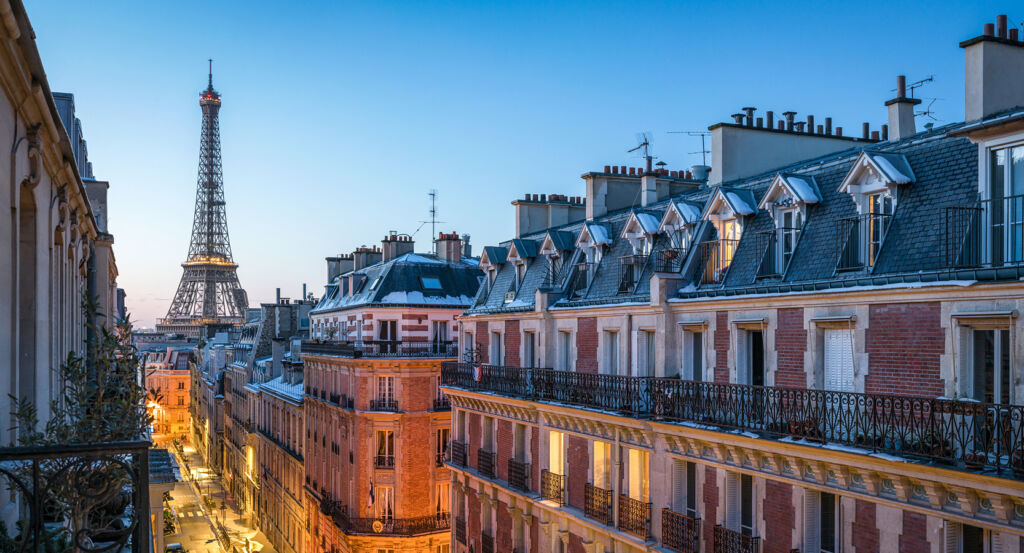
Why you should experience Hôtel Marignan Champs-Élysées in Paris, France.
Hôtel Marignan Champs-Élysées is an artful five-star hotel where Champs-Élysées's couture culture, private-house refinement, cinematic heritage and contemporary design authorship converge within Pierre Yovanovitch's interpretation of a Parisian residence.
Set along Rue de Marignan near Avenue Montaigne and just steps from Avenue des Champs-Élysées, the hotel occupies a historic house inside the Golden Triangle, where Yovanovitch's complete 2012 redesign reduced a former 70-room configuration to 50 rooms and suites while treating the interiors with the proportions and individuality of private apartments. Marble and oak establish the material style across accommodations arranged through irregular volumes, while several upper-level categories open toward the Eiffel Tower and Paris skyline. The Marignan Eiffel Suite concentrates that residential approach within 70 square meters on the sixth floor, adding a 50-square-meter private terrace with an unobstructed Eiffel Tower perspective, while a dedicated screening room gives cinema an unusually prominent place within the property. The result is a hotel where Pierre Yovanovitch's residential design, private terraces and cinematic culture give the Golden Triangle a hospitality character connected to the fashion, art and creative authorship surrounding it.
What you should know about Hôtel Marignan Champs-Élysées.
Hôtel Marignan Champs-Élysées is best known for its complete 2012 reinvention by Pierre Yovanovitch, whose first hotel project transformed a historic property from 70 smaller guestrooms into 50 larger rooms and suites conceived as individual Parisian apartments. Nathalie Richard, an heir to the Cafés Richard family, acquired the property and selected Yovanovitch for the reconstruction, which used graphic marble, oak, custom furnishings and restrained references to 1970s design while exploiting the building's atypical volumes rather than imposing a standardized room plan. The contemporary inventory comprises 45 rooms and five suites, with the 70-square-meter Marignan Eiffel Suite occupying the sixth floor alongside a 50-square-meter private terrace, while additional suites preserve unusually high ceilings and Eiffel Tower perspectives across the upper levels. Yovanovitch also incorporated a dedicated cinema into the hotel, and the current 70-square-meter screening room accommodates 50 people with a high-definition projector and screen while converting for presentations, private events and dancing. The reduction from 70 rooms to 50, Yovanovitch's first hotel commission, the 70-square-meter Eiffel Suite, its 50-square-meter terrace and a purpose-designed 50-seat cinema established Hôtel Marignan Champs-Élysées as a particularly concentrated expression of residential-scale French design within the Golden Triangle.
Makoto Nakada develops the property's contemporary culinary authorship through Ma Dame, where the Japanese chef draws on experience at Le Grand Véfour to reinterpret French cooking through seasonal market produce, precise presentation and Japanese inflections. Pastry chef Eri Hazama extends Ma Dame's character through desserts including her interpretation of tarte Tatin, while architect Carole Pfeiffer conceived the restaurant around vegetation and dried flowers, creating an interior inspired by woodland and connecting the culinary program with another distinct layer of design authorship. Ma Dame itself carries a historical reference to Claude de France, first wife of François I, whose association with the 1515 Battle of Marignano connects the restaurant's name to the same event behind the Marignan identity, while the hotel's event program extends across a 90-square-meter salon accommodating 80 for cocktails and the cinema accommodating 50. Makoto Nakada, Eri Hazama, Carole Pfeiffer and Pierre Yovanovitch give the contemporary property multiple layers of individual authorship across cuisine, pastry, restaurant design and hospitality interiors, allowing creative direction to remain central to Hôtel Marignan Champs-Élysées more than a decade after its 2012 reconstruction.
How to fold Hôtel Marignan Champs-Élysées into your trip.
Hôtel Marignan Champs-Élysées works as the anchor for an afternoon tracing the exhibition architecture, haute couture authorship and fashion preservation that define the Golden Triangle.
Begin at Grand Palais, created for the 1900 Exposition Universelle and organized beneath an immense iron, steel and glass structure that became a stage for exhibitions, automobile and aviation culture before François Chatillon directed its twenty-first-century restoration and reopening for the Paris 2024 Olympic Games. Continue to Musée Yves Saint Laurent Paris, where Yves Saint Laurent transferred his haute couture house into a Second Empire hôtel particulier in 1974 and worked for nearly three decades with six or seven studio collaborators and almost 200 tailors and seamstresses before the building became the Fondation Pierre Bergé - Yves Saint Laurent in 2004 and the museum in October 2017. Conclude at Palais Galliera, commissioned by Marie Brignole-Sale, duchesse de Galliera, and constructed between 1879 and 1894 by Paul-René-Léon Ginain with a steel substructure produced by Gustave Eiffel's company, before the City of Paris dedicated the building to fashion in 1977. The progression moves from the exhibition architecture of the 1900 Exposition through the working rooms of one of twentieth-century couture's defining houses into Paris's institutional preservation of fashion, revealing the continuum of performance, creative production and design history surrounding Hôtel Marignan Champs-Élysées.
Where your story begins.
Foresyte Travel reveals places that feel extraordinary long before you arrive.
Experience premium editorial crafted for luxury travelers.














































































































