
Why Hotel Relais Bosquet by Malone matters.
Hotel Relais Bosquet is an intimate hotel where Gros-Caillou's residential character meets a turn-of-the-century Paris building, more than six decades of hospitality at the same address and Malone Hotels' concentration of independent properties across the western Left Bank.
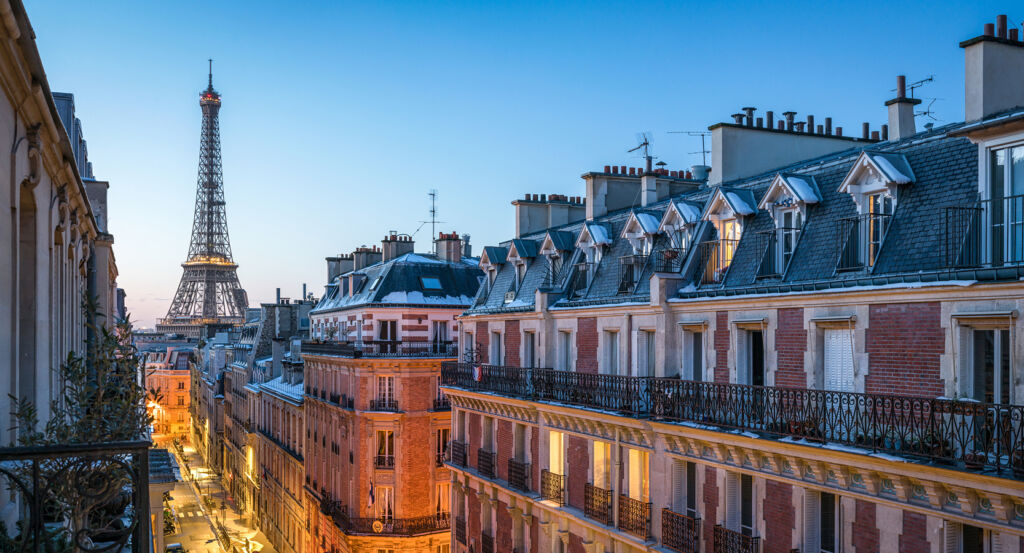
Set along Rue du Champ de Mars near Avenue Bosquet and just steps from Square Santiago du Chili, the hotel occupies a narrow Gros-Caillou parcel where the compact street grid between École Militaire and the Seine preserves the scale of an established residential quarter. The circa-1900 building rises directly from the street frontage beneath a pitched roof, with wrought-iron balconies and regularly spaced windows maintaining the vertical proportions of the surrounding blocks. A 2006 exterior intervention restored the street façade and introduced a projecting entrance canopy, refining the building's public face. Contemporary interiors combine patterned flooring, upholstered furniture, pale wall treatments and dark accents within the compact structure. The result is a hotel whose century-old building and long hospitality use preserve the small-scale architectural character of Gros-Caillou inside a district dominated at its edges by some of Paris's largest civic compositions.
What defines Hotel Relais Bosquet by Malone.
Hotel Relais Bosquet is best known for sustaining hotel use at 19 Rue du Champ de Mars across more than six decades before becoming part of the Malone Hotels collection. The address stands on a street opened by decree on February 13, 1852 between Rue Cler and Avenue de La Bourdonnais as the surrounding Gros-Caillou district underwent nineteenth-century urban consolidation. The building itself dates to 1900, placing its construction near the end of the transformation that replaced much of the area's earlier low-rise fabric with denser Parisian residential blocks. Hôtel Relais Bosquet had an established operating company at the address by January 1961, beginning the documented hospitality lineage associated with the property. That enterprise traded specifically as Hôtel Relais Bosquet and continued until a corporate restructuring in April 1997 closed the original company. Holding Bosquet had been created the previous year at the same address for hotel ownership and operation, carrying the property into another institutional phase. Exterior work in 2006 restored the street façade, followed by approval that December for a new canopy projecting above the ground-floor entrance. Malone Hotels later incorporated Relais Bosquet into the collection assembled after the group's creation in 2015. Yohann Benhamou developed Malone with Alain Benhamou as honorary president, building a portfolio concentrated in small Paris properties whose architectural rehabilitation became a defining element of the company's expansion. Relais Bosquet joined nearby Hotel de l'Empereur and 7 Eiffel Hotel within a particularly dense Malone presence in the 7th Arrondissement, connecting three independent addresses through shared ownership and management. The property links a circa-1900 Gros-Caillou building, a hotel operation documented from 1961 and a twenty-first-century Paris collection whose growth has centered on restoring compact urban hotels.
Yohann Benhamou built Malone Hotels around a strategy of acquiring existing buildings in established Paris districts and preserving their individual identities through renovation, giving Relais Bosquet a broader role within a collection created in 2015. Alain Benhamou's earlier business career preceded the family's move into hospitality, and the younger Benhamou combined studies at École Polytechnique and Columbia University with leadership of the new hotel group. Paris became the company's principal field of expansion as properties accumulated across the 5th, 6th, 7th and 15th Arrondissements. Relais Bosquet formed part of a western Left Bank cluster with 7 Eiffel Hotel, Hotel de l'Empereur and the later Almarine Eiffel Hotel & Spa, concentrating several Malone properties within the streets surrounding École Militaire. Hotel des Carmes entered the collection through a 2023 acquisition supported by Bpifrance, carrying the group into a historic Latin Quarter property associated with the postwar Caveau des Lorientais jazz club. Eastwest Hotel subsequently extended Malone beyond France through its first Geneva property, adding an international chapter to the Paris-based company. Rémy Baptiste assumed operational oversight of Relais Bosquet alongside Hôtel Edouard VI and Paris Art Hotel within Malone's management structure. The Rue du Champ de Mars property retained its established name through that expansion, preserving a character documented decades before the creation of its parent collection. Malone's development places Relais Bosquet inside a family-led hospitality network whose growth has joined long-established independent hotels through common management while retaining the individual names and architectural settings of the properties themselves.
How Hotel Relais Bosquet by Malone fits.
Hotel Relais Bosquet works as the neighborhood anchor for an outing connecting a neoclassical parish shaped by successive Paris architects, Louis XIV's extraordinary three-dimensional archive of fortified France and the national memorial institution devoted to the Free French and Resistance.
Begin at Église Saint-Pierre-du-Gros-Caillou, whose origins reach the expanding seventeenth-century settlement that required a new parish presence beyond Saint-Sulpice. A first stone was laid in 1733, and Jean-François Chalgrin later worked on a replacement before the unfinished structure disappeared during the Revolution. Étienne-Hippolyte Godde designed the neoclassical church constructed between 1823 and 1825, giving the district a restrained Doric landmark. Jean-Sylvain Bailly, Paris's first mayor during the Revolution, lies beneath its pavement. Victor Baltard designed confessionals in 1854, and Paul Vimond and Claude Petit added the Chapel of the Virgin in 1971, extending the building's architectural authorship across 150 years. Continue to Musée des Plans-Reliefs, descended from the collection created for Louis XIV in 1668 as Louvois and Vauban used three-dimensional models to examine fortifications across the kingdom. Models of Ath and Lille belonged to the earliest commissions, and a standardized scale of 1:600 subsequently allowed engineers to represent fortresses, cities and surrounding terrain with extraordinary precision. Louis XIV transferred the collection to the Louvre in 1700 before it moved into the Invalides attic in 1777. Public access began in 1799, and the collection survived Prussian seizures in 1815 before production ended in 1870. The museum created in 1943 preserves this exceptional archive of military engineering and historical urban form. Conclude at Musée de l'Ordre de la Libération, devoted to the order Charles de Gaulle founded in November 1940 to distinguish exceptional contributions to the liberation of France. De Gaulle transferred the institution to Hôtel des Invalides in 1967, and its museum opened there in 1970. Personal objects donated by Companions of the Liberation and their families built a collection structured around Free France, the internal Resistance and deportation. A comprehensive reconstruction from 2012 transformed the museum before its reopening in 2015, with more than 2,000 pieces distributed across 1,200 square meters. Six women belong among the 1,038 individual Companions whose lives form the human record behind the national order. The progression moves from the parish architecture of Gros-Caillou through royal military models that converted territory into three-dimensional strategic knowledge and culminates in a national institution preserving the individual lives behind France's wartime liberation.
Where your story begins.
Foresyte Travel reveals places that feel extraordinary long before you arrive.
Enjoy editorial crafted for luxury travelers.
Foresyte may earn a commission when you book.














































































































