
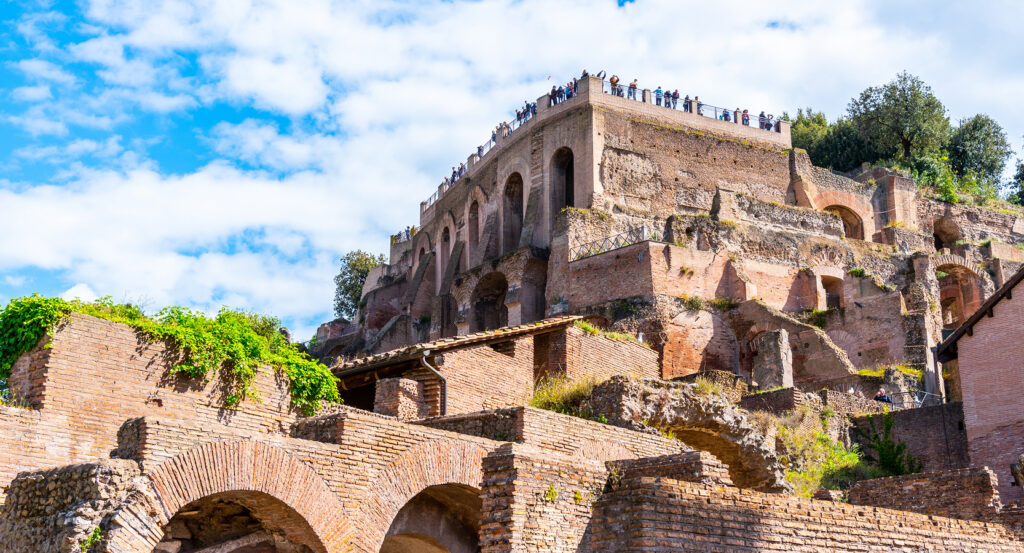
Why you should experience House of Livia on Palatine Hill in Rome, Italy.
Tucked quietly on Palatine Hill beside her husband's residence, House of Livia reveals a softer Rome, among privacy, intellect, and feminine poise hidden within the empire's beating heart.
Step inside and you feel the temperature shift: the hum of the city falls away, replaced by a serenity that feels deliberate, curated. Livia, Rome's first empress, lived not amid ostentation but harmony. The rooms are smaller, more intimate than the Domus Flavia's or the sprawling halls of Augustus, yet their refinement is startling. Frescoes still bloom across the walls, vines twisting upward, fruit heavy on the branch, birds poised mid-flight, so vivid they seem to breathe. This house was her realm, a retreat where she could move unseen, shaping influence in silence. Here, power was expressed through stillness, through art that spoke in whispers. House of Livia endures as one of Rome's purest lessons: that grace, when held with conviction, is the rarest form of strength.
What you should know about House of Livia on Palatine Hill.
What most travelers overlook is that this home became the blueprint for imperial elegance, centuries before the concept of a “palace” even existed.
Its frescoes, among the best-preserved in all of Rome, marked a turning point in domestic art, illusionistic landscapes that dissolved walls, opening rooms to imagined gardens beyond. This wasn't decoration; it was philosophy. Livia's home celebrated otium, the Roman ideal of cultivated leisure, where beauty was both escape and intellect. Archaeologists discovered advanced heating systems and a layout that channeled natural light precisely through the day, proof of how science and serenity intertwined. Every detail carried purpose: the symbols of fertility and prosperity spoke to her role as the mother of empire, while the restrained luxury reflected Augustus' vision of moral virtue. Standing within those painted chambers, you realize Livia's genius was subtle but seismic, she transformed domesticity into legacy, redefining what influence looked like from within the home's quiet corridors.
How to fold House of Livia on Palatine Hill into your trip.
To fold House of Livia into your exploration of the Palatine, move through it as you would through a piece of music, slowly, reverently, attuned to its rhythm.
Enter from the Farnese Gardens in the morning when the light is soft enough to kiss the frescoes. Allow your eyes to wander the painted leaves until illusion becomes belief; the walls melt, and you find yourself inside Livia's imagined paradise. From there, step toward the neighboring House of Augustus to sense the discussion between their spaces, his stately restraint beside her lyrical calm. Continue your walk along the Palatine paths, pausing at the overlooks where Rome unfolds below, and you'll see how her influence radiated far beyond these walls. End your visit at the small museum nearby, where fragments of fresco and sculpture whisper her story in fragments of pigment and stone. As you leave, you'll carry something rare, the impression that power once had a pulse, soft as breath, painted in color rather than carved in marble
Where your story begins.
Foresyte Travel reveals places that feel extraordinary long before you arrive.
Experience premium editorial crafted for luxury travelers.




















































































































