Why Palatine Hill matters.
Palatine Hill is an ancient archaeological park where Palatine's imperial origins, republican memory, dynastic power, and the birth of Rome unfold across the hill traditionally revered as the city's oldest inhabited ground.
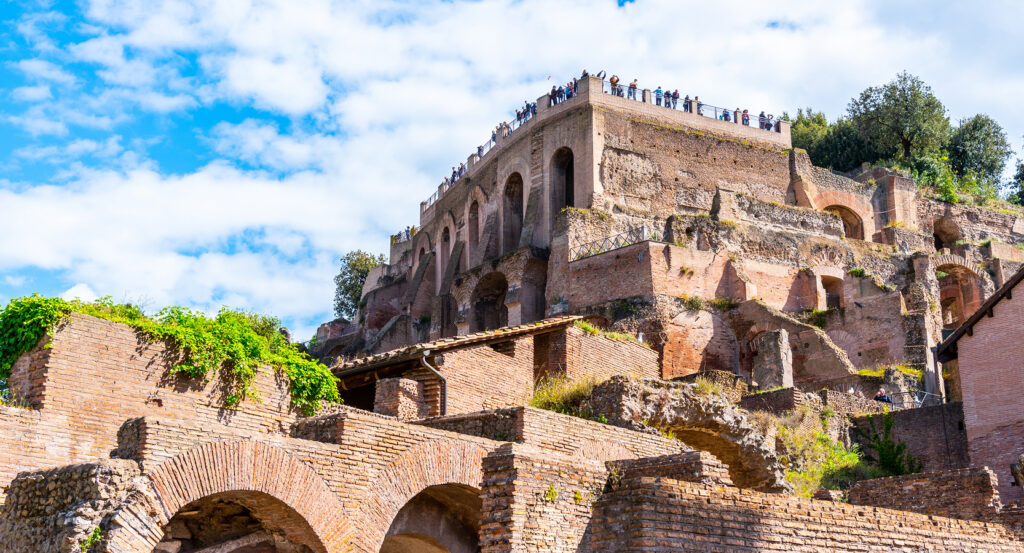
Set along Via di San Gregorio near Via dei Fori Imperiali and just steps from the Roman Forum, this sprawling hilltop carries visitors through imperial palaces, aristocratic residences, ceremonial courtyards, sunken gardens, sacred sanctuaries, panoramic terraces, and layers of archaeology spanning more than a thousand years of Roman civilization. Every pathway reveals the gradual transformation of a prestigious residential hill into the political and ceremonial heart of the Roman Empire as emperors continually expanded their residences above the Forum below. Sweeping views across the Colosseum, Circus Maximus, and Rome's historic center reinforce the hill's enduring role as the place where myth, archaeology, and imperial authority became inseparable. The experience is defined by dynastic ambition, archaeological discovery, and the foundations of one of history's greatest civilizations.
What defines Palatine Hill.
Palatine Hill is best known as the renowned birthplace of Rome where, according to Roman tradition, Romulus founded the city on April 21, 753 BC after the she-wolf Lupa nurtured him and his twin brother Remus nearby, while archaeological excavations have uncovered Iron Age hut foundations dating to the eighth century BC that closely correspond with the period assigned by ancient writers to Rome's earliest settlement. By the late Republican era the hill had become Rome's most prestigious residential district, attracting leading statesmen including Cicero, Crassus, and Mark Antony before Emperor Augustus established his permanent residence there after purchasing the House of Hortensius, transforming the Palatine into the political center of imperial Rome. Successive emperors including Tiberius, Caligula, Domitian, Septimius Severus, and Elagabalus expanded the complex into an interconnected series of palaces covering much of the hill through projects including the Domus Augustana, Domus Flavia, Domus Tiberiana, Stadium of Domitian, and the Septizodium, while the word “palace” derives from the Latin Palatium, permanently linking the hill's name with royal residences throughout much of the world. UNESCO later included the Palatine within the Historic Centre of Rome World Heritage Site in recognition of its central role in the development of Western civilization.
The archaeological landscape preserves nearly every phase of Rome's political evolution within a single hillside. Visitors encounter the House of Augustus with its surviving Second Style frescoes, the House of Livia, the Temple of Apollo Palatinus established by Augustus in 28 BC, expansive reception halls commissioned by Emperor Domitian under architect Rabirius, the sunken Farnese Gardens created during the sixteenth century by Cardinal Alessandro Farnese, and extensive excavation areas that continue revealing temples, residences, roads, and civic infrastructure beneath later construction. Together, these surviving remains trace more than thirteen centuries of continuous occupation, preserving the transition from Iron Age settlement to Republican aristocratic enclave, imperial capital, Renaissance garden, and one of the world's most significant archaeological sites.
How Palatine Hill fits.
Palatine Hill works as the centerpiece of an exploration through the birthplace of ancient Rome.
Begin at Roman Forum, where the civic, judicial, and political institutions of the Republic establish the historical context before ascending onto Palatine Hill to explore the residences of Rome's emperors. Continue to Arch of Constantine, whose triumphal reliefs and fourth-century history provide a natural transition between imperial Rome and the neighboring amphitheater. Conclude at Colosseum, where the engineering, performance, and political ambitions of the empire provide a fitting finale to a journey through the civilization that reshaped the ancient Mediterranean. The progression moves naturally from republican government to imperial authority before concluding with Rome's greatest arena, revealing why Palatine Hill remains indispensable to understanding the city's origins and evolution.
Where your story begins.
Foresyte Travel reveals places that feel extraordinary long before you arrive.
Enjoy editorial crafted for luxury travelers.
Foresyte may earn a commission when you book.