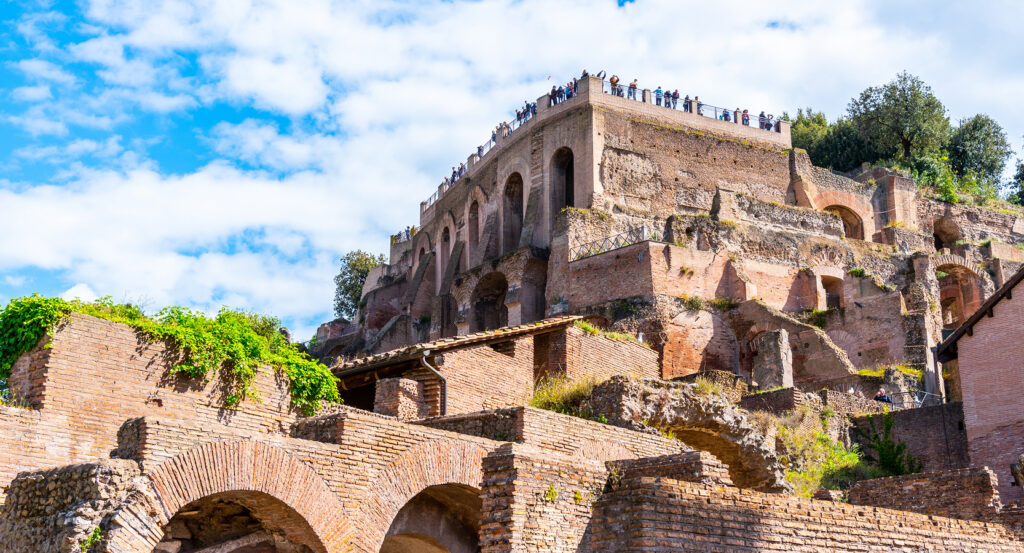
Why House of Augustus matters.
Perched atop Rome's Palatine Hill, House of Augustus whispers of intimacy amid empire, a private world carved into the heart of power.
Step beyond the grandeur of Roman Forum below and the scale of Colosseum nearby, and you'll find a space that redefines what it meant to rule Rome. Here, Augustus lived not in marble excess but in quiet refinement, a sanctuary of frescoes, symmetry, and sunlight filtered through courtyards. The walls still pulse with pigment, their mythological scenes painted in ochres and crimsons that defy the centuries. Unlike the expansive relics of later emperors, this house seduces through restraint, its elegance rooted in balance. You can almost picture Augustus pacing the mosaic floors, confiding in Livia, shaping decrees that would outlast dynasties. The air carries a softness here, the hush of a man who built an empire by mastering not only armies, but perception.
What defines House of Augustus.
Few realize how dramatic House of Augustus truly was, both architecturally and symbolically.
Long before imperial palaces sprawled across the Palatine, Augustus transformed an unassuming residence into a living manifesto. Its layout embodied his political genius: modest in form, yet rich in allegory. Every fresco and frieze was a coded message, Apollo's lyre for divine harmony, laurel motifs for triumph tempered by virtue. Even the orientation of the rooms mirrored celestial order, aligning the emperor's household with the rhythm of the gods. Beneath its polished restraint lay a revolution in self-presentation: Augustus wasn't just emperor, he was mythmaker, scripting humility into power. The house became a mirror of his persona, serene, moral, immortal in suggestion, a visual sermon to the Roman people that empire could be elegant, not ostentatious.
How House of Augustus fits.
The most evocative way to fold House of Augustus into your Roman itinerary is to experience it as the soul of the Palatine.
Begin your ascent early from the Arch of Titus, when the crowds have not yet crested the hill. Move slowly, the path itself winds through imperial ambition, from the House of Livia to the Flavian Palace. Save House of Augustus for the center of your walk, when the city hum has faded and you can hear the cicadas echo against the tufa walls. Let your guide or audio tour fade out, and take in the frescoes by natural light; their brilliance sharpens as the sun shifts, every hour repainting the myth anew. Afterward, continue toward the House of Livia for contrast, then descend the hill through the Farnese Gardens, where the basilica domes below shimmer like reflections of his legacy. Stop at the overlook facing the Forum, from here, you see exactly what Augustus saw each morning: a city that bowed to order, beauty, and vision.
Where your story begins.
Foresyte Travel reveals places that feel extraordinary long before you arrive.
Enjoy editorial crafted for luxury travelers.
Foresyte may earn a commission when you book.